Wednesday, August 24, 2022

First Comics: The Brave & The Bold #67

Batman entered my life on May 21st 1966, when the TV show debuted on Southern TV in the UK, four months after it had premiered in the US. But it was four months later that I acquired my first American  comic featuring Batman - Brave & Bold #67, the first ever team-up of Batman and Flash. 

© DC. 
My memory is a little hazy, but I believe I was given it to occupy myself while my Mum had her hair permed at the Co-Op ladies hairdressers which used to occupy the upstairs floors of what is now The Slug and Lettuce in Palmerston Rd, Southsea (and incidentally where I also acquired The Green Hornet #1 and an Alan Class comic probably Creepy Worlds).

Looking at my Thorp & Porter calculator, I reckon the book appeared on UK newsagent spinner racks at the end of October 1966. By this time I had been fully exposed to the TV series, had acquired the Cherilea play figures, the 4-Square Batman paperback, a toy Batplane fired by catapult, and had been bought my first pack of Batman cards.

© DC. Brave & Bold #67 - splash page.

Brave & Bold #67 - “The Death of The Flash” - was written by Bob Haney, with artwork by Carmine Infantino , inked by the prolific Charles Paris. Carmine Infantino had been a frequent artist on B&B since issue #45 , illustrating Strange Sports Stories, but this was the first time he’d drawn Batman in the pages of this particular book, now that B&B had been re-invented as a superhero team-up comic. Infantino was the natural - perhaps only - choice,  as he was strongly identified as the main Flash Artist and had been drawing Batman in the pages of Detective Comics since the advent of the New Look in 1964.

Re-reading the comic today, I am reminded that my first impression of the comic was formed by the splash page of Batman facing the reader and holding a dead Flash in his arms. I found this idea both shocking and confusing ; shocking because I don’t believe I had encountered death in comic book pages before, and confusing because I had not considered that other superheroes inhabited Batman’s universe. Who was this Flash?

Writer Bob Haney was acquiring a reputation as a writer of Batman stories which sat outside of canon, but were wildly entertaining. This story is full-on 'Haneyverse'. 

The story involves a crime club which has developed “speed sneakers” using radiation, so that its members can steal valuables and out-run the police. In parallel, the Flash finds his super-speed is gradually killing him. 

I won’t spoil the story (you must read it), but highlights include:

- Batman is a total klutz. Batman crashes first the Batmobile by driving down an alley too narrow to pass, and subsequently crashes the Whirly Bat into the corner of a building! (the Whirly-Bat was a staple in Batman's arsenal before the New Look, no engine - it appeared to be just a wooden chair with a helicopter rotor)

© DC. Batman crashes the Batmobile

© DC. Watch out for that building, Batman!

- Batman demonstrates convenient kit such as a jet pack revealed to be carried under his cape, as well as a segment of his utility belt that squirts enough black oil to cover the floor of an entire room.

© DC. Batman deploys the Jet-Pack

© DC. Enough oil in the Utility Belt to float a tanker.

The dialogue and panel captions are certainly tongue in cheek. I can’t quite make up my mind if Bob Haney’s “hip” commentary is trying to be authentic to appeal to teenagers, or is intended as a send-up. There are some great one-liners that now make me laugh out loud ; Batman calling Flash “FLASHER” ; the dialogue by the villain referring to their “Male Midget Member”.

© DC. Why is Batman calling Flash "Flasher" ?

© DC. Male Midget Member ?

And finally after many chases and some clever detection, Batman finally tracks down the villains’ lair which has a huge sign “Accelerated Gentleman’s Club” on the outside. At age 7, I had no inkling of what a ‘Gentleman’s Club’ implied.

© DC. Secret HQ of the "Accelerated Gentleman's Club"
Perhaps Haney was trying to capture some of the zaniness of the TV show. Back in 1966, I thought this was a great comic. I still do. The artwork was top-notch Infantino, with sympathetic inks by Charles Paris. 

The ads in the comic opened up a whole new world for me. Free admission and rides at Palisades Amusement Park! (Did all US readers live in driving distance of New York?). Ads for G.I. Joe with kit we could only dream of in the UK. Plus everything in the comic was in colour!

This was not Carmine Infantino’s only issue of Brave & Bold. He subsequently drew B&B #72, which was a Spectre/Flash team up (well worth reading), but did not draw another B&B until 14 years later - issue #172, a Batman/Firestorm team up  (“Darkness and Dark Fire”), which hit the stands in December 1980. That story could have been drawn in the sixties, apart from some concessions to the length of the ears on Batman's cowl. Even the Batmobile looks 1960s.. Written by (Gerry Conway , inks by Steve Mitchell)

A year later Infantino drew B&B #183  (Batman and The Riddler) “The Death of Batman” - the title perhaps a callback to the “The Death of the Flash” title of #67. (The artwork still evoked the 1960s, but the inks by Mike De Carlo detracted from Infantino’s pencils).  

B&B #190  - was an Batman/Adam Strange team-up  “Who Killed Adam Strange?” (there seems to be a death theme here), written by Mike W Barr, inked by Sal Trapani.

Finally, Infantino wound up his B&B tenure with issue #194  -  fittingly a Batman/Flash team-up “Trade Heroes and Win” (Mike W Barr and Sal Trapani).

At age seven I was confused by the comic numbering of Batman, Detective and Brave & Bold, not really cottoning on to the fact that these were different titles, so it was not until I got serious about comics in 1971 that I started collecting B&B with a vengeance.

© DC. Justice League of America #91


One final comment: I believe that Brave & Bold #67 (apart from being the first Batman/Flash team up)  was the first time that the Flash was to be killed (or apparently killed) in a DC comic. If a concept is popular, it gets done over and over. The cover of Justice League of America #91 seems to be an homage to the B&B #67 splash page.

Monday, August 22, 2022

Searching for comics in Portsmouth, 1970s style : Part Three

 [ Continuing a multi-part blog documenting the Mad Comic Hunt of collecting American Comic books on Saturday afternoons in the early 1970s. You can read Part One here and Part Two here.  -- baggsey]

An essential accessory to our comic hunting around Portsmouth was the canvas haversack that Nigel and I wore to hold the comics we collected along the way. These haversacks were purchased from Ben Grubb's Army Surplus store in Commercial Road, and were intended for carrying heavy school text books around. But at weekends, they were used for a better purpose. I don't think we were at all worried that the rough canvas would damage the comics. 

© Alarmy Stock Photo. A typical comic-fans' haversack


© Map from Google. From Castle Road to Somertown

Those of you following this blog series will recall that the previous stop was just inside Kent Rd, Southsea. We now re-mount our bikes for a quick trip of 50 yards or so into Castle Road, where we find...

Stop #14: Wilson & Co., 81 Castle Road. Newsagents at the bottom of Castle Road.

© Google. Site of Wilson's, 81 Castle Road

This newsagents is now a barber shop, but interestingly still retains the facade of the original newsagents. No plastic neon signs. The comic rack used to hang on the left hand side of the entrance. SuperStuff co-editor Nigel Brown reminisces:

“This was where my father used to stop to get cigarettes, after picking me and my brother up from Sunday School, on the way to my grandmother’s for our regular Sunday lunch. I remember him lifting me up to browse the comic rack – out of a child’s reach (perhaps to discourage pilfering as the rack was in the shop’s doorway!. We were allowed one comic each. When we got bigger, he used to detach the whole stand from the wall and bring it down to our height. After I accumulated sixty comics or so, I’d give them to my grandfather to sell (for a penny?) from a cardboard box he put on his counter at the family’s Edinburgh Road tobacco/confectionery shop.

“I bought many DCs here, from about 1967 onwards: mostly the Superman titles, Adventure Comics featuring the Legion of Super-Heroes, and also Flash. I remember being creeped out by the cover of Flash # 186 in 1969… but I still bought it!

"Stan Lee might be a legend, but in my book Jim Shooter's not far behind... .. not only did Shooter write the first Superman comic I read (Superman # 190), but he was 14 years old at the time!!

“This Castle Road newsagents was a reliable source of DCs – and also later well-positioned on the walk home from school – and seemed to stock a good range. I particularly remember buying Kirby’s stunning New Gods # 5 there, in 1971, and flicking through it in wonder, out in the street.” – Nigel 

© DC Comics. Superman #190 - Nigel's first comic.

© DC. Flash #186 - a suitably creepy cover.


© DC. New Gods #5

“Wilson’s was a newsagent owned by Mrs King, part of a local chain she and her late husband owned. I had a Saturday job in the Summer of 1978 opening the shop in the morning and marking up the papers for delivery, before heading to the Marina Cafe on Southsea Seafront for my other holiday job. By that date, Wilson's were no longer selling American comics.” – Ian

Leaving Wilson's, we head north towards Elm Grove, turning right/east to "Stan's", a shop which as the years rolled towards the mid-1970s, became one of the first ports of call for new Marvels. 


Stop #15. S Stan, Newsagents, 76 Elm Grove, Southsea

Stan's was situated a couple of doors east of the Elm Grove/Grove Road North traffic lights. It was not a pre-possessing shop (well, which newsagents were?), but it was well placed as being almost adjacent to Knight & Lee's boys school-wear shop, which our mothers dragged us to for new bits of school uniform from time to time.

© Google. "The Package Free Larder" site of Stan's


“Stan’s was a newsagent that carried Marvels (one of the relatively few places), and was a frequent stop in the 1975-1976 period, although the shop had been open under that management since 1972.  I have no special memories of it, but looking back through my diary I know that I bought copies of Daredevil issues and Kirby’s return to Captain America there in early 1976” - Ian


© Marvel. Captain America in Kirby's 1976 run

From Stan's, we now head north towards Somerstown, an area of Portsmouth with an identity of its own. (That's code for it being a part of Portsmouth where you cycled warily, lest some of the local youths took a dislike to you.) Importantly for us, Somerstown featured both a good newsagents that stocked comics on a spinner rack inside the door.


Stop #16. A.G. Taylor and Son, Somers Road.

© Unknown. A G Taylor's in 1971.

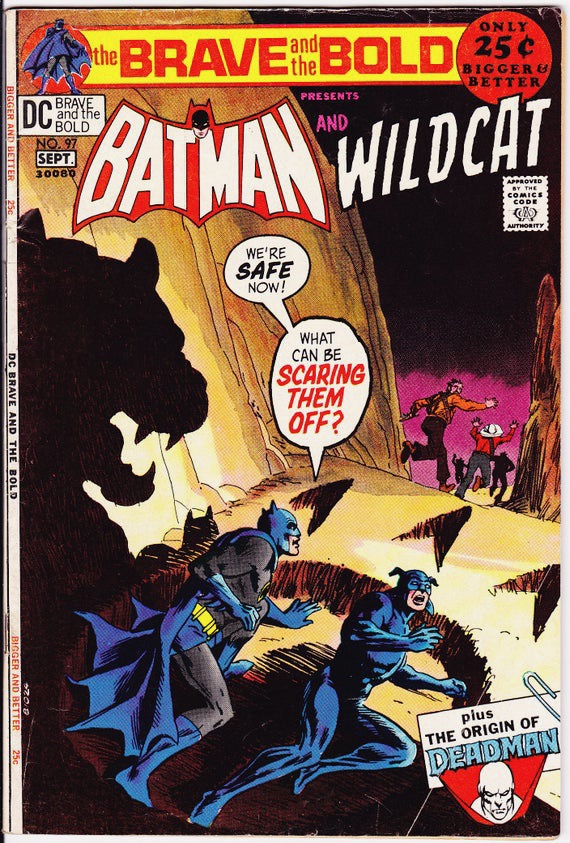
“There was a small newsagents in Somers Road, a DC shop. It had the spinner rack just inside the window. I remember getting Brave & Bold #97 there - the Wildcat team-up issue with a great Nick Cardy cover. I particularly remember that I picked up this issue having already read B&B #98 (The Phantom Stranger team-up) and #99 (The Flash team-up). This comic cemented my intention to collect Brave & Bold henceforth. I also remember that this shop was a good source of House of Mystery issues.The shop may have also featured a small Post Office Counter, but my memory is hazy on that score.” – Ian

© DC comics. Art by Nick Cardy


Re-reading the comic today, it is a great Bob Haney tale that takes Bruce Wayne (and Batman) to South America. Although Bob Brown did the pencils, the inks are unmistakably Cardy's. His art style so dominates  Bob Brown's pencils that some panels look like Cardy drew the whole thing. The panel of Batman's face below is prime Cardy.


There was to be one more stop in Somerstown before we headed towards the Dockyard.

Stop #17. Unknown newsagents in St Paul's Road area

The vagaries of urban redevelopment in Portsmouth have in many places completely razed row upon row of houses, and re-aligned roads, and built new blocks of flats. My pal Geoff Cousins and myself both remember a convenience store somewhere in the vicinity of St Paul's Road that we'd visit around 1974 on the bike ride, but a recent drive slowly cruising around the area yielded no evidence of the place. Perhaps some spark of memory will re-surface, but for now, we'll leave the area of Somerstown and head towards the Dockyard....in the next installment.

Tuesday, August 9, 2022

How Alfred Hitchcock brought Avengers Endgame to the movies in 1971

Fifty-One years ago this week my comic collecting began in earnest, when I bought Batman Giant #233 from Gardeners Newsagents in Albert Road, Southsea. 

That same week Albert Hitchcock was filming a key scene of his film “Frenzy” near Covent Garden in London. I watched the film for the first time this afternoon, and the extensive location shooting of the Thames and the area in and around Covent Garden provide a captivating window into the past - a kind of disturbing “Look At Life” travelogue with a serial killer and an innocently accused man as an added bonus.

The eagle-eyed amongst those of you who are familiar with the film may have noticed the scene at 14m 57s, where our anti-hero, played by Jon Finch, enters an alley on Charing Cross Road, walking past a news stand.


© Universal Studios. "Frenzy" 1971.

Visible to the naked eye we can see Harvey Comics, Alan Class reprints, Time magazine, Private Eye, Punch, and a wide variety of other British magazines of the day. Talk about a camera into the past! 


Unlike more recently filmed period pieces which feature comics of the era (eg Catch Me If You Can), Frenzy displays actual magazines on sale at the time of filming.


The Time magazine on display is of the week of Aug 9th 1971, while the Punch is for the week of 4th- 10th Aug 1971, so we have a pretty accurate pinpoint on when this scene was filmed.


The three Harvey comics on display are:

  • Richie Rich - #108 - Harvey - Aug 1971 - on sale in US May 15 1971
  • Wendy - The Good Little Witch - #68  (Aug) - on sale in US May 15 1971
  • Spooky #125 (Aug) - on sale in US May 15 1971

© Harvey Comics 1971

I was never a Harvey comic collector - in fact have no firm recollection of having seen them on the T&P spinner racks in Southsea, but here they are for all to see. And the dating of the filming giving some confirmation that Harvey, like DC and Marvel, were subject to a 3-month delay between US street-date and appearing on UK stands.


Of more interest to readers of this blog are the two Alan Class reprint comics:

  • Creepy Worlds #123  “The Final Battle” - 5p issue - reprinting The Avengers (Marvel, 1963 series) #71 (December 1969)
  • Uncanny Tales #80    -  a 1/- and 5p dual-priced issue - pre- and post-decimalisation - featuring bland Science Fiction reprints from Forbidden Worlds (American Comics Group, 1951 series) #76 (March 1959)

© Marvel and Alan Class. Avengers Endgame.

"The Final Battle" story (actually titled 'Endgame') was to be reprinted a number of times, first by Alan Class, and then in the Oct 1975 UK Avengers Weekly #109, before next appearing in the US Marvel Super Action #32 (1981). It was then reprinted in the US a further 11 times, the most recent being the 2019 True Believers reprint timed to coincide with the release of the Marvel mega-movie "Avengers Endgame", which was based on the comic.


© American Comics Group and Alan Class.


The Uncanny Tales story can make no claim for enduring in posterity, although it is graced by Al Williamson pencils. That said, Alan Class had had great success with reprinting this comic, having previously reprinted sections of it variously in Uncanny Tales #19, Forbidden Worlds #7, Astounding Stories #16 and #75, and would go on to reprint sections in Creepy Worlds #69 and #132 over the following two years! With its dual shilling/pence pricing, this particular issue may have been hanging around the newspaper rack for 6 months or more, since decimalization in February 1971.


I think that's about all I can discern from the books on display. Interesting to think that Alfred Hitchcock was the first director to bring Avengers Endgame to the big screen!


Alfred Hitchcock went to garner late career acclaim for the film, and I went on to a family holiday in Devon later that month.

Sunday, July 31, 2022

David Niven - Actor, Raconteur, step-son of Southsea, and Comic-Book star

[Ed note: Well, just got under the wire with at least one article for the month of July. Apologies for the delay - life and Mini Cooper rallies got in the way. - Baggsey]

As long-time readers of this blog will know, Portsmouth and Southsea has sent forth many illustrious celebrities who subsequently made their mark not only in popular culture, but also in the world of comics. In these pages, we’ve taken a look at Arnold Schwarzenegger, Arthur Conan Doyle. H. G. Wells, and others. This week we take a look at one of the world's most beloved actors, the late David Niven’s involvement with Portsmouth, and his subsequent impact on comics.

© Dell, Marvel and DC. The many comic-book appearances of David Niven


In his 1971 autobiography The Moon's A Balloon,  Niven talks about attending school in Southsea. It was, apparently, a school for naughty boys and located somewhere in or near Kent Road. He was sent there as a punishment, having been expelled from his previous public school.


He does not mention the exact year, but it was probably around 1922, when he was twelve years old. Being taken by car from Portsmouth and Southsea station, he recalled: ‘I can always remember Southsea Common: flat, greasy, wet and windswept with a dejected flock of dirty sheep morosely munching its balding surface.’


‘ The car stopped at a dreary house in a shoddy row. The "school" for "difficult" boys was run by a Commander Bollard. ‘


Niven appears to have spent only three or four weeks there before being shipped off to a ‘crammer’ to get him sufficiently capable of passing an entrance exam to a more reputable institution, but the experience left its mark.


Reading his very entertaining biography, Niven obviously employed a measure of artistic license in his descriptions. However, there must be some truth in the story, and it is likely that Niven was talking about Annesley House, a maritime training school in Queen’s Crescent, just off Kent Road. 


The intersection of Kent Road, Castle Road and Southsea Common may very well turn out to be the nexus of popular comics culture, with Niven being schooled within minutes of both the birthplace of Peter Sellers (who went on to portray Fu Manchu ), and the second-hand comic shop where Nigel Brown and I had our own “Edgar Church Collection” comic-buying experience in 1971, as documented here.


David Niven went on to have a glittering film career in Hollywood, and his likeness has graced comics from the late 1950s to the current decade, first in adaptations of his films, and later as the template for both a well-known villain and hero. Whether Niven ever gave permission for the use of his likeness, or was even aware of his involvement in comics, we shall never know.


#1 Around the World in Eighty Days - Dell - 1956


The earliest appearance of Niven’s likeness (that I could find) in comics was in the Dell comic adaptation of the film Around the World in Eighty Days - directed by Michael Anderson in 1956.


© Dell. Four Color Movie Classic Comic (No. 784) – December 18, 1956


Dell decided to adapt the film of the Jules Verne story "Around the World in 80 Days" in its Dell Four Color Movie Classic Comic (No. 784) – published December 18th, 1956. The story was adapted by Gaylord Du (Space Family Robinson) Bois with art by Mike (Justice League of America, Man from U.N.C.L.E.) Sekowsky & Mike (G-8 and his Battle Aces) Peppe. 


The likeness of David Niven as Phileas Fogg is well rendered by Sekowsky, although a comparison of the opening scene in the comic and the same scene in the film makes it quite clear that Sekowsky had either not seen a cut of the movie, or was drawing it from memory.


© Dell. Opening scene drawn by Mike Sekowsky

© MGM. Phileas Fogg at the Reform Club.


#2 David Niven as villain Sinestro - Green Lantern #7-#9 - 1961 


It has become commonly accepted in the comics community that the likeness of the Green Lantern villain Sinestro, as drawn by Gil Kane, was based on David Niven. However, despite many searches, I cannot find any source interview with Gil Kane that asserts this as fact.  


© DC. Green Lantern #8. Art by Gil Kane.

Sinestro was created in 1961 by John Broome and Gil Kane as an adversary for Hal Jordan. Sinestro first appeared in Green Lantern #7 in a story written by John Broome, and pencilled by Gil Kane and inked by Joe Giella. 


Gil Kane despised Joe Giella’s inking, as he stated in an interview in Alter Ego #149, reprinted from Fantasy Advertiser #100 (1988): "Unfortunately I also had Joe Giella for years. I thought that Giella was, generally speaking, a nice guy – but he was probably the most inept single inker that ever worked professionally in comics."


The earliest mention of the Niven/Sinestro connection I have found is in a Wizard article by Jeremy Brown posted on June 2007 - seven years after Kane's passing - where Brown notes that artist Gil Kane reported noted that Sinestro's appearance was based upon British actor David Niven, but quotes no source.


According to an interview with actor Mark Strong on April 10, 2010, the relationship between Sinestro and Jordan is based in part on the actors who inspired their creation.

“That widow’s peak and thin mustache was for some reason originally based on David Niven, and Hal Jordan was based on Errol Flynn,” said Strong. “In the ‘30s and ‘40s, they shared an apartment together in Hollywood when they were making movies and they were great friends. Obviously at the time, whoever was doing the original comics must have looked at them as guys doing very well in the film industry, and based those characters on them. So I would like to do justice to the Sinestro that was conceived for the comic books.”


Personally, I feel that any claim for a deliberate likeness between Sinestro and David Niven is pretty tenuous, unless any reader can put me right on this matter? Gil Kane confirmed that he based Morbius on Jack Palance in a 1999 interview, so anything is possible.


#3 Niven in '55 Days at Peking' - 1963 - Dell - film adaptation


© Gold Key

© Gold Key. Artwork by Mike Sekowsky


The comic is an adaptation of the film 55 Days at Peking, which tells the story of a siege during the Chinese Boxer Rebellion of 1899-1901. As detailed in the blogintomystery website, the comic does a pretty good job following the film's narrative. The panel above shows Charlton Heston’s and Niven’s characters (an American Marine officer and the British ambassador, respectively) trying to reason with the Dowager Empress Tzu-Hsi and her corrupt minion. The artwork, as in 80 Days Around The World, is by Mike Sekowsky. 


Mike Sekowsky’s likeness of David Niven is less accurate than his Phileas Fogg rendition of 7 years earlier, and Charlton Heston’s likeness is very vague indeed.


#4 Percy 'Pinky' Pinkerton - July 1964 - Marvel - Sgt Fury & His Howling Commandos


Niven's next appearance was as Percy 'Pinky' Pinkerton in the July 1964 issue of Sgt Fury & His Howling Commandos, playing an effete British Officer replacing the Juniper character in issue #8, "The Death Ray of Doctor Zemo". Niven can be seen on the cover in the lower right-hand corner.


© Marvel 1964

Artist Dick Ayers said in a subsequent interview that Stan Lee had told him to base the likeness on Niven, which bears some similarities to Niven's performance in The Guns of Navarone.


© Marvel. Sgt Fury July 1964. Percy Pinkerton's introduction

Pinkerton is introduced as a mistakenly effete individual, who quickly proves himself to be made of tougher stuff. Pinkerton has continued to be an ongoing member of the Commandos in comics, as well as being portrayed by actor Richard Short in episode 5 of the first TV season of Agent Carter. 


#5 Sarsfield - 1976 - Marvel - Master of Kung Fu


Niven's next appearance was twelve years later as MI6 communications officer Ward Sarsfield in Master of Kung Fu 1976, #47 “Phantom Sand” , from the Creative Team of Doug Moench & Paul Gulacy. The character Sarsfield is named after the real name of Sax Rohmer (creator of Fu Manchu).


Sarfield made six appearances in Master of Kung Fu, the last being in the June 1979 issue #77.


Gulacy admitted in a 1999 interview that he often used celebrities' likenesses for characters for fun, agreeing the deliberate likeness to Niven.

#6 Niven as Alfred Pennyworth - Batman's Grave #1  - 2019


Niven's most recent, and most iconic, comic's performance has been as Alfred Pennyworth in The Batman's Grave, a 2019 limited series from Warren Ellis and artist Bryan Hitch.

© DC Comics.

Of all the likenesses of Niven over the years, this is the most lifelike. 

Bryan Hitch told Den of Geek “I have been tempted to redraw Alfred’s face a bit but only because it’s come out more David Niven-y that I’d planned on. I’ve found actually that, as far as expressions go, less is always more. Over dramatize and you lose the emotion so, given the dialogue I get, I try to do as little as possible with the faces and hint at emotion and expression."

Perhaps Niven's appearance as Alfred will be his swansong in comic books. It amazes me that it has been sixty-six years since he first appeared in the pages of a comic book. There may be other appearances that I have missed ; if you're aware of any others, please let me know.

Tuesday, June 28, 2022

Favourite Comics - Irv Novick in Detective Comics #414


© DC Comics. Detective #414. Cover by Neal Adams and Dick Giordano

Of the three artists who defined the look of Batman in the 1970s - Neal Adams, Jim Aparo and Irv Novick, it is Irving H Novick who gets the least attention from fans. And yet he drew 107 Batman stories across the pages of Batman and Detective Comics during that period - far more than Neal Adams, and a production rate on a par with Jim Aparo.


Irv Novick was the artist at the helm as The Bronze Age for Batman started on 6th June 1968, with the publication of Batman #204 ("Operation Blindfold"), starting a fruitful partnership with Frank Robbins over the next two years. 


© Batman #204. The start of The Bronze Age for Batman

Robbins brought a crime caper story sense that he had honed on Johnny Hazard for two decades, but although Novick's artwork layout and perspectives were very innovative, the renditions of Batman were uninspired and relied too much on the more recent Silver Age depictions of Batman extant since the “New Look” premiered in 1964. 


©DC. Batman #204 "Silver Age style"

Over the following months Novick continued in this style, inked by Joe Giella through to issue Batman #214, but with #215 the style changed radically, with Dick Giordano now inking. Batman was no longer drawn in a cartoony fashion. 


© DC. A Panel from Batman #216 showing the transitional style

Batman issue #217 cemented the new image of Batman as a loner, with Novick upping his game considerably to draw the pivotal “One Bullet Too Many” story which took Batman out of the Batcave, and Robin went off to college. 


No doubt the change in illustration was driven by reader reaction to the Neal Adams version of the Batman present in Brave & Bold, but also I suspect that Novick was also smarting from having his cover to Batman #210 ("The Case of the Purr-Loined Pearl") redrawn by Neal Adams at short notice.


© DC. Irv Novick's original cover for Batman #210


© DC. Neal Adams' final cover for Batman #210


For my money, Novick’s best renditions of Batman were in Detective Comics #414, a story inspired by the movie Key Largo, again ably assisted by Dick Giordano on inks. The line work is the finest I ever saw on his work; the splash page showing Batman in the rafters is worthy of Adams, and the renditions of Batman in action are exciting and full of energy.


©DC. Detective #414 foreward page. Fine art work.


© DC. Detective #414 splash page. Batman in the rafters.


The story - written by Denny O’Neil - gives time over for quieter moments of discussion between the characters, and Novick brings his “A” game in those moments as well, with a touch of Adams pastiche particularly in this image of "Loosy".


© DC. A reflective moment from Detective #414

Unlike Adams and Aparo, Novick rarely (if ever?) inked his own pencils, and without doubt his work when inked by Dick Giordano shone at its brightest. Other subsequent inkers like Frank McLaughlin demonstrated that Novick's style dominated and was not unduly influenced by different inkers, but that said, Giordano was without a doubt brought out the best in Novick's pencils.