Showing posts with label Southsea. Show all posts

Monday, May 18, 2026

Comics placement in Movies: The Wrong Arm of the Law

[Republishing post from 2022.

Of all the posts of this blog, this received not a single comment back in 2022. C'mon chaps.....]

Spent part of this Saturday afternoon re-watching the 1963 British comedy The Wrong Arm of The Law. I’m sure many of our UK readers recall seeing this film many times on Christmas afternoons in the early 1970s, when I used to avidly watch any British comedy film of the late-1950s and early 1960s.

© Studio Canal. The Wrong Arm of the Law 1963

The film The Wrong Arm of the Law was one of the last films that Southsea-native Peter Sellers made in England before decamping to Hollywood, paired with Lionel Jeffries (incidentally Jeffries' brother owned a TV aerial and electronics shop in Southsea) for comic support.

Studio Canal have remastered this black & white film for blu-ray and the image really sparkles. Peter Sellers and Lionel Jeffries are on top form, and the extensive London suburb location work of various High Streets has real nostalgia value for a time of long gone streets and cars.

The film remains most famous for the high-speed car chase around Uxbridge Moor in a classic Aston Martin DB4, but this time around my eye was caught by comic books on display. 

There is a scene half-way through the film when police officers are idling the time in a control room on "No Crime" night, when the gangs of London have agreed a truce. To pass the time, they are all reading different magazines.

Take a look at this shot; what do you see? Look closely.

© Studio Canal. The Wrong Arm of the Law

Dominating the foreground is the Dell Comic Car 54 Where Are You?, issue #3, cover dated October 1962, published in the US June 14th 1962. The earliest this comic would have been on sale in the UK was at the very end of September 1962.

© Dell . Car 54, Where Are You? #3

© Dell. Car 54, Where Are You? #3 - Interior Art

Car 54, Where Are You? had aired on NBC on TV in the States from September 1961 to April 1963, but it was not until April 9th 1964 that ITV premiered the show in the UK, with the final UK transmission on 29th September 1966. The strong placement of the comic on screen would only have had relevance for US cinema-goers at the time of the films release in 1963.

The eagle-eyed among you will have spotted the 'Superman' logo on the magazine that the young lad is reading in the background. It is an unusual styling of the logo. After a bit of digging, I've concluded that the comic in question is an issue of UK comic weekly Buster, folded around to show the Superman masthead from an interior page.

According to George Shiers' "Whacky Comics" blog, Superman US newspaper strips were repurposed  in the UK in 1959 for the pages of Radio Fun, continuing right up until the title merged with Buster in 1961, at which point it continued in Buster for a further year. The panel below (credit the Whacky Comics blog) is a sample of a Superman page within Buster.

© Fleetway Comics. Scan credit to George Shiers

So we can conclude that the Buster comic (published prior to the end of 1962) and Car 54 #3 (in UK end Sept 1962) were reasonably contemporaneous, but there is a timing mystery concerning the headline of a newspaper seen on screen a few seconds later. (See below).

© Studio Canal. Headline "Ron Flowers Collapses".

The newspaper headline "Ron Flowers Collapses" refers to Wolves football (soccer) player, wing half Ron Flowers, who collapsed from 'flu during the England national team practice on 12th April 1962. It is interesting that a newspaper at least six months old was used in the filming.

I am coming to the conclusion that the scene with Car 54 and Superman were cut in at a later date for the US release of the film, and that UK Studio Canal have restored the film from a US print.

There is one final shot of an unknown comic page in this scene. I have rotated the image should any of you wish to peruse your Buster collections to identify the exact page.

© Mystery page - presumably from Buster in 1962.

Monday, August 22, 2022

Searching for comics in Portsmouth, 1970s style : Part Three

 [ Continuing a multi-part blog documenting the Mad Comic Hunt of collecting American Comic books on Saturday afternoons in the early 1970s. You can read Part One here and Part Two here.  -- baggsey]

An essential accessory to our comic hunting around Portsmouth was the canvas haversack that Nigel and I wore to hold the comics we collected along the way. These haversacks were purchased from Ben Grubb's Army Surplus store in Commercial Road, and were intended for carrying heavy school text books around. But at weekends, they were used for a better purpose. I don't think we were at all worried that the rough canvas would damage the comics. 

© Alarmy Stock Photo. A typical comic-fans' haversack


© Map from Google. From Castle Road to Somertown

Those of you following this blog series will recall that the previous stop was just inside Kent Rd, Southsea. We now re-mount our bikes for a quick trip of 50 yards or so into Castle Road, where we find...

Stop #14: Wilson & Co., 81 Castle Road. Newsagents at the bottom of Castle Road.

© Google. Site of Wilson's, 81 Castle Road

This newsagents is now a barber shop, but interestingly still retains the facade of the original newsagents. No plastic neon signs. The comic rack used to hang on the left hand side of the entrance. SuperStuff co-editor Nigel Brown reminisces:

“This was where my father used to stop to get cigarettes, after picking me and my brother up from Sunday School, on the way to my grandmother’s for our regular Sunday lunch. I remember him lifting me up to browse the comic rack – out of a child’s reach (perhaps to discourage pilfering as the rack was in the shop’s doorway!. We were allowed one comic each. When we got bigger, he used to detach the whole stand from the wall and bring it down to our height. After I accumulated sixty comics or so, I’d give them to my grandfather to sell (for a penny?) from a cardboard box he put on his counter at the family’s Edinburgh Road tobacco/confectionery shop.

“I bought many DCs here, from about 1967 onwards: mostly the Superman titles, Adventure Comics featuring the Legion of Super-Heroes, and also Flash. I remember being creeped out by the cover of Flash # 186 in 1969… but I still bought it!

"Stan Lee might be a legend, but in my book Jim Shooter's not far behind... .. not only did Shooter write the first Superman comic I read (Superman # 190), but he was 14 years old at the time!!

“This Castle Road newsagents was a reliable source of DCs – and also later well-positioned on the walk home from school – and seemed to stock a good range. I particularly remember buying Kirby’s stunning New Gods # 5 there, in 1971, and flicking through it in wonder, out in the street.” – Nigel 

© DC Comics. Superman #190 - Nigel's first comic.

© DC. Flash #186 - a suitably creepy cover.


© DC. New Gods #5

“Wilson’s was a newsagent owned by Mrs King, part of a local chain she and her late husband owned. I had a Saturday job in the Summer of 1978 opening the shop in the morning and marking up the papers for delivery, before heading to the Marina Cafe on Southsea Seafront for my other holiday job. By that date, Wilson's were no longer selling American comics.” – Ian

Leaving Wilson's, we head north towards Elm Grove, turning right/east to "Stan's", a shop which as the years rolled towards the mid-1970s, became one of the first ports of call for new Marvels. 


Stop #15. S Stan, Newsagents, 76 Elm Grove, Southsea

Stan's was situated a couple of doors east of the Elm Grove/Grove Road North traffic lights. It was not a pre-possessing shop (well, which newsagents were?), but it was well placed as being almost adjacent to Knight & Lee's boys school-wear shop, which our mothers dragged us to for new bits of school uniform from time to time.

© Google. "The Package Free Larder" site of Stan's


“Stan’s was a newsagent that carried Marvels (one of the relatively few places), and was a frequent stop in the 1975-1976 period, although the shop had been open under that management since 1972.  I have no special memories of it, but looking back through my diary I know that I bought copies of Daredevil issues and Kirby’s return to Captain America there in early 1976” - Ian


© Marvel. Captain America in Kirby's 1976 run

From Stan's, we now head north towards Somerstown, an area of Portsmouth with an identity of its own. (That's code for it being a part of Portsmouth where you cycled warily, lest some of the local youths took a dislike to you.) Importantly for us, Somerstown featured both a good newsagents that stocked comics on a spinner rack inside the door.


Stop #16. A.G. Taylor and Son, Somers Road.

© Unknown. A G Taylor's in 1971.

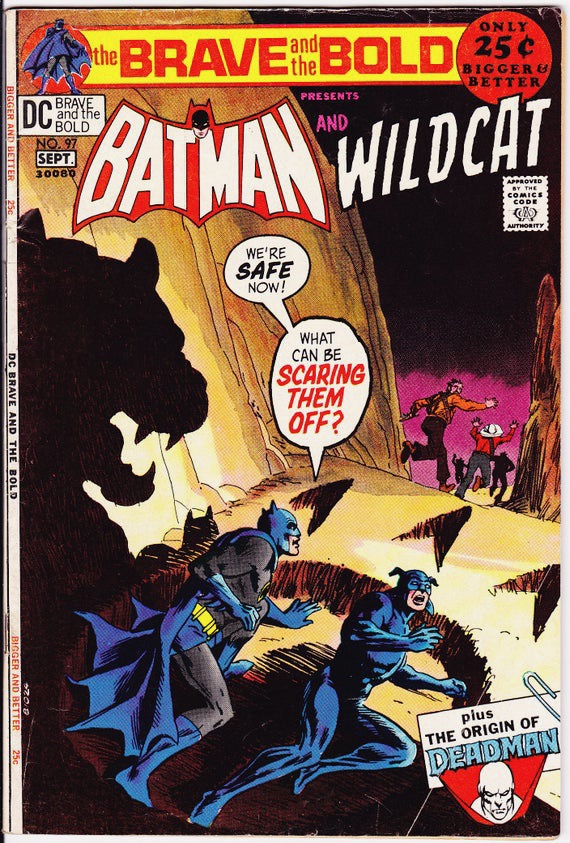
“There was a small newsagents in Somers Road, a DC shop. It had the spinner rack just inside the window. I remember getting Brave & Bold #97 there - the Wildcat team-up issue with a great Nick Cardy cover. I particularly remember that I picked up this issue having already read B&B #98 (The Phantom Stranger team-up) and #99 (The Flash team-up). This comic cemented my intention to collect Brave & Bold henceforth. I also remember that this shop was a good source of House of Mystery issues.The shop may have also featured a small Post Office Counter, but my memory is hazy on that score.” – Ian

© DC comics. Art by Nick Cardy


Re-reading the comic today, it is a great Bob Haney tale that takes Bruce Wayne (and Batman) to South America. Although Bob Brown did the pencils, the inks are unmistakably Cardy's. His art style so dominates  Bob Brown's pencils that some panels look like Cardy drew the whole thing. The panel of Batman's face below is prime Cardy.


There was to be one more stop in Somerstown before we headed towards the Dockyard.

Stop #17. Unknown newsagents in St Paul's Road area

The vagaries of urban redevelopment in Portsmouth have in many places completely razed row upon row of houses, and re-aligned roads, and built new blocks of flats. My pal Geoff Cousins and myself both remember a convenience store somewhere in the vicinity of St Paul's Road that we'd visit around 1974 on the bike ride, but a recent drive slowly cruising around the area yielded no evidence of the place. Perhaps some spark of memory will re-surface, but for now, we'll leave the area of Somerstown and head towards the Dockyard....in the next installment.

Sunday, July 31, 2022

David Niven - Actor, Raconteur, step-son of Southsea, and Comic-Book star

[Ed note: Well, just got under the wire with at least one article for the month of July. Apologies for the delay - life and Mini Cooper rallies got in the way. - Baggsey]

As long-time readers of this blog will know, Portsmouth and Southsea has sent forth many illustrious celebrities who subsequently made their mark not only in popular culture, but also in the world of comics. In these pages, we’ve taken a look at Arnold Schwarzenegger, Arthur Conan Doyle. H. G. Wells, and others. This week we take a look at one of the world's most beloved actors, the late David Niven’s involvement with Portsmouth, and his subsequent impact on comics.

© Dell, Marvel and DC. The many comic-book appearances of David Niven


In his 1971 autobiography The Moon's A Balloon,  Niven talks about attending school in Southsea. It was, apparently, a school for naughty boys and located somewhere in or near Kent Road. He was sent there as a punishment, having been expelled from his previous public school.


He does not mention the exact year, but it was probably around 1922, when he was twelve years old. Being taken by car from Portsmouth and Southsea station, he recalled: ‘I can always remember Southsea Common: flat, greasy, wet and windswept with a dejected flock of dirty sheep morosely munching its balding surface.’


‘ The car stopped at a dreary house in a shoddy row. The "school" for "difficult" boys was run by a Commander Bollard. ‘


Niven appears to have spent only three or four weeks there before being shipped off to a ‘crammer’ to get him sufficiently capable of passing an entrance exam to a more reputable institution, but the experience left its mark.


Reading his very entertaining biography, Niven obviously employed a measure of artistic license in his descriptions. However, there must be some truth in the story, and it is likely that Niven was talking about Annesley House, a maritime training school in Queen’s Crescent, just off Kent Road. 


The intersection of Kent Road, Castle Road and Southsea Common may very well turn out to be the nexus of popular comics culture, with Niven being schooled within minutes of both the birthplace of Peter Sellers (who went on to portray Fu Manchu ), and the second-hand comic shop where Nigel Brown and I had our own “Edgar Church Collection” comic-buying experience in 1971, as documented here.


David Niven went on to have a glittering film career in Hollywood, and his likeness has graced comics from the late 1950s to the current decade, first in adaptations of his films, and later as the template for both a well-known villain and hero. Whether Niven ever gave permission for the use of his likeness, or was even aware of his involvement in comics, we shall never know.


#1 Around the World in Eighty Days - Dell - 1956


The earliest appearance of Niven’s likeness (that I could find) in comics was in the Dell comic adaptation of the film Around the World in Eighty Days - directed by Michael Anderson in 1956.


© Dell. Four Color Movie Classic Comic (No. 784) – December 18, 1956


Dell decided to adapt the film of the Jules Verne story "Around the World in 80 Days" in its Dell Four Color Movie Classic Comic (No. 784) – published December 18th, 1956. The story was adapted by Gaylord Du (Space Family Robinson) Bois with art by Mike (Justice League of America, Man from U.N.C.L.E.) Sekowsky & Mike (G-8 and his Battle Aces) Peppe. 


The likeness of David Niven as Phileas Fogg is well rendered by Sekowsky, although a comparison of the opening scene in the comic and the same scene in the film makes it quite clear that Sekowsky had either not seen a cut of the movie, or was drawing it from memory.


© Dell. Opening scene drawn by Mike Sekowsky

© MGM. Phileas Fogg at the Reform Club.


#2 David Niven as villain Sinestro - Green Lantern #7-#9 - 1961 


It has become commonly accepted in the comics community that the likeness of the Green Lantern villain Sinestro, as drawn by Gil Kane, was based on David Niven. However, despite many searches, I cannot find any source interview with Gil Kane that asserts this as fact.  


© DC. Green Lantern #8. Art by Gil Kane.

Sinestro was created in 1961 by John Broome and Gil Kane as an adversary for Hal Jordan. Sinestro first appeared in Green Lantern #7 in a story written by John Broome, and pencilled by Gil Kane and inked by Joe Giella. 


Gil Kane despised Joe Giella’s inking, as he stated in an interview in Alter Ego #149, reprinted from Fantasy Advertiser #100 (1988): "Unfortunately I also had Joe Giella for years. I thought that Giella was, generally speaking, a nice guy – but he was probably the most inept single inker that ever worked professionally in comics."


The earliest mention of the Niven/Sinestro connection I have found is in a Wizard article by Jeremy Brown posted on June 2007 - seven years after Kane's passing - where Brown notes that artist Gil Kane reported noted that Sinestro's appearance was based upon British actor David Niven, but quotes no source.


According to an interview with actor Mark Strong on April 10, 2010, the relationship between Sinestro and Jordan is based in part on the actors who inspired their creation.

“That widow’s peak and thin mustache was for some reason originally based on David Niven, and Hal Jordan was based on Errol Flynn,” said Strong. “In the ‘30s and ‘40s, they shared an apartment together in Hollywood when they were making movies and they were great friends. Obviously at the time, whoever was doing the original comics must have looked at them as guys doing very well in the film industry, and based those characters on them. So I would like to do justice to the Sinestro that was conceived for the comic books.”


Personally, I feel that any claim for a deliberate likeness between Sinestro and David Niven is pretty tenuous, unless any reader can put me right on this matter? Gil Kane confirmed that he based Morbius on Jack Palance in a 1999 interview, so anything is possible.


#3 Niven in '55 Days at Peking' - 1963 - Dell - film adaptation


© Gold Key

© Gold Key. Artwork by Mike Sekowsky


The comic is an adaptation of the film 55 Days at Peking, which tells the story of a siege during the Chinese Boxer Rebellion of 1899-1901. As detailed in the blogintomystery website, the comic does a pretty good job following the film's narrative. The panel above shows Charlton Heston’s and Niven’s characters (an American Marine officer and the British ambassador, respectively) trying to reason with the Dowager Empress Tzu-Hsi and her corrupt minion. The artwork, as in 80 Days Around The World, is by Mike Sekowsky. 


Mike Sekowsky’s likeness of David Niven is less accurate than his Phileas Fogg rendition of 7 years earlier, and Charlton Heston’s likeness is very vague indeed.


#4 Percy 'Pinky' Pinkerton - July 1964 - Marvel - Sgt Fury & His Howling Commandos


Niven's next appearance was as Percy 'Pinky' Pinkerton in the July 1964 issue of Sgt Fury & His Howling Commandos, playing an effete British Officer replacing the Juniper character in issue #8, "The Death Ray of Doctor Zemo". Niven can be seen on the cover in the lower right-hand corner.


© Marvel 1964

Artist Dick Ayers said in a subsequent interview that Stan Lee had told him to base the likeness on Niven, which bears some similarities to Niven's performance in The Guns of Navarone.


© Marvel. Sgt Fury July 1964. Percy Pinkerton's introduction

Pinkerton is introduced as a mistakenly effete individual, who quickly proves himself to be made of tougher stuff. Pinkerton has continued to be an ongoing member of the Commandos in comics, as well as being portrayed by actor Richard Short in episode 5 of the first TV season of Agent Carter. 


#5 Sarsfield - 1976 - Marvel - Master of Kung Fu


Niven's next appearance was twelve years later as MI6 communications officer Ward Sarsfield in Master of Kung Fu 1976, #47 “Phantom Sand” , from the Creative Team of Doug Moench & Paul Gulacy. The character Sarsfield is named after the real name of Sax Rohmer (creator of Fu Manchu).


Sarfield made six appearances in Master of Kung Fu, the last being in the June 1979 issue #77.


Gulacy admitted in a 1999 interview that he often used celebrities' likenesses for characters for fun, agreeing the deliberate likeness to Niven.

#6 Niven as Alfred Pennyworth - Batman's Grave #1  - 2019


Niven's most recent, and most iconic, comic's performance has been as Alfred Pennyworth in The Batman's Grave, a 2019 limited series from Warren Ellis and artist Bryan Hitch.

© DC Comics.

Of all the likenesses of Niven over the years, this is the most lifelike. 

Bryan Hitch told Den of Geek “I have been tempted to redraw Alfred’s face a bit but only because it’s come out more David Niven-y that I’d planned on. I’ve found actually that, as far as expressions go, less is always more. Over dramatize and you lose the emotion so, given the dialogue I get, I try to do as little as possible with the faces and hint at emotion and expression."

Perhaps Niven's appearance as Alfred will be his swansong in comic books. It amazes me that it has been sixty-six years since he first appeared in the pages of a comic book. There may be other appearances that I have missed ; if you're aware of any others, please let me know.

Wednesday, July 14, 2021

"My Word!!! Sherlock Holmes is a JUNKIE!!!" by Ian Baker


With apologies to Neal Adams, E.R. Cruz and Sidney Paget.


Cataloging old comics recently, I came across Eternity #5 , a Sherlock Holmes comic containing reprints of the 1930s newspaper strips illustrated by Leo O’Mealia (a fantastic illustrator whose work is reminiscent of Mike Kaluta - see cover of Action #2) ,and I erroneously made the assumption that Sherlock Holmes had featured quite a bit in comics over the years, despite traditional Sherlock Holmes stories really not lending themselves to the things that comic books excel at - punchy narrative and explosive action.  


Attempts to turn Holmes into an action hero within comic pages have generally engendered a lukewarm response, Guy Richie’s movies not withstanding. However, the more recent TV series of Sherlock and Elementary, set in the modern age, have successfully breathed new life into an old character, being both commercial and critical successes, and have done so while avoiding the tropes that have sometimes defined the character to the extent of becoming a cliche.


Today we’ll take a closer look at Sherlock Holmes in comics within the confines of the Bronze Age.


As this blog is both Portsmouth and comic centric, let’s start with a brief primer on Holmes’ connection to Portsmouth through his creator, Edinburgh native Sir Arthur Conan Doyle.


Here are a few facts about his creator Sir Arthur Conan Doyle:

  1. Arthur Conan Doyle came to work in Southsea as a young doctor in 1882 to set up a medical practice at Bush Villas in Elm Grove. Here he took up writing Holmes stories to while away the time between patients (strange he would have spare time as I’m sure Portsmouth was awash with social diseases at that time) 
  2. His first Holmes adventure written in Southsea was A Study in Scarlet , followed by The Sign of Four.
  3. He based elements of the character of Holmes , along with his approach to deductive reasoning, on his mentor the Edinburgh Doctor Joseph Bell 
  4. He was also the first goalkeeper of Portsmouth Association Football Club, predecessor to today’s Portsmouth Football Club (“The 3 Lions problem” was an early discarded story idea :-) )


Mark Wingett’s blog on Doyle’s early days in Southsea is well worth a quick read. In addition, many of the Holmes stories written by Doyle contain references to Portsmouth, Southsea, Fratton and the surrounding area, and more detail can be found here.


Despite the number of books, films and television adaptations, I’ve been surprised there are so few iterations of Sherlock Holmes in comic books at all, and only five appearances in the Bronze Age in total.  


Holmes’ appearances in the pages of DC and Marvel in the mid-1970s coincided with that period of frantic expansion prior to the “DC implosion” when the major comic companies were looking around for literary properties that could be easily adapted - the pulp characters such as The Shadow, Doc Savage and The Avenger being prime examples that were transferred with varying success a few years earlier.


Here is the list of appearances by Sherlock Holmes in the pages of DC and Marvel, a mixture of straight adaptations and new material which clearly indicates that there was no strategic plan for developing the character.


  • DC: Sherlock Holmes #1 (Pub 26th June 1975) by Denny O’Neil and E.R. Cruz, adapting The Final Problem and The Empty House, as an integrated story. 

  • DC: Joker #6 (pub Dec 4th 1975) - where the Joker fights head -to-head against an actor who believes he is Sherlock.  Writer: Denny O’Neil Art: Irv Novick 

  • Marvel: Marvel Preview #5 and #6 - A surprisingly faithful adaptation of Hound of the Baskervilles. (published 1976-01-06 and 1976-04-06)  These two stories are superior adaptations drawn by Val Mayerik and Tony Dezuniga ; written by Doug Moench
    © Marvel Preview #5
  • © Marvel Preview #6


  • DC: Detective #572  (published Dec 26th, 1986) celebrating the 50th anniversary of Batman (Mike W Barr and Ernie Cruz, Ed Denny O’Neil).   The Detective Story features an elderly Holmes encountering Batman.


And that’s it.


So why only 5 comics?  Denny O’Neil - as editor and/or writer, was the engine behind the DC incarnations, and has spoken of his affinity for Sherlock Holmes in blogs and videos over the years. Over at Marvel, Archie Goodwin provided editorial duties.


The Marvel Preview issues which Goodwin edited are superb adaptations which take their cue from the Sidney Paget illustrations. Val Mayerik’s illustrations evoke both Paget and Berni Wrightson in equal measure and was obviously a labour of love.  


In contrast, the DC comics adhere to a Basil Rathbone-clone approach inspired by the Universal Studios films of the 1930s and 1940s. All fog, deerstalkers and  “gor blimey’s”. E.R. Cruz's art in the singular issue of “Sherlock Holmes #1” from DC is excellent as well, and the fine lines would have benefitted from a Black & White presentation.


So why did Sherlock Holmes not prosper in the Bronze age of superheroes? Well, there are a number of reasons.


  • A boring costume. Comic book protagonists dress the same from comic to comic, and so stories about regular citizens (even smart ones) are not really suited unless our heroes are members of the police or military, where a uniform provides a consistent look to the hero. DC decided upon clothing Holmes in a green checkered coat and deerstalker in all situations - not the most dynamic of costumes.
  • Lack of Motivation. All great comic book heroes have an origin story. Holmes has no back story or motivation beyond the need for mental stimulation. Doyle’s cold, eccentric thinking machine  has no real friends other than Watson. He describes himself as a “high-functioning sociopath” .
  • Lack of Differentiation. Sherlock is insufficiently differentiated from other crime solvers, and pales in comparison to heroes who can both solve crime with their brains and fists. If he really was the World’s greatest detective, where does that leave Batman?  (I have yet to read a Batman comic where he solves a crime just by thinking through the clues.  Or is there?)
  • No Rogue’s Gallery. Holmes has only one worthy villain - Moriarty - who has been already dispatched in DC issue #1 .

  • Poor use of Locations.  Holmes of the books traveled around the country - he was not stuck in a foggy London. In the Bronza Age the convention was that heroes were bound to a place - Gotham City, Metropolis, Star City, Central City, etc. - and a fog-ridden London would provide limited scope for varied encounters.

  • Constrained by Public Domain.  The Bronze Age adaptations were based on the Holmes character as presented in the Public Domain stories, and the writers were unable to use the stories or characterization of Holmes as found in  the Copyrighted Stories between 1923 and 1927, when Conan Doyle’s personal losses in the Great War brought humanizing changes to the Holmes character .


If we consider the key attributes of Holmes as described by Doyle in the books, we find a cold, calculating, misogynistic, drug addict, relying heavily on Watson as his Boswell, his one fixed point in a changing world.  These are all qualities that make him interesting on TV, yet by the very nature of the Comics Code Authority in the 1970s ensured that these admittedly anti-social qualities could not be easily portrayed.  


The breakthrough of DC’s Green Lantern- Green Arrow #85 in 1972 of portraying the effects of substance abuse was insufficient to result in a major sea change in comic book stories in the Bronze Age. It was more an outlier that signaled the end of “relevance” in mainstream comic books, and certainly did not pave the way for a compelling presentation of Sherlock Holmes.


So is there a good comic to be made to feature Sherlock Holmes today? 


I do believe that it is possible. I am heartened by the superior mystery and character work being turned out today at Image by Chris Condon and Jacob Phillips, or by Ed Brubaker & Sean Phillips , all working in the the noir genre. Their books demonstrate that there is room for non-superhero stories with intelligence, no longer relying on explosive action, in the independent creator-owned segment. I look forward to seeing what is possible. 


Just avoid the foggy streets and deerstalker. 

Thursday, June 24, 2021

Batman beyond the Ocean at the End of the Lane – by Ian Baker

South Parade Pier, Southsea, Hants. Sept 1967. © Public Domain


“I wonder what it is about that area. I'd go down the South Parade Pier and return home to my grandparents' bookless house* with comics... 


*They had Readers Digests, and a set of Dickens on the bookshelves in the grandfather clock.”


Neil Gaiman, Twitter, July 7 2018  


For those of you unfamiliar with the geography of Portsmouth & Southsea, the South Parade Pier juts out into the Solent, at the southernmost tip of Portsea Island, not so many yards from the short road at the end of the Canoe Lake that in recent years was formally named "The Ocean At The End Of The Lane" in honour of famed writer with local connections, Neil Gaiman.


Many of you will already be familiar with South Parade Pier from the role it played in Ken Russell’s film of The Who’s rock opera “Tommy”, when it was significantly damaged by fire on 6th June 1974 during filming of said film. Never one to waste an opportunity, director Ken Russell incorporated footage of the conflagration into the completed film.


However, this was only one of many times during its illustrious lifetime that the pier had burned down, and so despite the glamourous presence in the film of such luminaries as Elton John, Jack Nicholson, Ann Margaret, Roger Daltry and Oliver Reed, "Tommy" is not the subject of today’s blog.


Today we go further back to the summer of 1967 and examine the role that South Parade Pier played in shaping our comic collecting lives.


As readers may know from experience, seaside towns hold special place in the hearts of UK comic collectors, due to the abundance of back-issues that used to be found in gift shops that only opened during the summer season, when unsold stock from previous years once again saw the light of day, which in many cases included DCs and Marvels from spinner racks of yore.


In late 1966 Manchester-based World Distributors (publishers of countless children’s annuals, and sometime distributor of American Marvel comics in Britain) were looking to capitalize further on the Batman TV series craze. They saw a gap in the market that could utilize the skills of their reliable writer Douglas Enefer and talented house artist Walt Howarth, to take advantage of the approaching period when fellow Mancunians, other Lancastrians and Yorkshiremen of all ridings would be heading south with their families for a week or fortnight's break in a guest-house by the seaside. For local hoteliers, the mid-sixties was that watershed moment before the attractions of a cheap week in Benidorm had impinged fully on the British holiday-going consciousness, a time when Wallace-Arnold coaches (or “Wally Trolleys” as they were affectionately known) blocked the main arteries of the British landscape on Saturday afternoons as they bore northerners down congested A-Roads in search of the summer sun of south coast resorts.


The photo at the top of this blog, taken on a rather damp 1967 summer’s day, shows two small shops under the front awning of the pier entrance.  In the foreground you’ll see the Lyons Maid Ice Cream concession where many of us bought Zoom’sSea Jets and FAB ice creams in the hope of getting a full set of collectors’ cards, while in the background on the opposite side of the pier entrance stands the newsagents/tobacconists which usually stocked American comics.


Better shot of newsagents. © JJ Marshallsay, from Memories of Bygone Portsmouth FB group

But in 1967, the newsagents was also to stock a new bi-weekly series of Batman text novellas (a bit of a stretch to call them pulps, more digests, with covers a little larger than paperback size) which rode the coattails of the Batman ’66 TV craze, published by World Distributors under the World Adventure Library umbrella series title.


Batman Storybook Annual 1967 plus all 11 issues of BATMAN! digest


Aimed at individuals with a short attention span (be it a parent dozing in a deckchair or a child experiencing a candy-floss sugar high), each digest had 64 action-packed pages based on the characters as they were depicted in the Batman TV Series, interspersed with black and white line illustrations. Although records indicate that these digest novellas were published from November 1966 through May 1967, the first of these books that I acquired from South Parade Pier was #9 – “No Quack for the Penguin” – probably at Easter 1967 - and I then went on to track down the previous eight issues plus the two subsequent titles.  


I was an avid 7-year old reader. I had already exhausted the extant “Five Find-Outers” books by Enid Blyton, so I was on the lookout for tougher fare. The writer Douglas Enefer delivered the goods. 


Take a read of the opening page of #3 – “Batman meets Dr. No-Face” (below). 


If Douglas Enefer was not an ardent disciple of Lester Dent’s “Doc Savage” Master Plot formula, he certainly knew his way around placing the reader immediately into the middle of the action, setting up a scene of suspense and introducing the mystery on page one.  Of course, Douglas Enefer had a strong set of bona fides from the years he spent writing mystery novels and short stories under a variety of pen names (Dale Bogard, John Powers, etc) and well as under his own monicker. His last magnum opus in the 1970s would be to write a series of novels about TV Private Eye Frank Cannon, under the pseudonym Paul Denver. 


Douglas Enefer (1906-1987) had worked in the 1960s as a journalist in the regional British press, then national. In 1967, he joined the Daily Telegraph in Manchester, where he remained until his retirement in 1981. In addition to his journalistic activities, he wrote a few adventure novels and westerns, but above all more than forty detective novels. The adventures of his two heroes almost equally share his police production: Dale Shand, an American private detective residing in London, whose accounts are akin to the noir novel , and Sam Bawtry, an inspector from Liverpool who leads less violent investigations under orders from Chief Superintendent Braxted.


In addition, Enefer wrote novel tie-ins for British and American television series , and also made a few forays into television screenwriting, notably writing in 1966 an episode of The Saint  : The Man Who Liked Lions , season 5, episode 8.


Whether Batman World Adventure Library novella #1 “Batman….And the Ringer!” was Enefer’s first foray into writing Batman stories is open to conjecture. I suspect that he was also the man who wrote all the short stories in the first Batman Storybook Annual 1967, which hit the shelves around September 1966, a couple of months before the digests premiered. The 1967 Batman Storybook annual also introduced the UK Batman Fan Club, where for the princely sum of 5/6d sent to Batman, Heanor, Derbyshire (yup, the real address), a young fan could be inducted into the club and receive instructions on decoding secret messages from the Dynamic Duo.  The World Adventure Library digests then continued to promote the fan club in each and every issue – a shrewd move from World Distributors to keep the Post Office postal orders rolling in. 


Partnering Enefer on the digests was cover artist Walt Howarth (1928-2008), a longtime illustrator for World Distributors Ltd. As the more fully detailed biography in Bear Alley Books blog  details, Howarth's ability to capture a likeness in paint meant that he became WDL's leading artist, producing covers for most of their annuals. He was used to working from photographs of actors and would usually have his covers painted almost a year in advance of publication.


However, with the short lead time for the World Adventure Library covers due to the surge in the Batman craze, Walt took the route of painting covers that were “inspired” (ahem) by covers of previously published DC comics, Topps/A&BC trading cards, and promotional artwork developed for the Batman TV show.  Whether permission was sought or given, we may never know, but the works of Joe Kubert, Carmine Infantino, Sheldon Moldoff, Norman Saunders, Bob Powell and others were certainly plundered to provide bright covers that would jump out from the spinner rack.


Joe Kubert's Cover for Detective #349 repurposed for Batman...and the Ringer #1


Swipes from Carmine Infantino, Norm Saunders, Bob Powell and Sheldon Moldoff.


The line artwork inside each issue was fairly rudimentary, and does not appear to have been drawn by Howarth. However, it was certainly drawn by the same artist who contributed the illustrations to the 1967 Batman Storybook Annual.


Co-inciding with the summer holiday crowds returning home and the South Parade Pier shops closing up for the year, Batman stopped transmission on ITV Southern Television with the end of the second season of episodes. It would not be until 1976 that the third season was to be transmitted. World Distributors would not revive the Batman World Adventure series the following summer, although they still published Batman Storybook annuals for the Christmas market for the next three years. Whether Douglas Enefer wrote the stories appearing therein, I do not know.


Questions for our readers:

n  Do any of our readers know if Douglas Enefer wrote the Batman Storybook annuals?

n  Who drew the interior artwork of those annuals and the World Adventure Batman digests?


More information and references:


n  Kid Robson’s blog at https://kidr77.blogspot.com/2016/11/batman-fully-paid-up-member-of-world.html for information on other books in the series.

n  AtomicAvenue.com for covers and US values

n  Artist info from mycomicshop.com

n  UK issue values at https://www.comicpriceguide.co.uk/uk_comic.php?tc=batmanwor

n  Walt Howarth bio at https://bearalley.blogspot.com/2008/03/walt-howarth-1928-2008.html