Showing posts with label Neal Adams. Show all posts

Thursday, May 23, 2024

Kojak in Comics by Ian Baker

© Universal / Peter Pan records. Who drew this? Neal Adams? Crusty Bunkers?
In the previous blog, we discussed the prevalence of the TV Tie-In paperback in the UK in the 1970s. Now lets take a closer look at how comics attempted to capitalise on the success of 1970s TV Cop sensation Kojak on the printed page.

First, to refresh your memory on the pop-cultural rise and fall of the lollipop-sucking police lieutenant from the NYPD portrayed by Telly Savalas, the show’s pilot premiered in the US on Mar 8th 1973, and its final episode first-run showing was five years later on Mar 18th 1978.

The UK was late to latching on to the Kojak phenomenon , and it wasn’t until 23 Aug 1974 - almost 18 months after the US debut - that BBC-1 premiered the pilot film - The Marcus-Nelson Murders. The BBC knew they had a hit on their hands, and quickly ran through the episodes of Season One in a totally haphazard sequence, even flowing right into episodes of Season Two before they exhausted episodes from Season One (with the exception of the never-UK-broadcast banned episode “Therapy in Dynamite”).


Back in the US, Universal Television had quickly negotiated with writer Victor B Miller to pen what would turn out to be a series of nine TV-Tie-In paperbacks, which were published in the period Sep 1st 1974 - Oct 1st 1975 in the States (see table at foot of article). These are very good episode adaptations, compelling stories written as a first person narrative by Kojak himself. 


Victor Miller, as per his website , was initially approached by Bernard Shircliff of Pocket Books to novelize three Kojak episodes from Television. He was paid $2700 to adapt the first three scripts, going on to write a total of nine adaptations. These are very readable books. Miller is no hack, has a great ear for dialogue and narrative drive, and successfully went on to write his own novels and screenplays.


Kojak was a tough, gritty show for its time, and Universal Studios had no expectations of licensing a comic book adaptation. Police comics had gone out of fashion in the US in the 1950s. 


Police Comics in the 1950s


Marvel’s Police Action had run for only seven issues in 1954 ; Quality’s Police Comics had finished its 127-issue run in 1952.  Avon published Police Line-Up for 4 issues from 1951-1952, following it up with four issues of Sensational Police Cases from 1952-1954 for thirteen issues.


Mr District Attorney ran at DC from 1948-1959 for 67 issues, surviving latterly on mysteries linked to Aliens and Invisible criminals, avoiding tough gritty storylines which might fall foul of the Comics Code Authority. Similarly, Gangbusters ran at DC from 1947 to 1958 for 67 issues, but had limped to a halt with fanciful stories about robots, frogmen, human cannonball criminals, and alligators.


From an early TV Tie-In perspective, the famous TV series Dragnet had been represented in a daily newspaper comic strip distributed by the Los Angeles Mirror Syndicate from June 23, 1952 to May 21, 1955, but that finished well before the end of that series, which had continued on television in the US until 1959.


One exception to the continued popularity of police comics based on TV properties was Dell's Car 54, Where Are You?, which had a mildly successful run for a year in 1962. Of course, the mild comedy of Car 54 was a world away from Kojak and the NYPD.


A decade later, DC dipped their toes in the water with their publication of DC Special #10 titled "STOP! You Can't Beat The Law!", hitting US stands in November 1970 with a series of early 1950s reprints from Gangbusters, but reader response was tepid despite a fabulous cover by Nick Cardy.


 So by early 1973, the received wisdom was “Police Comics Do Not Sell!”


However, by the beginning of 1975, Pocket books had published six of Victor Miller's Kojak novelizations to strong sales. Martin Goodman at the newly formed Atlas Comics had taken notice, and felt that his new Atlas Comics line could tap into this public obsession for cop shows. And so Atlas Comics released the only 1970s US comic book with “Police” in the title in Feb 1975, called “Police Action with LOMAX NYPD”, which ran for only three issues, and folded with the rest of the Atlas line that Summer.


With the success of Kojak on TV in the UK (and with an eye on World Distributors’ UK success with publishing paperbacks of TV Private Detective Frank Cannon), Star Books (an imprint of W.H. Allen) kicked off UK publication of some of Miller’s Kojak novelizations, starting with book #2 “Requiem for a Cop” in August 1975, following up with “Girl In The River” (book #3) in September 1975. The first book had sold 100,000 copies in the UK, and by the time that the third book “Marked For Murder”
  (a retitled version of US book #5  “Death is Not A Passing Grade”) was published in December 1975, 165,000 copies had been sold. 


Kojak was a popular mass-market paperback phenomenon in the UK at a time when most mass market paperback series success stories involved soft porn in the vein of Timothy Lea’s “Confessions Of…” series. 


By 1976, Kojak’s star was starting to wane. The publication of the US paperbacks by Victor Miller had ended in Oct 1975, but Star persevered in the UK printing a few more books into 1976.


Kojak had started its 4th season in October 1976 on BBC-1 in the UK, now in lockstep with US transmission dates . Public enthusiasm was waning, and the show was routinely moved to a late time slot in the UK.


Counter-intuitively, publishers Stafford Pemberton of Knutsford, Cheshire, jumped in to the market with a 1977 hardback children’s Kojak Annual for Christmas 1976.  The book was a mix of illustrated text stories  and comic strips. I assume that they picked up licenses cheaply now that the show was in decline ; it was certainly no longer dominating pop culture in the UK.


Jon Davis artwork
The strips in the Annual were drawn by artist Jon Davis (1928-2020),  aka John Fox. Most of his previous output had been for licensed titles made in cooperation with Gerry and Sylvia Anderson's TV production company Century 21.  In the girls' title Lady Penelope, he illustrated 'The Angels', a spin-off of 'Captain Scarlet and the Mysterons', but also the non-Anderson feature 'Daktari'. He was also present in Joe 90: Top Secret (1969) and TV21 with 'The Champions' and 'Secret Agent 21'. In the 1970s, he continued his Anderson-related work at Polystyle Publications, drawing 'Joe 90' and episodes of 'UFO', 'Thunderbirds', and 'The Secret Service' for Countdown (1971-1973).   (Per lambiek.net)


In parallel in 1977,  there was a single attempt at a Kojak comic strip in the US as an adjunct to a Kojak book and record set of two original Kojak stories played by session voice actors. (Peter Pan Records #BR 518 "Five Star Final' & 'A Question of Honor'). The strip was drawn by Alan Kupperberg according to GCD, claiming that Neal Adams did the album cover. Peering at the cover at the top of this blog, I think I see more of Dick Giordano’s work, so perhaps it was a Crusty Bunkers collaboration.  The script was by David Dann.


Artwork Alan Kupperberg?


Over in the UK, the 1977 Kojak Annual was deemed a success. Remember that children’s Annuals were typically purchased by doting aunts for their nephews and nieces, not generally bought by the recipient. And so Stafford Pemberton followed up at Christmas 1977 with a follow-on Kojak Annual for 1978.


Artwork Jon Davis
Sales were nowhere near as good.By March 1978, the TV series was cancelled in the US, and would finish its run in the UK in a few months by August. Yet Kojak's appearances in comics was not yet done. 


Polystyle Publications was looking for licensable characters for its new TV-oriented comic strip weekly Target. They acquired the rights to Kojak, and the strip appeared in  Target Issue 1 cover dated 14th April 1978, a month after the show’s US cancellation. When Target was amalgamated with TV Comic, the strip continued in August 1978, ending its run with issue #1408 on 24th Nov 78.


Jon Davis had initially continued to draw the strip in Target, at some point handing over the reins to David Lloyd of subsequent V for Vendetta fame to close out the strip. (per Down the tubes).


A typical Kojak Strip from TV Comic
A total of 64 pages of black and white artwork was drawn during this period.


Reading the strips, they are a strange curio of rambling narrative interspersed with violent action. Jon Davis’ artwork is serviceable ; David Lloyd’s art contains hints of the masterly work for Warrior and DC a few years later.


There is a similar story linked to publication of Cannon TV tie-ins which resulted in a comic strip in Target also.


For those of you further interested in US TV Tie-In’s I recommend TV Tie-Ins by Kurt Peer, which purports to list every US-published TV tie-in. It’s a good reference book, although by excluding books published only in the UK, it only tells part of the TV Tie-In story. 


Table of Kojak TV Tie-Ins


Wednesday, February 7, 2024

A look back at Weird Heroes

Weird Heroes #1-#4
Since the demise of the adventure pulps in 1949, there have been infrequent attempts to resurrect the genre of outlandish tales for succeeding generations. While a few short-story based pulps survived (Astounding stories , Ellery Queen, Alfred Hitchock Presents) (?) continued regardless, it was the success of the Doc Savage reprints by Bantam starting in 1964 that first rekindled interest in adventure pulp heroes, and reprints of the written adventures of The Shadow, The Avenger, Tarzan, G-8 and others swiftly followed.


As the 1970s dawned, there was also an interest to rekindle the higher quality end of the pulp market, either through reprints or through attempts to develop a new kind of pulp which took advantage of a climate of looser mores, the acceptance of SF as a mainstream genre in popular culture, and the availability of a new generation of comic book artists for spot illustrations. The new generation of writers had been pulp readers in their adolescence, and so were drawn to the challenge of reinventing the genre.


The period of this “new pulp” renaissance lasted for just over a decade, starting with Byron Preiss’s Weird Heroes in 1975, and probably ending with the demise of New Black Mask quarterly in 1988.


Weird Heroes was an experiment, in the words of editor Byron Preiss, to create a New American Pulp. Back in 1976 I managed to procure two copies from DTwAGE. Recently I have managed to collect the other issues. There are 8 issues in total, featuring a mix of short stories and full-length novels. The authors embrace a wide spectrum of talent, from old hands like Philip Jose Farmer to young turks like Harlan Ellison.


I bought my original issues at a time when I was avidly following the work of Harlan Ellison, had a new interest in the old pulps, had a burgeoning interest in movies and SF and Crime TV shows, and so Byron Preiss’ book, with illoes by hot comic artists, hit all the right buttons.  


Weird Heroes #5-#8
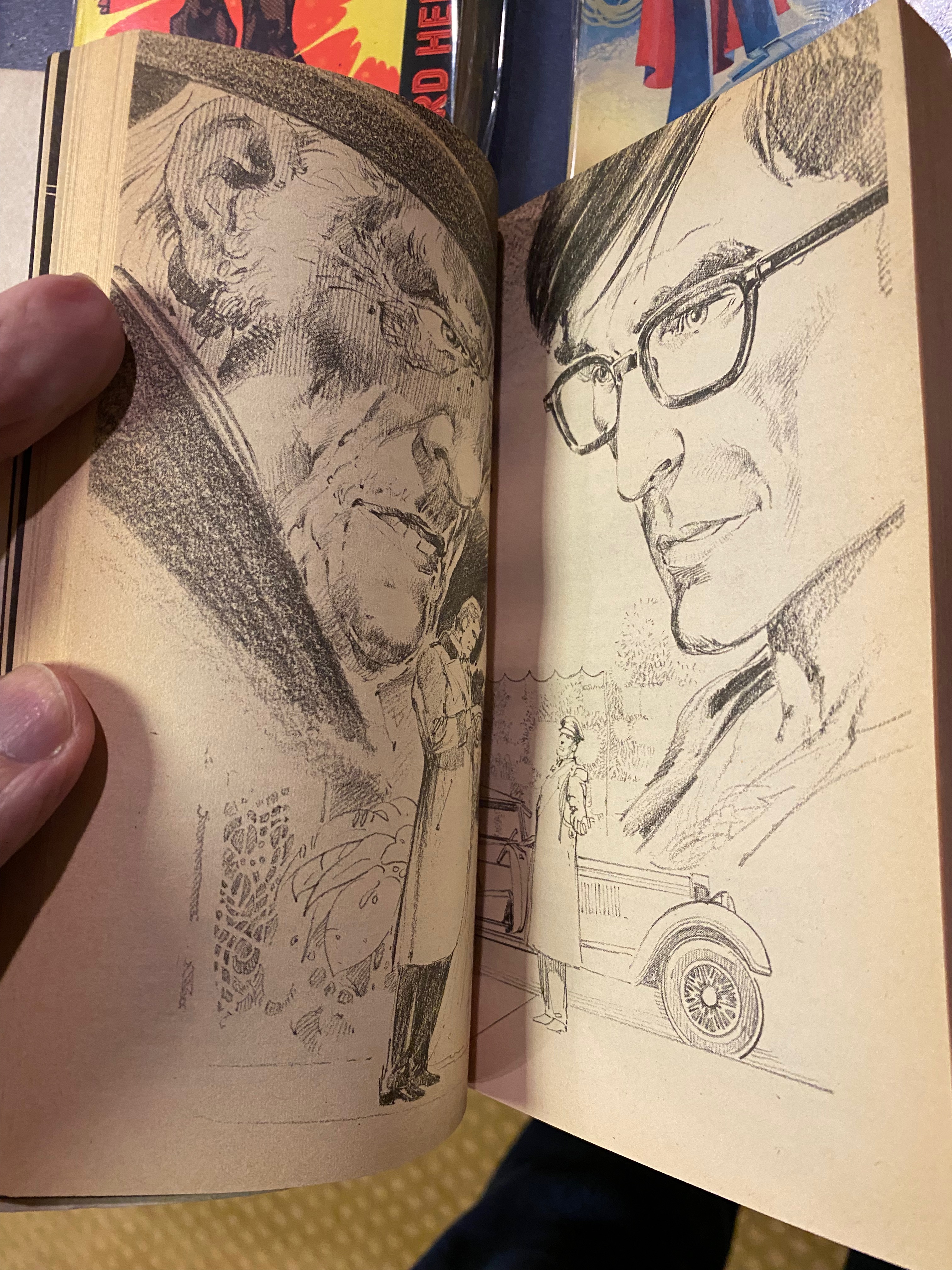
The pages below highlight Neal Adams’ artwork contribution the New York Review of Bird, a story featuring a thinly-disguised Harlan Ellison in his alter-ego of Cordwainer Bird, meeting an aged version of the Shadow.


The experiment lasted only 8 books, but they are worth tracking down to read something that really tried to stretch the envelope of graphic storytelling in the mid 1970s.

Friday, January 19, 2024

Alternative covers - JLA #81 - A pivotal issue at the end of the Silver Age

A while back we highlighted a rejected Batman cover by Irv Novick that was re-drawn by Neal Adams. You can read the blog here.

This week a rejected Gil Kane cover for Justice League of America #81 (June 1970) is up for auction on Heritage Auctions, a cover subsequently re-drawn by Neal Adams after editor Julie Schwartz rejected the original. At first glance they are very similar, but Adams’ rendition (in my biased view) is undeniably superior. Small differences add up to a huge difference ; there is now movement in the image as Flash and Batman are visibly struggling ; Superman’s frustration and sadness through the change of an open palm to a clenched fist; Atom on his knees and not on his back makes him more heroic.  The Hawkman figure is more clearly delineated. 


And the biggest change - Batman’s cowl is now rendered in the new long-eared Adams style, rather than the old short-eared cowl of previous years. This brought consistency to the other DC covers featuring Batman on the cover that month (Batman #222, Detective Comics #400 and Brave and Bold #90).


©DC. Published cover to JLA #81
I took the opportunity of a quick re-read of JLA #81 (“Plague of the Galactic Jest-Master”,  written by Denny O’Neil), and realized that it was quite a pivotal issue in the transition from DC’s Silver Age to Bronze Age.  The JLA come up against the Jest-Master, an alien with the ability to turn his enemies into fools.


Of course, the scene on the cover is nowhere to be found within the comic. Quite a bait-and-switch to disappoint the buyer with a Dick Dillin and Joe Giella interior. The story does briefly feature Jean Loring (former wife of The Atom) under a madness spell at the start, as the story ties up threads from both O'Neil's previous issue of JLA (#80) and his final issue of the abruptly cancelled The Atom and Hawkman #45 “Queen Jean - Why Must We Die?” from nine months earlier (Oct/Nov 1969).


The issue also ties into the highly regarded O’Neil/Adams run on Green Lantern/Green Arrow, providing a full page featuring the Guardians on OA, highlighting Hal Jordan, Ollie Queen and one of the Guardians camping in the wilderness in their quest to find America. 

©DC.  Linking to the Green Lantern #77
It is a shame that Neal Adams was not given the chance to draw page 8 in a cameo appearance, in much the same way that he was given the opportunity to draw the Deadman scenes in JLA #94, or Green Arrow's flashback appearance in World’s Finest #210.


Unless you're a big Justice League fan I wouldn't suggest you go out of your way to pick up a copy of JLA #81, but as a curiosity-item pulling together the story threads of JLA, The Atom & Hawkman and Green Lantern/Green Arrow it's worth a read.


This was a month of high productivity for Adams ; in addition to drawing all (interiors and cover) of Green Lantern/Green Arrow #77, he drew the covers to House of Secrets #86, Superboy #166, Witching Hour #9 that same month.  What a great set of covers. Take a look below and enjoy the master at work.


©DC. Batman #222

©DC. Brave & Bold #90

©DC. Detective Comics #400

©DC. Green Lantern/Green Arrow #77

©DC. House of Secrets 86

©DC. Superboy #166

©DC. Witching Hour #9


Wednesday, December 14, 2022

The Book That Never Was - DC Universe Illustrated by Neal Adams - Vol 2

 by Ian Baker

©DC. Advance image of cover for Volume Two.

Back on January 13th, 2009, DC published what was to be the first of a series of three trade hardbacks (and paperbacks) of collected comic stories drawn by Neal Adams, bringing together his DC work beyond the realm of Batman, Green Lantern/Green Arrow and Deadman, which had already been reprinted as collections on multiple occasions 

The previous hardcover collections of Adams' work on Batman had been very successful, and so the decision was taken to curate three more volumes that would bring to light Adams' lesser known work on War, Horror, Western and Humour comics at National, dating from Adams first work for the company in 1967. Adams would re-colour the selected stories, as he had done (somewhat controversially) on the Batman volumes since their first publication in October 2003.

The first volume of DC Universe Illustrated by Neal Adams contained a mixture of war stories from Our Army At War and Star-Spangled War Stories, along with a few Super-Hero tales in the form of Teen Titans, Superman and Elongated Man. [Note: the list of stories on MikesAmazingWorld.com is incorrect]. The package was topped off with some sketches and public service ads to pad out the Superhero material in the book. No covers were reproduced, though, which I found to be a disappointment. The new cover drawn by Adams in 2009 focused solely on the Superhero content of the book, and is not one of my favourites. It went through at least one rejected iteration before the final cover of the first printing was agreed.The imagery is somewhat humourous, at odds with the war story content within. A subsequent printing of the book replaced the cover with an image of the Justice League, harvested from a Dollar comic - DC Summer Special 1977.

©DC. Unused Cover for Volume One. From Albert Moy website

©DC Final cover for Volume One


©DC. Second Print Cover of Volume One. Taken from DC Summer Special 1977
In discussion with Neal Adams at the New York Comic Con nine months later in October 2009 (see Superstuff blog Meeting Neal Adams), he mentioned to me that work was underway on the project to "collect together all the old crap" including early covers. He expressed dissatisfaction with the technical proficiency of some of his early work (although it all looks brilliant to me), and in his introduction to volume one he mentions "the quirky and terrible job" he did on the Elongated Man story in Detective #369. These books were an opportunity to rectify past illustrative mistakes (in his eyes), plus re-ink stories if needed.

The first volume of DC Universe Illustrated by Neal Adams sold respectably, but it was decided to put Volume Two on hold for a while. The second volume would focus on Adams' work on Supernatural hero material ; the proposed cover as shown in solicitations (see top of blog) highlights the Spectre, Phantom Stranger and El Diablo (a supernatural anti-hero with a Western slant). Work got underway, and an announcement was made in the trade press that the hardcover version of Volume Two would contain 192 pages, to be published on November 6th, 2012. An ISBN number was secured for the publication - 9781401225186 (ISBN10: 1401225187).

Somewhere along the line, the decision was made not to publish the book after all; perhaps sales projections were low, or perhaps Adams had not progressed sufficiently on re-colouring the stories. Which is a shame, as the proposed stories contained some of his very best work.

The proposed contents and running order of the book have not been made public, but a bit of analysis and educated guesswork leads me to suggest the following items. Certainly the proposed cover confirms stories about The Spectre, Phantom Stranger and El Diablo (from Weird Western Tales), composed of a collage of interior images from Spectre #5, Phantom Stranger #4 and Weird Western Tales #13.

Here is my suggested contents list:
  • Assume 9 pages for introductions and forewords, mirroring the layout of Volume One - (Volume One story reprints start on page 10 (so 9 before)
  • Spectre #2 - "DIE SPECTRE--AGAIN!" (Story: Gardner Fox) 23pgs plus cover
  • Spectre #3 - "Hang 'Em Up Wildcat - You're Finished!"  (Story & Art: Neal Adams) 24 pgs plus cover
  • Spectre #4 - "Stop That Kid..Before He Wrecks The World!" (Story & Art: Neal Adams) 23 page plus cover
  • Spectre #5 - "The Spectre Means Death?" (Story & Art: Neal Adams) 22 pages plus cover
  • Phantom Stranger #4 - "The Dead Don't Sleep Forever" (Writer: Bob Kanigher, Pencils: Neal Adams, Inks: Bill Draut)  23 pages plus cover
  • Weird Western Tales #12 - "A Time To Die" (Writer: Cary Bates, Pencils: Neal Adams, Inks: Berni Wrightson) 4 pages 
  • Weird Western Tales #13 - "Night of the Living Dead" (Writer: Cary Bates, Art: Neal Adams) 11 pages
  • Weird Western Tales #15 - "Never Kill A Demon" (Writer: Cary Bates, Art: Neal Adams) 12 pages plus cover  
  • Biographies of writers and inkers (3 pages)

The material above would cover 160 pages (or 154 pages if Adams' covers were not included). That leaves 38 pages to fill in Volume Two. 

If we assume that the theme of the future bumper final Volume Three would be "Humour and Horror", to include the Bob Hope & Jerry Lewis comics (186 pages) plus 90 pages worth from the titles House of Mystery, House of Secrets, Witching Hour, Secrets of Sinister House, that leaves these oddities for inclusion in Volume Two:
  • Superman #249 'The Origin of Terra-Man'  7 pages
  • Weird War Tales #8 'Thou Shalt Not Kill' 7 pages  (Adams inks on Crusty Bunkers' penciler Steve Harper) - unlikely inclusion - 
  • Action Comics #425 'Human Target:The Short-Walk-to-Disaster Contract' 6 pages
  • Hot Wheels #6 'The Humbug Run' - 14 pages
These add up to 34 additional pages (excluding Adams' cover to Weird War Tales #8). Alternatively, these four stories could be held over for Volume Three and replaced with the covers that Adams did for The Spectre and Phantom Stranger, all of which were absolute crackers.

The Spectre issues


The Spectre stories as drawn (and mostly written) by Adams are uniformly excellent. [ For an in-depth commentary on those issues, I refer you to Part One of Nigel Brown's article "The Spectre 1966-1975" as published long ago in SuperStuff #6 (Mar 21st 1976).]

©DC. Spectre #2 cover (courtesy of HotComics.net).

Issue #2 (above) contains a story by Gardner Fox with art by Adams. Great artwork, but uninteresting story. Adams really hit his stride with #3 (below), writing and drawing, bringing back Wildcat as the main protagonist, and really pushing the envelope of inventiveness on the artwork, incorporating collages, perhaps inspired by Jack Kirby.

©DC Spectre #3.

©DC. Interesting use of collage by Adams

Issue Spectre #4 hits the high point of the run with "Stop That Kid...Before He Wrecks The World!", again story and art by Adams.

©DC. Spectre #4

©DC. Sample page from Spectre #4. Such detail and care and dynamism.

With issue #5, Adams' last Spectre book, he intrigues us with a prologue that has later echoes of Batman's time in snow-clad Nanda Parbat, as well as treats us to what may have been Adams first double-page spread in a DC comic!

©DC. Spectre #5 - the template for the aborted TPB Volume Two

©DC Spectre #5 - the intriguing prologue

©DC. Double page-spread in an off-kilter angle city street style that Adams would return to a number of times in subsequent comics

Phantom Stranger

©DC. Phantom Stranger #4

©DC. Love the detail of the city skyline plus the up-angle and sky colouring of the bottom panel.
The Phantom Stranger #4 story is the sole time that Adams tackled the character in an interior story (despite drawing the covers for every issue from #3 to #19) , in a story featuring both the Stranger and Dr Thirteen.  I loved it.  The Stranger is much more of a protagonist than an observer. Adams set the artistic bar for the book so high following the workmanlike work of Bill Draut, that it was only when Jim Aparo took the artistic reins on the interiors with issue #7 that the book regained its stride.

El Diablo - Weird Western Tales


The three El Diablo stories contain some of Adams best work of the 70s...the detail is amazing and rivals the best of Green Lantern/Green Arrow and Batman in this period. Was this only time that Adams and Berni Wrightson collaborated?

©DC, Weird Western Tales #12. Adams & Wrightson

©DC. Weird Western Tales #13. Pencils, Inking and Colours by Adams.

©DC. Weird Western Tales #15. The only El Diablo cover by Adams.


If by some chance Volume Two was published, or someone had an advance copy, I'd love to know the final content.