Monday, April 24, 2023

Steranko in the Windy City


© Black Dog Books.

Back in the early carbon-copy days of SuperStuff (and I’m talking 1974 here), we could’ve only dreamed of sitting down and having a conversation with one of our idols. So this past Friday morning I started the day with no idea that by early afternoon I would’ve had a 30-minute conversation with famed  illustrator, comic historian, publisher and advertising/creative designer Jim Steranko, still vigorous, engaged and excited by the potential of the medium.

It happened this way. It had been a year since my last report of the annual Windy City Pulp and Paper Convention (see here for the 2022 report), so I decided to swing over to Yorktown Westin hotel in Lombard on Day One of the 2023 event to see what had changed in the year since the first post-COVID con had taken place. I was pleased to see that it was already vibrant and humming at 11am in the morning.

The Windy City Pulp & Paper con is a fascinating event, anchored around a main dealers room, with pulp-related films, auctions and panels taking place in smaller ball-rooms around the building. This is no scruffy comic mart set in the back-room of a downstate bowling alley. Attendance was high for a Friday morning, and a cursory look at prices indicated that the lower prices from last year, where many dealers were looking to shift pre-COVID inventory, were a thing of the past.


Upon arriving my welcome back contained a copy of Windy City Pulp Stories #22, an annual book published especially for the con by Black Dog books of Normal, Illinois.  In addition to reprinting some rare pulp stories ,it lead with a very interesting historical essay by Will Murray on the uncredited authors of G-8, plus also some fascinating excepts from the writers' trade journals of 1933, providing great insights in market conditions at that time. The idea of this book, providing content and context to stimulate further interest in the hobby seems a very sound one to me, and could be transferred to the comic-con world as well.


Being a pulp convention, the pickings for comics enthusiasts was generally limited to pulp-related comics, but also included many interesting novelties such as the colour Sunday Funnies sections from 1940s newspapers.


A box of Superman and Tarzan Sunday Funnies from the 1940s

My own route into the pulp world had been via the Doc Savage, Shadow and Avenger paperback reprints in the early 1970s, and then by the subsequent DC and Marvel comic adaptations of those characters. My knowledge of pulp history was subsequently informed by the research and writings of Will Murray and Ron Goulart. So I’m pretty much a pulp novice who doesn’t know too much about G-8 and His Battle Aces, or The Spider, or any of the more obscure characters that surfaced in the 1930s, parallel to the growth of the nascent Science Fiction pulp world. But if I had a barrel of cash this con would be the place to fill in the gaps in my knowledge - table after table of classic pulps - both adventure and SF - and 1950s/1960s paperbacks with their saucy, enticing covers by the artists who had made their bones in the pulp world. 


My first stop was at Chuck Welch’s table. Chuck is the editor of the pre-eminent Doc Savage fanzine “The Bronze Gazette”, which had carried a version of my blog entry on the links between Serpico and Doc Savage from a while back. It was a pleasure to meet him. I encourage anyone with an interest in Doc Savage to take a look at the website  . 


Following my first turn around the dealers table, I headed over to Will Murray’s table, shared with Anthony Tollin, to pick up a copy of Mr Murray’s expanded, revised and retitled edition of his 1980 work “The Duende History of the Shadow”, now christened “Dark Avenger - The Strange Saga of the Shadow”.  I can’t wait to find the time to read the book. Mr Murray also shared that he will be publishing a further volume, collecting a multitude of Shadow articles written over the years, which I will no doubt seek out.


© 2022. Will Murray

Finally I came to a table which was devoted to rare pulp items for sale. What had caught my eye was a copy of #1 of the UK Batman mini-pulps published under the World Adventure Library banner by World Distributors in 1967 - priced at $300! I had paid a pre-decimal one shilling for it in 1967, as recounted in this 2021 blog entry  .


Raising my eyes from the table, I encountered the outstretched hand of Jim Steranko himself on the opposite side, safari-suited and coiffed hair, introducing himself with the question “Can you think of any other comic book artist who has also held a fine art exhibition in one of the most prestigious galleries in the US?”.   I hazarded a guess that perhaps Frank Robbins had exhibited his paintings once he had retired to Mexico, but I don’t think that was the answer that Mr Steranko was looking for. 
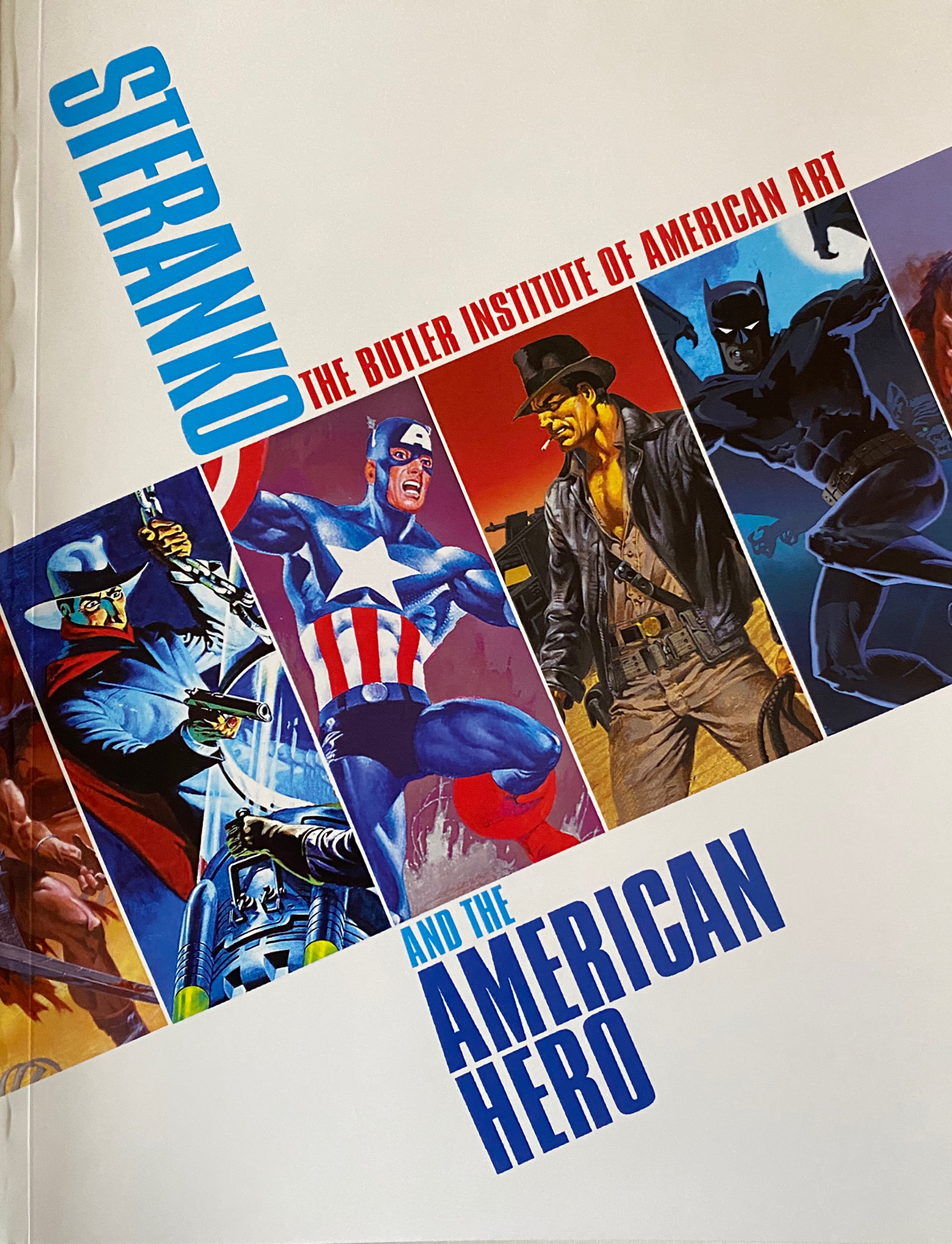

Artwork © Steranko

Referring to his artbook “Steranko and The American Hero”, published as a companion piece to his exhibition by the Butler Institute of American Art, we then had a pretty wide-ranging conversation about his approach to art. He opined that artists were either intuitive or analytical. He put Kirby in the intuitive category - someone who drew from his imagination without initial regard to composition - whereas Steranko saw himself on the analytical side, thinking through the placement of elements in a  picture, very much influenced by his advertising discipline.  One example of Kirby’s approach was a sketch of Captain America where Kirby started by drawing Cap’s belt buckle, and then expanding the image out from the centre.


We discussed Steranko’s work on Chandler, as well as his cover design for the Philip Marlowe graphic novel collection.


We also discussed his Shadow paperback covers commissioned for Jove/Pyramid back in the 1970s, and the degree of freedom that he had on overall design. There were no unpublished covers in that series - he always worked on commission. All fascinating stuff.


Mr Steranko  is still working today, most currently on conceptual art for Francis Ford Coppola’s upcoming film Megalopolis (currently in production), continuing a strand of conceptual artwork creation which encompassed Raiders of the Lost Ark, Blade Runner and Coppola’s Dracula.


My final question was about his famous work “Steranko’s History of Comics’, which was published as two volumes of an anticipated six-volume series. Steranko told me that in fact  he had envisioned a four-volume set. He said that he had completed much of the content for Volume 3, but whether it would ever be published was an open question.


I would have liked a photo of Mr Steranko, but he declined as it had been a policy of “no photos” that he’d had to adopt. I made do with his personalized signature in my copy of Steranko and The American Hero”. It was a great pleasure to meet the gentleman ; he is truly a force of nature and remains an outstanding talent. 


And now one of the last men standing from the Bronze Age.


Text © Ian Baker.


All images used are copyright their respective owners and are included here under the context of  Fair Use for the purposes of illustration


Thursday, March 23, 2023

Play it Again, Stan


© Marvel.

I think it's pretty unusual for a comic to publish the same tale, but drawn by different artists. But when it does happen, it does bring into focus how much impact the choice of artist has on the tale. Most recently, Kid over at kidr77.blogspot highlighted a tale of premature burial that appeared both in a Marvel and DC comic, one drawn by Jack Kirby and another by Wayne Howard. Head on over and take a look..it’s worth your time.  In that particular case eighteen years had elapsed between the publishing of the two tales.

In the case of the classic Superman run of “Kryptonite Nevermore”, the story of Kryptonite turning to lead in the early 1970s was returned to twice , each time adding a new perspective. Denny O’Neil wrote the first tale, drawn by Swanderson ; then it was featured in a 1992 Superman Special drawn by Walt Simonson, and finally revisited in the Adventures of Superman in 2001.  So thirty years spanning those tellings. Again, Kid has the details.


But in the case of 1970 Marvel horror anthology title Chamber of Darkness, a mere 6 months had elapsed before the same story received both a new writer and new artist treatment.


Each rendition of the tale was only six pages long:  An airforce pilot crashes , bails out, but eventually realizes that he died and a man who walks through walls turns up to take him into the beyond. 


In the June 1970 edition of Chamber of Darkness #5 (Jack Kirby wrote and drew the tale with inks by John Verpoorten)  a pilot flying a U-2 plane crashes over Red China - eludes capture - and finds his way to a monastery when a mysterious stranger meets him to take him to the hereafter, as they both walk as ghosts through walls.


Six months later in Chamber of Darkness #8, Bill Everett (Script and Inks) and Dan Adkins (pencils) have the pilot flying over Cold War Russia, only to bail out, and find his way to Moscow, only to meet a stranger who meets him, tells him he already died, accompanying him through a wall to the great beyond.


© Marvel. Splash page to the Kirby Story

I much prefer the Kirby rendition - a great splash page, beginning the tale in the aftermath of the crash, an exciting chase scene, and spooky ending. And it merits the Kirby cover. Verpoorten’s inks are very pleasing.


The artwork in the Adkins/Everett rendition is superb, and the inked artwork that sold on Heritage Auctions a while back is stunning, but somehow the lack of tension and horror leaves a rather pedestrian feel to the whole thing.


A comparison of the final panels from the two comics is shown below.


© Marvel.  Jack Kirby's final panels of the tale

© Marvel. Dan Adkins and Bill Everett wrap up the story
There is no editorial comment as to why the story was re-done, but I suspect that Chamber of Darkness #8 needed 6 pages of story to be sandwiched between Ditko and Don Heck reprints and this was an easy way out. At least the heading on the Everett/Adkins story highlights that it is an alternative version.


If you’re thinking of picking up an issue, #5 is the one to go for.  It also features a new tale by Denny O’Neil and Paul Reinman - “The Beast From The Bog!” - which is worth picking up for the title alone!


The cover for issue #8 is a Berni Wrighton rendition.


© Ian Baker

Sunday, March 19, 2023

The demise UK Comic Fandom began in 1979

© WB animation. With apologies to Warner Brothers.

by Ian Baker

The spark for the first era of UK comic fandom was kindled in October 1959 and was snuffed out twenty years later in 1979. 

Without American comics importer Thorpe & Porter, UK comic fandom would never had existed. Of course, comic collecting in the UK continued past 1979, but the advent of the Direct Market signaled the death knell for the new UK comic reader, the impressionable 12-year old who could go into a newsagent and pick something off the spinner rack for no more than 10p.


Some UK price variants were still available after the demise of T&P, but these were then only available in W H Smith or through the very few Direct Market comic shops - a reduction in retail availability from 88 corner newsagents to 3 WH Smiths in Portsmouth alone. 


The days of mass, cheap American comic book availability had passed, and with it the chance of a casual buyer being attracted by a comic seen hanging on a peg, or stuffed into the lower rungs of a spinner rack. The spinner racks disappeared, along with the salacious men's magazines at the top and comics at the bottom.


Thorpe & Porter defined the era ; In January 1979 there were 23 titles published by DC ; most of those titles disappeared from newsstands in the UK, and with it the feeder system for new readers. 


The last T&P stamped comic was the Superboy & The Legion of superheroes #240, June 1978   - a 60 cent comic priced at 25p. (As documented by “Get Marwood & I” on the excellent UK Price Variant thread on the CGC boards).    


© DC. The Last T&P-stamped import? Swiped from CGC thread.


The received wisdom in the comics industry at that time was that the average new comic reader of eleven years "aged out" at eighteen, with a complete readership turnover every seven years. 


At their height, T&P were importing one million comics per month, distributed to thousands of corner newsagents up and down the country.  Of the 88 newsagents alone in Portsmouth in the mid 70s, if we assume that each newsagent got 60 new comics each month - that would be 60x88 = around 5,000 new comics in Portsmouth each month for a population of 200,000,  of which say 2.5% were adolescent lads aged 10-14 (sorry girls). It follows that there were 5,000 lads of comic reading age in Pompey as a market for 5,000 DC comics. If you extrapolate that to the total country population in 1975 (56.2m), then we have 1.4m lads as a possible market for a million comics imported every month.


As a twelve-year-old going on thirteen in 1972, I knew nothing of comic fandom, unaware of the work of Frank Dobson on Fantasy Trader, or the infrequent early UK comic marts since the late 1960s. My pals and I were islands with no fandom other than ourselves and a very few collectors at school. How big was that local community? Not big - or if it was big - we never knew because comic fans kept their heads down, keen to avoid the jeers of their classmates and the despair of their parents.


Things changed when I ordered Fantasy Unlimited from an ad in Exchange & Mart because it had a sales list, and discovered a whole community of fans, most of whom I was only ever to know as names on a page, yet somehow we regarded as members of an extended circle of friends.


So where were these fans - who were they - and what drove the growth of fandom in that decade of the 1970s?


Fantasy Unlimited


For the purposes of the definition of being a member of UK fandom I believe that one had to contribute to a mainline fanzine at least once.


I do believe that Fantasy Unlimited (later Comics Unlimited) was the one fanzine that most accurately reflected fan participation in the comic collecting hobby in the decade of the 1970s. Not withstanding the many other zines out there in this period, I believe that FU/CU is a reasonable barometer of the growth of UK comic fandom in that decade which ended with the termination of Thorpe & Porter. 


I’ve spent an inordinate amount to time reading and re-reading every issue to note down the names, locations (where known) and role of fans involved in the creation of the ‘zine’s content - whether it on production duties, article writing, letters published, requests in the “We Want Information” section, reviewers, etc.  I started first with Alan Austin’s first effort “Ad Adzine” #1 (April 1970), right through the title transitions to “Aftermath” and then to Fantasy Unlimited and later Comics Unlimited up until the final issue #53 (Feb 1983).


Over that 53 issue period, there were 483 unique contributors, of whom a core of twenty-two individuals were active participants over a period of five years or more. (Many of those names will be familiar to readers of this blog as still being active in UK fandom)


For those of you with a statistical bent, the Normal Distribution bell-curve below plots the average number of months of active participation in fandom, as characterized by writing to/writing for/being reviewed in Fantasy Unlimited. 


The average duration of involvement was 13 months, with 68% of participants (one Standard Deviation) being involved for up to 3 years; 95% of fans had ceased involvement after 5 years; 99% had stopped at the 6-and-a-half year point, and the remainder stayed around. This maps very closely to the comic industry's own beliefs in regular reader turnover every seven years.


Click the image to enbiggen.


© Ian Baker. Analysis of duration of fan involvement in FU/CU 1970-1979

If we examine the inflow of new fans making their very first contribution - getting their name in lights - it becomes clear that 1975 was a banner year for participation and fandom growth. We'll examine possible reasons for this further on.


If we plot the numbers of new participants cumulatively, the flattening of the curve of new fan involvement clearly co-incides with the cease of T&P distribution.


© Ian Baker for analysis. Click to enbiggen.

What is instructive is to see the growth curve of new contributors, with 1975 being the year when interest and active participation exploded, with 135 new fandom names added within the pages, but following the end of 1979, only 11 new names appeared over the following four years. Evidence that the demise of T&P’s business stopped the flow of new fans.


In the early 1970s, Alan Austin doubted if there were more than 200-300 serious American comic-book collectors in the UK. He had been printing 30 copies of his fanzine early in 1971, which had risen to 250 copies per issue by the end of 1972. This rose to 600 per month by the end of 1975, and by 1977 he was selling two thousand copies of Comics Unlimited per month of which almost a quarter of the readership had actively contributed to the ‘zine in some form or another.


UK Comic Fandom was a community with a strong London base from the start. But by the end of the decade, there were strong communities which had developed in other major counties. A look at the chart for England below highlights where those clusters of fan were based.  Interestingly, there were some counties which never attracted a fan contribution in any form.


By the end of 1979, London & Middlesex was represented by 71 fans (plus a further 40 whose addresses were not published, but were most likely London-based), with a further 42 in the Home Counties. A further  30 were based in Yorkshire across the Ridings, with a further 22 in Lancashire, 10 in Cheshire and 10 in Nottinghamshire.  The remainder were spread across the remaining counties.  


My own county, Hampshire, fielded 10 active contributors, lead by the irrepressible Allan J Palmer in Basingstoke with thirty contributions over a seven-year period , and with a creditable 10 entries from SuperStuff's own Nigel Brown. (Modesty prevents me from listing my own contributions). 


I’m inclined to believe that the fanbase was in direct proportion to the number of newsagents and a reflection of Thorpe & Porter’s distribution reach.


Here's the chart showing the active fanbase in England as recorded in Fantasy Unlimited as of 1979.


Map © Microsoft. Analysis of data by Ian Baker


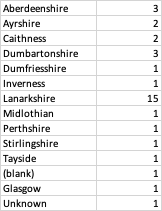
The picture for Scotland is better represented in a table (see below), where there developed a steady core of fans in Lanarkshire, mostly centered around Glasgow.


In Wales, 12 fans made a contribution over the years, of which 9 were in Glamorgan.


In Northern Ireland, 11 fans made their presence known, fairly well distributed, with the largest group of 4 based in Co Antrim.


I have no knowledge if these clusters of fans in certain counties made contact with each other. 


I am interested in what drove the explosive growth of UK comic fandom in 1975. Is it just an outlier, or were there other factors at play?  Or perhaps more interestingly, what caused the decline from 1976 onwards? The UK inflation rate in 1975 peaked at 24.24%, and declined only to 16.54% the following year. Comic prices had gone from 5p to 10p over this period, and the availability of colour Marvel comics had declined to avoid competition with the UK Marvel weeklies. Perhaps it was just a case that pocket money could not buy nearly so many comics, and supply issues were preventing new readers coming on board.


There’s a lot more analysis yet to be done on the data - for example, the types of questions raised in Alan Austin’s “We Want Information” column . What is clear is that in the early days questions focused on the Golden Age - that mythical time before 1959. As the years rolled by, questions were much more related to concerns of T&P distribution breaks and Non-Distributed issues of Marvel Comics. Fans were becoming educated consumers.


I don’t claim this to be an exhaustive analysis ; certainly a good read of other fanzines of the time will yield more names, but I do think the pages of FU/CU reflects the growth of UK comic fandom in its second decade.


Reading through the roll-call of names mentioned in the pages of FU/CU the names of various individuals who made the transition to the professional comics world jump out - John Bolton, Kev O'Neill, Grant Morrison, Dez Skinn, etc - along with others less well known. Other people found careers as musicians, lawyers, writers, designers, with quite a few names still to be found at London Marts today, both as dealers and punters.


If Mr J.C. Hill of Watford, Hertfordshire should be reading this, did you ever write your envisioned History of UK Comics Fandom?


UK Comic Fandom today


So how big is UK comic fandom today - if we accept that it was perhaps a couple of thousand with a core of almost 500 active participants back in the late 70s?


Is UK comics fandom just a bunch of men in their sixties and seventies trying to rekindle those days of the 1970s when anything seemed possible? Does comics fandom for the latest comics even exist? Where does an intelligent discussion of new comics today take place? Certainly not on the Social Networks I frequent. 


As of a few months ago, these Facebook groups targeted at a UK audience recorded the following membership: 


  • 936 members of London Loves Comics
  • 288 in Fanscene 
  • 4,200 in Marvel UK comics
  • The Comic Book Group UK.  1,600
  • Comics Buy and Sell UK.  4,000
  • Comic Books for Sale UK.  19,000 members


Perhaps there is a substantial following today, but once you weed out the Silver Age and Bronze Age fans, and the professional sellers, the Cosplay fans, the MCU an DCEU movie fanbase, does that core set of fans of the printed page exist?


Comments welcome.


© Ian Baker, 2023

Wednesday, March 1, 2023

"Say It Ain't So, Irv!!" - Even the Best can swipe

 by Ian Baker

©DC. Page 1 of Batman #226

I became quite a fan of Irv Novick as he adopted his artwork style to emulate Neal Adams' rendition of Batman in the early 1970s, but I was stopped in my tracks recently when I realized that his splash page to Batman #226 "The Man With Ten Eyes" (Cover date Nov 1970) blatantly swiped from not one but two previous Adams renditions.

Take a look at the splash page above, and then compare first to the cover of Brave & Bold #79 (Cover dated Sept 1968) 

©DC. Brave & Bold #79

....and then this panel from page 4 of Detective #397 (Cover dated March 1970).

©DC. Panel from page 4, Detective Comics #397

Well, they say if you're going to copy, copy from the best. I decided to take a closer look at Irv's work on Batman in the period when he amended his style, to see if they yielded further swipes. I started to take a closer look.

Neal Adams' work on Brave & Bold #79-#86 had been nothing less than revolutionary in re-defining the Dark Knight. Over on the Batman comic, Frank Robbins and Irv Novick had been rendering a less campy Batman than previously presented during the rage of the Batman TV series. However, the fans, on seeing Adams' work, wanted that same level of depiction in the flagship Batman comic.

Irvick's first exploration of Adams' style was in introducing variety to panel design, as shown in Batman #209, where Irv adopts for the first time the angled panel layout so favoured by Adams in his first run on Brave & Bold (#79-#86).

©DC. Batman #209. Novick introduces angled panel design.

Through the next six comics, Novick experiments with more realistic facial expressions, going back to Adams as a reference. Here's a version of that grimace again in Batman #211...

©DC. Batman #211.

Batman #215 really marked a turning point in Novick's depiction of Batman, marked by the smallest of changes. He starts to adopt changing Batman's cowl design to include a little indentation on the cheekbone at the top of Batman's mask opening, the same way that Adams drew it.

Here's an example from the final page of Batman #215, showing Adams' influence:

©DC Batman #215. The nick on the cheekbone of the cowl. 

By Batman #216 (Cover dated November 1969), the style changes had been established, and Novick once again swipes Batman's grimace from the cover of Brave & Bold #79.

©DC. Page 2 of Batman #216.

I'm sure a bit of research will uncover other examples of Novick going back to Adams' work for "inspiration". I'll leave you with this panel from Batman #216....clearly Adams-inspired.

©DC. Batman #216 Page 18. An Adams-inspired pose