Monday, May 9, 2022

Windy City Pulp and Paper Convention - Con Report

It’s been thirteen years since I last attended the Windy City Pulp and Paper Convention, one of the premier cons in the US that focuses on pulps and related ephemera. It’s a big 3-day event held at the upmarket Westin hotel in Lombard, in the Chicago suburbs. Since it was a beautiful Spring day on Saturday (May7th 2022) I decided to head over to Lombard to see how the con had changed since I last attended in 2008.

© Ian Baker. The Westin, Yorktown Center, Lombard, IL.

I had paid $25 for a 1-day membership, which entitled me to attend the dealers rooms, the panel discussions, the films on show, and the painting gallery. A 3-day membership cost $35.


Upon arriving my welcome back contained a copy of Windy City Pulp Stories #21, an annual book published especially for the con by Black Dog books of Normal, Illinois. In addition to reprinting some rare pulp stories by Dashiell Hammett and Robert E Howard and others,it lead with a very interesting historical essay by Will Murray on the Fall and Rise of Fiction House, a prime mover in the transition of the sedate dime novel to the fast adventure stories of the pulps. The idea of this book, providing content and context to stimulate further interest in the hobby seems a very sound one to me, and could be transferred to the comic-con world as well.


© Black Dog Books, Normal, IL


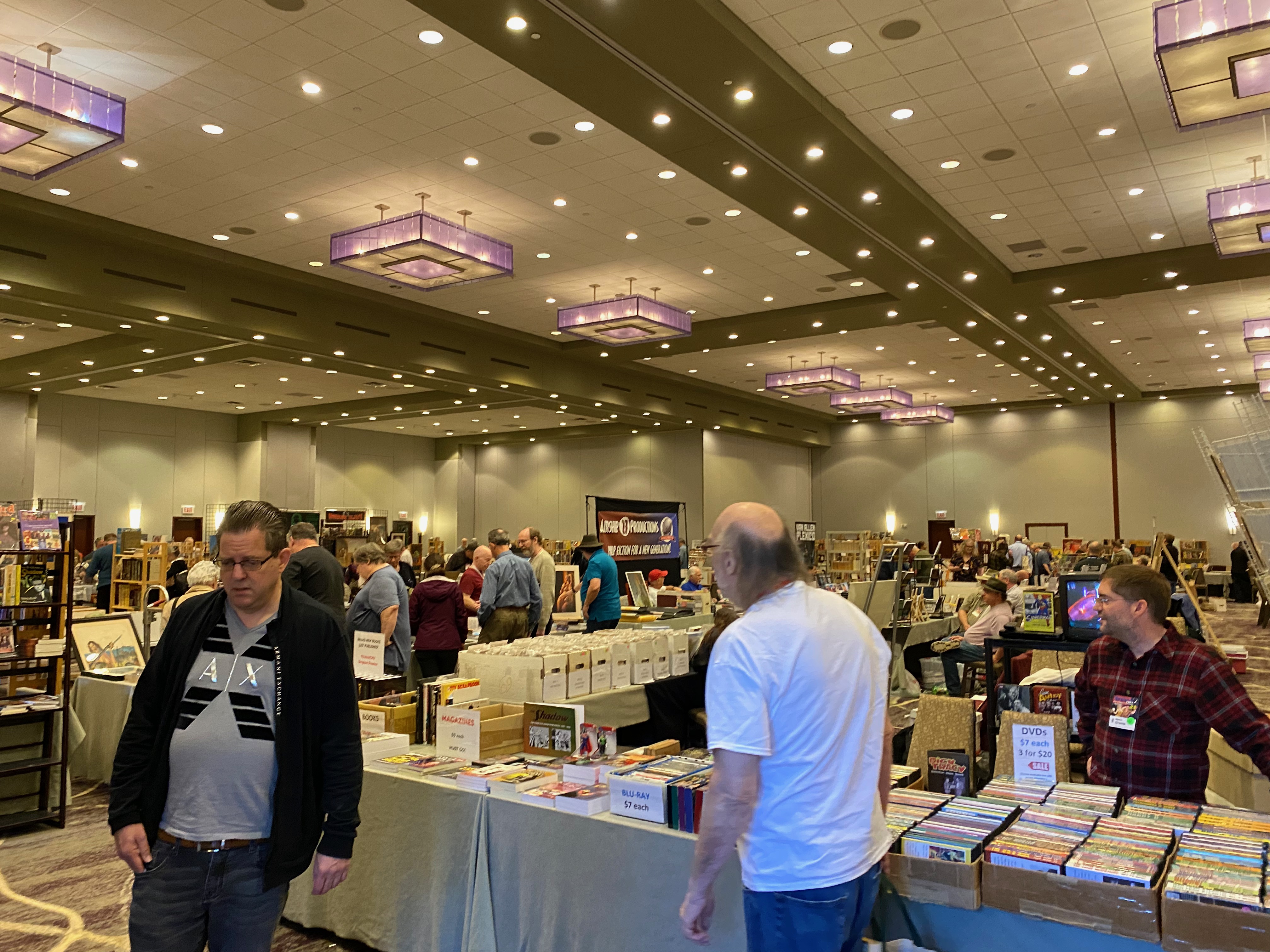
I spent a very enjoyable few hours wandering around the dealer tables. What struck me immediately about a Pulp con (as opposed to a Comic-Con) was the both the attendees and dealers are in general significantly older than their Comic-Con counterparts. These are people who probably first encountered pulps through the 1960s and 1970s reprints of Doc Savage, The Shadow, Conan, Tarzan and that stimulated their passion for those characters, which in turn made them seek out the original pulps.


© Ian Baker. Dealers Room.

Entering the main ballroom, at first glance it seems similar to a comic mart, but this time the long boxes are full of pulps in Mylar bags. Immaculate pulps are displayed on stands and it is quite a sight to see the bright painted covers of The Shadow by George or Jerome Dozen on display, along with the Spider and The Avenger, amongst others.


The Adventure House dealer's table.


Part of the Adventure House stand.


Of course, copies of Astounding Stories and other seminal SF pulps are also to be found alongside the more character-driven pulps.


In addition there were quite a selection of Golden Age comics from a few dealers, along with a good selection of DC and Marvel comics from the 1970s that featured comic adaptations of famous pulp characters (eg Ka-Zar, Conan, John Carter of Mars, Tarzan, etc) .


But it is not all pulps. Mass-market paperbacks from the 1960s and 1970s were also on sale - those cheap sci-fi and cheap-thrill paperbacks with frequently sleazy covers that really filled the vacuum left by the pulps after they died in the late 1940s.


A typical $2 box

I saw no price gouging at all. There were a few slabbed CGI-authenticated pulps but usually valuable stock was displayed in the usual Mylar bags, and available for inspection. Comics for sale were in the $3-$5 range. I saw good quality Doc Savage Bantam paperbacks for sale as low as $1 each. People were there to enjoy themselves and meet old friends.


I wound up having an enjoyable discussion with Will Murray (foremost authority on Doc Savage and the writer of a score of Doc Savage novels since the 1990s, writing under the original house name of Kenneth Robeson). Mr Murray is in process of arranging the publishing of a revised and updated version of his “Duende History of the Shadow”, a book I first bought back in 1979. I’ll be first in line to get the revised book. For anyone interested in the history of the pulps, I can particularly recommend three of Mr Murray’s non-fiction books - “Writings in Bronze” (essays on Doc Savage), “The Rise of The Shadow” (essays focusing on the background to the character and the original radio show), and “Wordslingers” (a history of the Western pulp, which I found fascinating).


I ended up buying a few old Avenger paperbacks for the re-acquisition nostalgia value, a couple of 1970s “Weird Heroes” anthologies by Byron Preiss, and two of the most recent Doc Savage novels by Will Murray. I returned home a happy man.


Part of my haul.

So, it was a very enjoyable morning and afternoon. I did not get the opportunity to return in the evening for the Saturday panel sessions (the son of artist Norman Saunders - famed for his Mars Attacks and Batman trading card paintings - was due to run a session), but I will be sure to return next year.


© Ian Baker

Tuesday, May 3, 2022

Three boys and three typewriters: the secret origin of SuperStuff

[Thanks to regular commenter McScotty for posing the question...."Was SuperStuff a real fanzine?" My good pal Nigel Brown, co-editor, co-founder of this blog, and regular columnist, took up the challenge of telling the SuperStuff story... ]

 by Nigel Brown

It was Ian Baker’s idea to do our own comics fanzine. I came up with the name SuperStuff, no doubt inspired by my favourite comic book character.

We’ve already described how it was, fifty years ago, when we hunted down American comics books all over Portsea Island (‘Mad DC Comic Hunt’ and ‘Comics Shops in Portsmouth (Upcoming blog entry)’). 

To set that time in context, that was just before Marvel decided to enter the UK comics market with their own comics (they had earlier allowed reprints in Fantastic, Terrific, Pow! Wham! and Smash! comics in the late 1960s).The Mighty World of Marvel # 1, a UK comic, arrived in September 1972. This was successful enough for them to follow it up early the next year, with the appearance of Spider-Man Comics Weekly #1 in February 1973. (I remember we were pretty scornful of these comics when they first appeared, comparing them to the full colour and up-to-date American originals that were still available in newsagents, and as back-issues in second-hand shops.)

A more epoch-defining event in the SuperStuff story occurred that following Easter, on April 22nd 1973, when Ian Baker received his first issue of Alan Austin’s Fantasy Unlimited #14, having seen an advert for it in Exchange & Mart.

I subscribed soon after, and together with Ian we began to send postal orders off for back-issue comics to ‘fill those gaps’ in our comic collections.

It took another year before we produced our own comics fanzine.

Shang-Chi swipe © Marvel. The rest © SuperStuff.

SuperStuff #1 debuted in May/June 1974 (with an optimistic March cover date). It was, frankly, the best imitation of Fantasy Unlimited that we could manage… but so what? We had tremendous fun doing it. If we could have only transferred a small part of our enthusiasm onto our schoolwork I’m certain our schoolteachers would have been impressed by our diligence and energy!

As Alan Austin has described himself in his book about his life in comics (Comics Unlimited: My life as a Comic Collector and Dealer ), a major problem with producing fanzines is the duplication required for any kind of wide circulation.

Alan himself eventually solved this problem by acquiring a second-hand Gestetner Roneo No.2 duplicator. We never got that far, using two pieces of carbon paper with our typewriters to produce three copies in total of our own fanzine. Three sheets of carbon paper rendered the last page too faint to be legible. (Ian recalls experimenting with four carbon papers, but he had to hit the keys on his old Remington typewriter so hard that his Dad would call upstairs: “Stop that racket!”)

After the debut of SuperStuff #1, we were away. A second issue followed shortly afterwards.

Although I was the ‘editor’ of the first issue, in truth it was a total joint effort. We would each type up our own pages, then put them all together to make up the fanzine.

Once SuperStuff was established, it became an outlet for our creative energies and we produced further issues down the years. Some I produced wholly by myself, others were typed out by Ian and our other comics-collecting friend, Geoff Cousins. A healthy rivalry developed between us, leading to greater efforts to produce bigger and better fanzines, although still with circulations of three!

At least we knew our readership.

The SuperStuff contents were a mixture of comic and science fiction paperback reviews, along with some original fiction and articles (many of which were swiped from sources as varied as other fanzines, the comics themselves and, as I recall, even The Radio Times). We did come up with the odd original article, or took what was there and rewrote much of it to fit in with our own opinions.

Ian remembers that the paper we used for SuperStuff originally came from school, so the most expensive outlay was the carbon paper and the photocopies (5p) for the covers, first done at the Portsmouth Main Post Office, then later in the Main Library by Portsmouth Guildhall.

Here’s what we produced; see the end of this blog entry for a selected list of the contents of each issue.

SuperStuff covers #1-#10. Characters © their respective publishers


I was pleased enough with SuperStuff #7 to send one of my precious copies to Alan Austin. He wrote back with a encouraging letter (that I published in the letter column of SuperStuff #9) but – more importantly – he asked if I had any material he could use for his own fanzine, by then named Comics Unlimited. I sent him a reworked article I’d written for my other fanzine Fantastic Voyages #2 (A Chronology of the Planet of the Apes), and he published it as the cover article in Comics Unlimited #36 (May 1976).

Planet of the Apes Chronology republished in Comics Unlimited #36


This was the second SuperStuff era-inspired article to see print in another fanzine. Previously, I’d had an article I’d written in SuperStuff # 1 (about Kirby’s 4th World) appear in the fanzine Eon #2 (May/July 1975).


EON #2 reprinted the Kirby 4th World article from SS #1

Geoff Cousins had a contribution published in one of Alan Austin’s fanzines, with a Silver Surfer illo in Fantasy Unlimited #27 (June 1975), and he also drew a Conan cover (unpublished) for Alan Austin's abandoned Sword & Sorcery issue of Comics Unlimited, which would have been #38.

Not that Ian Baker’s name was lacking in Fantasy Unlimited, either. He often contributed a wide range of interesting questions to the popular ‘We Want Information’ feature that Alan Austin ran.

Looking back, Ian notes now that we pretty much achieved our aim of producing a new SuperStuff every school holidays from March 1974 to May 1976, which covered eight issues.

1974 to 1976 was really the heyday of our fanzine-producing, but I decided to produce a SuperStuff swansong in 1984.

By then, I had access to Alan Austin’s own Gestetner 160 in the basement of his Islington shop, Heroes. He was generous with his time and patience and, along with his encouragement and advice, I managed to print enough copies of SuperStuff #11 (August 1984) to go on sale to the public.

We had begun SuperStuff as an imitation of Alan’s own Fantasy Unlimited fanzine, and now I determined to make this final SuperStuff a true tribute, printed on the same hallowed machine that had printed Fantasy Unlimited.

The main feature was an interview with Alan himself. I also was lucky enough to commission an original Baragrin strip for SuperStuff, generously provided by Patrick Marcel and Jean-Daniel Breque. SuperStuff #11 also featured articles by Ian Baker and others such as the leading Portsmouth Star Trek fan and founder of S.T.I.G. (Star Trek Information Group), Ross Carter.

© Nigel Brown. SuperStuff #11 - 1984

Alan Austin sold SuperStuff #11 in his shop Heroes, and Paul Hudson in Comics Showcase was also kind enough to allow a box of SuperStuff for sale on his shop counter in Covent Garden.

I can’t recall how many were sold, but an issue has turned up on eBay. If anyone still has a copy I’d advise them to hold onto it as one of the rarest genuine fanzines of that era!

That was intended to be the end of the SuperStuff story, but thanks to advances in technology since those days, SuperStuff has come alive again as the blog Superstuff73…  as much fun to produce, I admit, as those type-written carbon-copied fanzines of yesteryear.

©Nigel Brown


List of SuperStuff issues 1-10


SuperStuff # 1

March 1974 cover date (May/June 1974 interior date)

Nigel Brown editor. Nigel Brown, Ian Baker contents

This featured articles on Kirby’s 4th World, World’s Finest Comics, Marvel’s Shang-Chi and various comic indexes, ending on a page with our spare comics for sale.


SuperStuff #2

April 1974. Nigel Brown editor. Nigel Brown, Ian Baker contents

This featured a Neal Adams biography, along with articles on C.C.Beck, DC’s Plop!, Marvel’s Iron Fist, and a feature on the best Batman artists.


SuperStuff # 3

Summer 1974. Ian Baker editor. Ian Baker, Geoff Cousins contents

This issue was more TV orientated, with an interview with Burt Ward of the Batman TV series and a piece on Star Trek, alongside articles about Iron Man, Robert E. Howard and a biography of Walter Gibson. 


SuperStuff # 4

March/April 1975. Ian Baker editor. Nigel Brown, Ian Baker, Geoff Cousins contents

This had articles about the origins of some Marvel super-heroes, Kirby’s Forever People and an interview with Arthur C. Clarke. 


SuperStuff # 5

July/August 1975. Ian Baker editor

We featured Kirby’s O.M.A.C., Ditko’s The Creeper, the best way to store comics, and an index of the first Bantam paperbacks reprinting Doc Savage pulps.


SuperStuff # 6 (incorporating Nigel’s separate fanzine Fantastic Voyages # 3)

April 1976. Ian Baker & Nigel Brown editors & contents

This issue continued the Bantam Doc Savage paperback index, a retyping of a Batman TV series script, as well as an article about The Spectre.


SuperStuff # 7

April 1976. Nigel Brown editor & contents. 

This was a Superman Special, featuring articles about the Golden Age Superman, a comprehensive origin of Krypton and Superman, as well as the second part of The Spectre article.


SuperStuff # 8

May/June 1976. Ian Baker & Geoff Cousins editors & some contents

This issue featured the changing images of women in comic books, along with articles about Red Sonja, the origin of The Batman, and the Alan Dean Foster Star Trek paperbacks.


SuperStuff # 9

July 1978. Nigel Brown editor & contents.

This featured articles about comic back-issue prices, the new super-hero TV series (one starring Wonder Woman, the other The Hulk), and an index of SuperStuff issues 1 to 8, 

SuperStuff # 10

July 1980. Nigel Brown editor & contents

This slimmer issue featured comic and book reviews.


We also produced our own fanzines separately, towards the end of 1975:


Fantastic Voyages #1

August 1975. Nigel Brown editor.

Similar mix of contents to SuperStuff, with opinion column, comic information feature and comic quiz.


Fantastic Voyages # 2

Autumn 1975. Nigel Brown editor

Similar mix of contents to SuperStuff, with a Planet of the Apes chronology, Denny O’Neil interview.


The Light of Other Days #1

Autumn 1975. Ian Baker editor

An intended mix of Science Fiction paperback reviews and discussions of Black & White SF comics. This never got beyond the "ashcan" stage.


The Light of Other Days and Other Worlds

Winter 1975. Geoff Cousins editor


Amazing Science Fiction Stories # 1

April 1976. Nigel Brown editor & contents

Science fiction.


SuperStuff Special #1

September 1979. Ian Baker editor & contents. 

An original Shadow story.


Friday, April 29, 2022

Meeting Neal Adams

 [With the sad news today of Neal Adams’ passing at age 80, I thought I’d post this piece I’ve been holding back for a while.  baggsey (Ian)]

© Forbidden Planet. Neal Adams at Forbidden Planet 16th June 1979

My good chum Nigel Brown tells me that we first met Neal Adams in Forbidden Planet at their old premises in Denmark Street, London on June 16th 1979 at a signing that Neal Adams was doing to promote a Ms Mystic art portfolio. Nigel reminds me that we had to queue around the block to get in. My mate Geoff Cousins tells me the same thing ; that he has a note in his pocket diary from those days that we headed to London on June 16th 1979 and met the great man himself. Nigel relates how Neal signed one of his comics.

I have no strong memory of any of this. Well, perhaps an inkling of remembrance of the queue outside the shop. I have no idea why. Okay - at that time I was approaching twenty and my interest in comics had waned considerably, and I was getting into pulps and private detective fiction, but surely I would remember meeting Neal Adams?  Surely I got something signed by him? But I have only the vaguest memory of it, and even the photo that Forbidden Planet published in their 40th anniversary magazine (reproduced above)  does not trigger a strong memory.

So it was 30 years later, on the evening of Friday Oct 16th, 2009 that I came across an ad that the New York Comic Con was being held at the Jacob Javits Center in NYC over the next 2 days (I’d already missed opening day ), and on a whim I resolved to head to New York City the following Saturday morning on the off-chance that  I could meet my teenage idol Neal Adams. I’d heard that he was working on a new Batman comic in collaboration with Frank Miller (which would eventually be Batman Odyssey (sans Miller)), and thought that this might be my one chance to meet the guy. 

American Airlines had a promotion for return tickets from Chicago to New York for $69 return from O’Hare to La Guardia, so I took the plunge. I could get up early, drive to the airport, get a 6:30am flight, head to the con, have lunch, and be back home that evening. I mentioned my intentions to both sons (aged 17 and 15 at the time) and they voiced their desire to accompany their middle aged Dad (presumably to stop me getting lost).

So the following morning at quarter past 10am all three of us, having landed in New York, found ourselves  in a taxi traveling past Long Island City and by 11:25am, I was shaking hands with the great man himself.

It happened this way.

When we got to the con, the doors had already opened, and as we entered the complex we were confronted by crowds of people in cosplay milling around. There were multiple Rorschachs (remember this was the year of Zack Snyder’s Watchmen).

Almost immediately I was button-holed by a number of art dealers who pressed their business cards on me (presumably assuming I was in the business). Although the NYCC is probably still the largest comic con on the East Coast (and probably has the largest number of well-known dealers) it is increasingly dominated by individuals in costume who have trouble discerning the line between reality and fantasy. This makes for an uneasy mix of professional artists and writers, long-time dealers and hordes of people for whom the Marvel and DC films dominate their waking hours (but have little interest in the comics themselves).

Anyway, having spent a while looking at original art on display behind glass display cases, we headed further into the arena along celebrity row, where actors of cult TV shows had individual booths.

We passed David Hedison of “Voyage To the Bottom of the Sea” fame in his own booth standing next to a model of the Nautlius on display. I didn’t ask if he’d made it himself.

Jackson Bostwick (Captain Marvel from the 1977 “Shazam!” TV series) looked lonely and depressed in his booth, with no-one stopping by. It probably didn’t help that he was lounging back on an orange plastic chair with his feet propped on the low fence at the front of the booth.

Lou Ferrigno (The Incredible Hulk) was grinning, flexing his biceps, and posing with fans for photographs. Seemed a very approachable guy.

Silver haired, sharp-suited Jim Steranko was being interviewed in the main lobby by Mickey Dolenz of Monkees fame (wearing Pork-Pie hat) for a news segment.

Adam West, Julie Newmar and Adam West’s son were setting up their table getting ready for punters to pay $50 a time ("cash only please") for a photo with Mr West. [I cannot fault this approach, as both actors and comic artists rarely have Pension plans].

But we pushed further on into the hall, first past one of the many George Barris-designed  Batmobiles, then past a table where Joe Kubert had a number of fans clustering around , and then further back to the Neal Adams table, where there he was. Surrounded by his books and artwork, and no-one, NO ONE, else around. He seemed glad at the prospect of someone to talk to.

What a great conversationalist! Full of energy and ideas. He was interested in why a Brit was there on a Saturday morning? Had I flown from the UK? What did my lads think of their dear old Dad being there? We got talking. I told him what an impact the splash page of Batman #234 (Half an Evil) had had on me as a 12-year old, how it had cemented me as a Batman fan and set me off on a lifetime of comic collecting. He told me some of his future ideas for Batman Odyssey - bringing in Deadman, having Deadman inhibit the Joker’s body in the Batcave ; the attraction of straightening out long-time continuity issues in the Batman canon.

That’s when Mr Adams asked me if I’d like to get a view of the artwork he was working on for Batman Odyssey, and invited me to come behind the table and sit down further to continue our chat. He then produced his art portfolio from under the table - basically a folder comprised of two bits of hinged hardboard, sandwiched between which were all the pages he’d drawn so far for Batman Odyssey #1. Some were still pencils ; others were partially inked. He let me read them all and asked for my opinion.

You can see the smile on my face in the photo below. 

© Ian Baker. baggsey and Neal Adams, 2009

Mr Adams then mentioned that he had to head over to participate in a panel with Joe Kubert discussing their work during the Bronze Age, and would I like to sit in on it? 

So we traipsed over to a break-out conference room and my sons & I spent a couple of hours first sitting in an audience of about 40 people asking Neal and Joe questions about the genesis of many of the Green Lantern/Green Arrow and Sgt Rock comics, and then Joe Kubert conducted an impromptu art class, developing a comic page in real time with input from the audience. Andy Kubert teamed with his Dad in the art workshop. Considering the hundreds, perhaps thousands, of fans at the Center that day, I despaired that so few were motivated to attend these sessions by the masters of the Bronze Age.

After the panel and class wrapped, my sons and I grabbed a hamburger and then caught a taxi back to La Guardia and on to home.

As we left the Jacob Javits Center my last memory is of the long Adam West table with his son managing the queue of fans, holding a fistful of tens and twenties as he collected the funds before shepherding fans alongside the trestle table to meet his Dad and Julie Newmar.

I’d turned 50 that year and meeting Neal Adams in person was quite a transformative event for me. It re-ignited my enthusiasm not only for comics, but also for my day job - reminded me that anything was possible as long as I got on my hind legs and made it happen. I remembered how back in 1971 I’d pored over Brave & Bold #93 - the Batman….and the House of Mystery team-up issue “Red Water, Crimson Death” issue - and seen the drawing of one of my heroes in the ACBA ad -  Neal Adams - and could never have imagined that one day I would meet the man who had made Batman real to me fifty years ago.


Thursday, April 28, 2022

H G Wells and War of the Worlds

[I started writing this before I’d read McScotty’s blog entry about Amazing Adventures #18 over at his blog  which is well worth a visit].

© Marvel


H.G. Wells - © Public Domain

My home town of Portsmouth and its seaside resort Southsea has many historical heroes with links to the Bronze Age of comics, of which famed SF & Fantasy writer and visionary Herbert George Wells is but one.

It is hard to imagine if HG Wells, while working in a Draper’s Bazaar in Elm Grove, could have foreseen that one day he would be teaming up posthumously with Stan Lee and Don McGregor on Amazing Adventures #22, wherein Killraven battles the Human Squid, but I’m sure that he would have found the Marvel adaptation “inspired” by his War of the Worlds in tune with many of the ideas of his vast portfolio of SF creations.

Wells’ connection to Southsea stems from the time between 1880 and 1883, when he had an unhappy apprenticeship as a draper at Hyde's Drapery Emporium in Southsea. His experiences at Hyde's, where he worked a thirteen-hour day and slept in a dormitory with other apprentices, later inspired his novels The Wheels of Chance, The History of Mr Polly, and most appositely Kipps, which portray the life of a draper's apprentice as well as providing a critique of society's distribution of wealth.

It was soon after leaving Southsea for Woking in Surrey that Wells enjoyed his most creatively fertile period, when  he planned and wrote The War of the Worlds and The Time Machine and completed The Island of Doctor Moreau, (all of which would inspire later Marvel comics adaptations).

Slightly more than a generation later, in the United States in April 1926, famed editor Hugo Gernsback would reprint much of Wells's work in the pulp magazine Amazing Stories, regarding Wells's work as "texts of central importance to the self-conscious new genre".

And so a further generation after the pulp Amazing Stories, it was fitting that Wells’ work was featured in Marvel’s own Amazing Adventures comic in the guise of Killraven - freedom fighter Jonathan Raven - depicted in several post-apocalyptic alternate futures. Created by co-plotters Roy Thomas and Neal Adams, under the auspices of scriptwriter Gerry Conway and initially penciller Adams himself, the character first appeared in Amazing Adventures vol. 2, #18 (Cover-dated May 1973) .

© Marvel

The cover was very clear on the basis of the source material “Amazing Adventures featuring “WAR OF THE WORLDS” based on concepts related in the prophetic novel by H G Wells!” .

Co-creator Neal Adams' early ideas for Killraven involved the character being the son of a Doc Savage archetype. (Ref: Comic Artist #3). This concept had been reworked by the first issue in which co-creator Adams penciled only the first 11 pages with Howard Chaykin completing the remaining nine. The second issue was fully written by the debut's scripter, Gerry Conway, followed in the third by Marv Wolfman.

On the alternate-future Earth designated Earth-691 by Marvel Comics, the Martians from H. G. Wells' The War of the Worlds return in 2001 for another attempt at conquering the planet. With humanity enslaved, the men forced to battle gladiator-style for the Martians' amusement, Jonathan Raven (dubbed Killraven as his gladiatorial nom de guerre), escapes to join the Freemen, a group of freedom fighters .

As the series progressed, the link to Wells’ original vision became more and more tenuous, as reflected in the constantly changing book’s title across 22 issues (Amazing Adventures #18-#39 inclusive).


#18 "Amazing Adventures featuring “WAR OF THE WORLDS” based on concepts related in the prophetic novel by H G Wells"

#19 (Note “Prophetic” was dropped) "Amazing Adventures featuring “WAR OF THE WORLDS” based on concepts related in the  novel by H G Wells"

#20-#27( New tagline “The Most Widely Acclaimed Science Fiction Series Ever!”) "Amazing Adventures featuring “WAR OF THE WORLDS” based on concepts related in the  novel by H G Wells"

#28 (All reference to H.G. Wells dropped from the cover) "Amazing Adventures featuring “WAR OF THE WORLDS” - featuring Killraven!"

#29-#34 (rebranded - and H.G. still gets the boot!) "Killraven…WARRIOR OF THE WORLDS”

#35-#39 "War of the Worlds"

While the series was running, Marvel UK had developed a headache over content for their Planet of the Apes weekly, as they were running out of US Planet of the Apes content to reprint.  They hit upon the idea of repurposing Killraven as “Apeslayer” for the UK Planet of the Apes fan base as an emergency measure. The US Killraven stories were partially redrawn and re-lettered to create a new story that would fit into the Marvel version of the Planet of the Apes continuity. (Fun Fact: technically Apeslayer is the first ever Marvel UK-originated character).

Apparently, the UK team felt that Apeslayer, by way of Killraven, was so far removed from the original source material that H G Wells did not require a credit in the UK P.O.T.A. weekly. In fact, the credits for “The Birth of Apeslayer” do not even mention Neal Adams himself as either co-creator or contributing artist despite integrating artwork by the great man himself


© Marvel - enbiggen this to read !! Comparison of Killraven and Apeslayer

As H.G. Wells’ books were still within UK copyright at the time, rebranding Killraven as Apeslayer in the UK, and removing any reference to H G Wells on the US comic covers, may have been a move to avoid any legal issues.

The UK Apeslayer adaptations appeared in just 8 issues of Planet of the Apes weekly (#23-#30) , running from March 29th 1975 to May 17th 1975.

What was strange is that Marvel did not choose to stop distribution of the US Amazing Adventures in the UK during this period, which would have been the May-September 1975 cover issues (#30-#32),  but they had previously stopped the distribution of US issues #23-#25 a year earlier in 1974, with those issues not being available in UK price-variant guise.

Amazing Adventures was eventually cancelled with issue #39. I don’t believe that I owned all of the issues. I certainly collected issues #18 and #19 in 1973 (bought from Simpsons in Osborne Rd), and was again buying later issues in April 1976 from See's newsagents in Copnor, but it was not a regular purchase by that time. The overlap with Planet of the Apes weekly had caused me to put the US Amazing Adventures comic far down the list of US Marvels to buy each month. 

Marvel tried some innovative pricing approaches with their UK price variants; issues #18-#22 were 8p each ; following the “non-distributed” hiatus of issues #23-#25, issue #26 was priced at 7p, before returning to 8p pricing with the next issue. In that time of rampant inflation, the price quickly rose from 9p to 10p, and became too rich for my blood. However, if HG Wells had miraculously survived into the 1970s, I suspect he would have sought out and enjoyed every issue.

Killraven would later resurface in his original incarnation in the UK Star Wars Weekly a few years later.When Marvel UK eventually began reprinting the original Killraven series in Star Wars Weekly, one reader complained that they had 're-drawn Apeslayer, with Martians'.


Thursday, April 7, 2022

A week in Ventnor - July 1972

Sometimes comic memories stick in the mind because they’re linked to seminal events in your life.

In the summer of 1972 I had just turned 13, and so I was allowed to go on my first holiday on my own, to Ventnor on the south side of the Isle of Wight to stay with my Aunt and Uncle for a week.


I went with high hopes of getting more comics at Mr Keen’s antiquarian bookshop in Pier Street, Ventnor. Earlier that year  on a holiday with my Mum and Dad - at Easter -  I had hit the jackpot with scoring a pile of comics in Mr Keen’s antiquarian bookshop in Ventnor at 2p each, including a run of most of Detective 390-412- which included those classic Denny O’Neil/Neal Adams Man-Bat stories plus the Enemy Ace crossover. (For those you wishing to take a look at Google street view , the address is 19 Pier Street, Ventnor. Mr Keen is long gone, of course, owning the shop from 1972-1981.)


Each day that week  in July I would walk down from Upper Ventnor to the town centre in the hopes of finding new comics in John Menzies or at one of the seafront gift shops.


Even though it was Summer, I felt compelled to wear my over-sized army-surplus combat jacket which had come from Ben Grubbs, a store in Portsmouth. I felt it lent me an air of rugged individuality.


My Aunt and Uncle’s daughter, my cousin, who was four years older than me at seventeen, welcomed me to tag along with her, her boyfriend and their friends. Her boyfriend (“call me Zak”) was an amiable bearded long-haired groovy guy with a penchant for check jackets with wide lapels.  I felt honored to be allowed to hang out with them (no doubt at the behest of my aunt).


The Regal, Shanklin, 1972


The week kicked off on a Sunday night with a trip to Shanklin to see Diamonds are Forever at the Regal cinema in Shanklin. We went in a van driven by a friend of my cousin. I think there were five of us siting on a mattress on the floor in the back, as we rattled around inside the rear of the van. (I have an inkling that the driver - a curly-haired, more conventional, friendly guy inclined to a rosy complexion - had a crush on my cousin.)


What a film! This was my first exposure to Sean Connery as Bond (having previously seen OHMSS in 1969), and the early scene where he is trapped in a coffin inside a crematorium incinerator sticks in my mind. I also took notice of the film poster (by the great Robert McGinnis), realizing how the common motif of Bond with his arms folded had become connecting tissue across all the Bond film posters.


As I went to bed that night at my Aunt’s house (I was staying in the room vacated by my cousin’s older brother who was away) I became aware that a paperback book had fallen on the floor from where it had been tucked under the mattress. It was a bit of an eye-opener for. 13-year old.


That book was The Perfumed Garden (Panther Edition,1966), a translation of an ancient Indian sex manual by Sir Richard Burton, famed Arabist, polymath and explorer. I would a few years later re-encounter Sir Richard Burton as the fictional protagonist in Philip Jose Farmer’s book To Your Scattered Bodies Go. Well, those Indians knew a thing or two about human gymnastics that wouldn’t end up an an Olympic sport , and I reflected that learning a different language at school may have had applications I had not previously appreciated. 


The Silvermere Cafe gift shop where I found Detective #355

The next day I decided to walk down to the seafront, and on the spinner rack of a gift shop I found an excellent condition copy of Detective #355  (“Hate of the Hooded Hangman”).What a find! Six years after publication and not a crease! It felt almost as good as if I’d found Detective #27! I can remember the crispness of it now (presumably sun-baked over the previous 6 summers, even though there was no evidence of direct sunlight fading)


The Rex Cinema, Ventnor

As the week was coming to a close, hormones raging, I persuaded my Aunt to take me to see Up The Front at the Rex Cinema on Thursday. I was a great fan of the Carry On films at this time, and figured that this would probably be a bit risqué, with Frankie Howard ably supported by the ample charms of Madeline Smith. I was not disappointed, although I think that my Aunt had some misgivings that she was culpable in exposing her nephew to something so salacious (well it was “A” rated).


So at the end of the week I returned home with the experience of having moved in a maturer circles of friends, had some education that garden swings had more uses that previously envisaged, had seen an exciting Bond film with a fantastic poster by Robert McGinnis, had seen Madeline Smith in fine form on the silver screen, and had an immaculate copy of Detective #355 safely stored in my haversack.


Shanklin - the Isle of Wight ferry


As I crossed the Solent back to Portsmouth on the Isle of Wight ferry "Shanklin", waiting for me back in Pompey was the prospect of the new DCs hitting the spinner rack on the following Thursday.


What a summer! Golden Days indeed.

Wednesday, January 26, 2022

Belfast, Thor and growing up in the Sixties

Over the weekend I watched the most wonderful film “Belfast” , Kenneth Branagh’s autobiographically-inspired film of growing up in Belfast in 1969. For any of us British schoolboys born around the start of the sixties, the film will touch on a lot of memories and emotions of a time that has suddenly disappeared. 

All the actors are at the top of their game, and the young Jude Hill as “Buddy” is a revelation. I shelled out $19.99 to watch it with the family on Amazon Prime and it was well worth it. The attention to period detail in the film is immaculate, and for those of you with an abiding affection for Star Trek, Thunderbirds, Corgi and Matchbox toys, the enjoyment is that much the greater. 

Those of you with eagle eyes will spot young Buddy reading a Thor comic (#139 – “To Die Like A God”) and if you zoom in, you’ll even see that Buddy is reading the 10d UK “price variant” edition. (A two-year old comic at the time the film is set). A nice nod to Branagh’s subsequent desire to direct the first Thor movie. 

Great stuff! Go and see the film, or stream it. You’ll thank me.
© Universal/Focus Features. "Buddy" (Jude Hill) reading Thor #139

© Marvel Comics.


Saturday, January 15, 2022

Where were you in ’72? Remembering when comics were “relevant”

 Do you remember when comics were “relevant”? 

Any discussion of social relevance in comics always lights upon the topics of skin color and social deprivation highlighted in Green Lantern/Green Arrow #76, or mentions Speedy’s drug addiction as shown in Green Lantern/Green Arrow #85 and #86. While it is true that those stories can be regarded as the high water mark for DC comic books connecting with real-world issues,  they also marked the start of a decline to a blander and less challenging approach to packaging superhero material that continues to this day. 

Green Lantern #76. © DC Comics 1970

When New York mayor John Lindsey praised the “no-holds barred” approach to highlighting drug abuse depicted in Green Lantern/Green Arrow in 1972, DC had been quietly bringing “relevance” into DC comics for the past 4 years since 1968, reflecting a growing desire by a small cadre of young writers at DC to tackle the most pressing social injustices in a way accessible to a college youth disaffected and worried about going to Viet-Nam.

Over a period of five years, thirty-eight DC comics tacked the problems of the day head-on, and a further forty-plus comic stories, while less confrontational, quietly reflected the current mores within the United States ; the changing attitudes to Women’s roles in the pages of Wonder Woman and Lois Lane ;  Bat Lash humourously bringing the modern hippie counter-culture to the Old West, and Tomahawk highlighting contemporary Native American concerns through the lens of Hawk, Son of Tomahawk. In addition, Mike Friedrich’s authorship of the Robin back-up stories first in Detective Comics and then subsequently in Batman brought a modern perspective to college life.

Looking back from a vantage of fifty years, I think that DC did a great job of educating me on social issues as a 12-year old. I was not an avid reader of UK-produced comics and I doubt that if I’d been a collector of solely UK comics that I would have been exposed (either consciously or sub-consciously) to the evils of political corruption or environmental concerns at such a tender age.

From 1968 to 1973, stories of relevance snaked their way through many popular DC titles, although I think it is fair to say that if you were not a fan of Justice League of America or Green Lantern/Green Arrow, the themes may have passed you by.

1968 - DC dips its toe in the water of social relevance

The start of "relevance" at DC. Wonder Woman #178. © DC Comics

It can be argued that the ascendance of “relevance” marked the start of the comics Bronze Age. Certainly, the first flag planted in the ground for “relevance” in comics was the September 1968 issue of Wonder Woman #178 “Wonder Woman’s Rival” , under the shepherding of twenty-nine year-old Denny O’Neil. Denny wrote a story in which Wonder Woman re-assesses her life and motivations, in the process relinquishing her costume in the quest to become a liberated woman.  These early "New" Wonder Woman stories did not overtly push the Women’s Lib agenda. In fact, many of the stories still revolved around Diana Prince trying to hold on to Steve Trevor as a romantic beau, but the fact that DC’s most famous female superhero was embracing the new social sensibilities sent a major message to the audience. Young Denny O’Neil was quietly crafting some major changes, first under the editorship of old DC hand Jack Miller, and then subsequently under artist-turned-editor Mike Sekowsky.

Reader reaction on the letters page of Wonder Woman #181 was overwhelmingly positive, and included praise from a certain Mark Evanier. Relevance was off to the races!

Denny O’Neil was already a known advocate for the peace movement and women’s rights when he joined DC. In a later interview with Gary Groth of The Comics Journal he said “It was part of my agreement with DC that I will not be asked to write a story glorifying war because I don’t believe that war is ever a good thing and I would not feel comfortable with a military hero. I also don’t like to write romance stories. I did Millie way back when. That’s a skeleton in my closet, though. I think the way those stories are handled demeans what happens between a man and a woman.”

The following month in October 1968, Bat Lash #1 hit the stands (again written by Denny O’Neil, this time abetted on plot by Sergio Aragones,  drawn by the incomparable Nick Cardy) which introduced a counter-culture Western hero – an amoral, hippie-inspired lead character – in a quietly subversive and highly enjoyable comic romp.

© DC Comics . Bat Lash #1

1969 - Personal Responsibility and Political Corruption take center stage

And so for a period of six months over the end of 1968, these comics were quietly reshaping the landscape, until April 1969 saw the first in-your-face “relevant” DC comic in the guise of Brave & Bold #83 “Punish Not My Evil Son”, to be followed two issues later by Brave & Bold #85 “The Senator’s Been Shot!” , both from the pen of Bob Haney and the pencil and brush of Neal Adams. 

B&B 83 - Punish Not My Evil Son: greed is the face of evil. © DC Comics

“Punish Not My Evil Son” involved Batman and the Teen Titans battling corruption in the oil industry, whereas “The Senator’s Been Shot!” highlighted political corruption, and marked a major turning point in establishing Green Arrow as a tough advocate for social justice. Interestingly, Brave & Bold #85 ends with Bruce Wayne, as a US Senator, arriving at the last minute to move the anti-crime bill forward, in a clear support for democracy and belief in Government. Richard Nixon is featured, two years before the Watergate allegations cast him in a very different light.
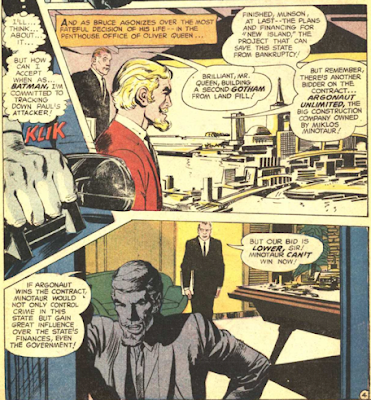
© DC Comics. B&B 85. The dangers of big business corrupting Government

©DC Still believing in Democracy before Nixon's downfall

Writer Bob Haney was an interesting individual. Having first entered the comics business in 1948, he was very much autonomous in his writing approach under the flexible editorship of Murray Boltinoff. A brief bio of Bob published in that same Brave & Bold issue underlined that “Bob feels that the whole world of comics and animation has yet to reach maturity and proper exploitation”. I suspect that Bob Haney had much in common with the much younger Denny O’Neil, and was open to co-ordinating themes across comic lines. I think it is fair to say that DC avoided bringing contentious issues into the pages of their big mainstream money-makers (Batman, Superman, Detective, Action), but had fewer concerns about using the pages of a lesser-known Batman title like Brave & Bold as a vehicle for more ground-breaking storytelling.

The year of 1969 was rounded out by two Justice League of America issues (#75 and #77) which directly addressed concerns about individual, personal accountability (a theme that would be re-visited a number of times ) as evidenced by the “new” Green Arrow coming to terms with his new place in the world in “In Each Man There is a Demon”, and the insidious perils of political manipulation in a story “Snapper Carr – Super Traitor!”. Both stories were written by Denny O’Neil, with art chores by Dick Dillin and Joe Giella.

© DC Comics. JLA #75. Green Arrow gets introspective.

© DC Comics. JLA #77. "Snapper Carr - Super-Traitor!"

© DC. Green Arrow hits out at the "dumbing down" of society.


1970 Going mainstream with Race, Pollution, Native American Rights

As the year turned to 1970, some shaking out of the DC portfolio had taken place with the cancellation of Bat Lash as of issue #7, but the presence of “relevant” story telling was on the rise. February 1970 saw the first of a JLA two-parter focusing on the perils of pollution in Justice League of America #78 “The Coming of the Doomsters” (by Denny O’Neil, Dick Dillin & Joe Giella) , while over on Batman #219, the Neal Adams’ Christmas classic backup  “Silent Night of the Batman” quietly slipped in some observations of street homelessness and GI’s returning from Viet-Nam, as written by emerging author and O’Neil protégé Mike Friedrich.

©DC JLA #78. "The Coming of the Doomsters"

© DC. JLA #78. Green Arrow takes on pollution

March 1970 saw the second part of the JLA pollution story #79, “Come Slowly Death, Come Slyly”, and then in April 1970, Green Lantern/Green Arrow #76 took relevance to a whole new level as “Beware My Power!” exploded on comic-buyer’s senses , bringing together multiple themes already addressed by Denny O’Neil in the pages of JLA, but now cemented by the dynamic artwork of Neal Adams. 
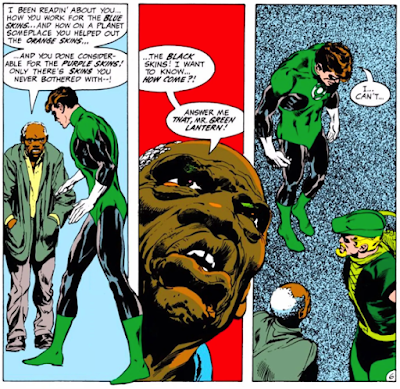
©DC. Green Lantern/Green Arrow #76 "Beware My Power"

Then began a sixteen-issue run covering GL/GA #76-87, 89 and Flash #217-#219 with stories that were to directly address the full spectrum of social issues through the lens of the skepticism of Green Arrow, contrasted with the sometimes naïve conservative sensibilities of Hal Jordan. As the series got underway in the summer of 1970, the first issues to be addressed were racial discrimination, worker exploitation, the problems of Native American reservations , and the disposal of toxic waste. A heady brew. The agenda was clearly set, and other books in the DC were taking notice.

©DC. Lois Lane #106. Why did Superman build this machine?

As the Autumn of 1970 came into view, two full years after the first Wonder Woman story set in the Age of Aquarius,  DC’s other major female role-model Lois Lane started to demonstrate a similar social awareness, when in October 1970 she  first embraced Women’s Lib by first charging Perry White with sex discrimination, and the following month decided to use a machine constructed by Superman to turn herself into a black woman so that she could embrace the Black Experience first-hand. This was a rather heavy-handed and patronizing, if well intentioned, piece by Robert Kanigher (“I am Curious (Black)”). Looking back now, the idea of assigning a morose, middle aged white male to write the story seems unfathomable. If published today, the cover was the epitome of “click-bait”.

As the year rolled towards a close, unbridled relevance was now featured as the main topic in two major comic books each month. In November 1970, while Lois was taunting Superman that she was black, the Justice League fought a villain who first wanted to enforce a peace serum on the global population, before deciding that mass genocide was a better way to address the world’s problems and start over in JLA #84 "The Devil in Paradise". This opus was the work of Bob Kanigher, Dick Dillin and Joe Giella, giving Bob Kanigher the honour of having two “relevant” stories on the stands in the same month.

Even Tomahawk, in its final few issues before becoming "Son of Tomahawk", was tailoring its Old West stories to address contemporary issues of race.

©DC Comics. A fine Neal Adams cover for Tomahawk #128

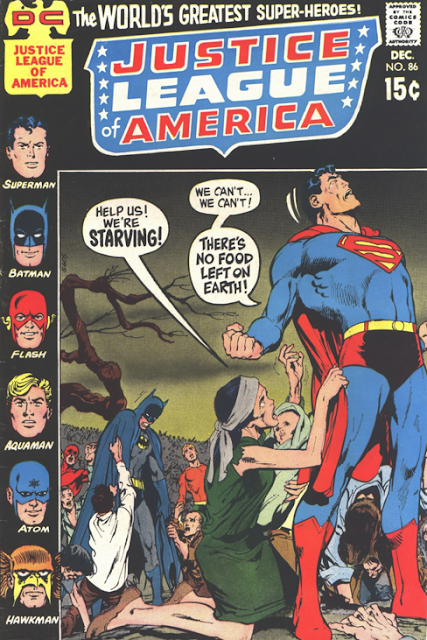
Dec 1970 can be seen as the start of "peak relevance" in DC comics. Wonder Woman and Lois Lane were reflecting the broader concerns of the younger generation, with Green Lantern/Green Arrow and Justice League of America as the backbone of “relevance” in comics, with a continuous stream of stories directly addressing hot issues. The perils of over-population were highlighted in GL/GA #81 "Death Be My Destiny" and a Justice League of America (JLA #86) featured a story about Food Supply in a tale called “Earth’s Final Hour” written by young Mike Friedrich (Denny O’Neil is billed as “script consultant”) and artwork by Dillin and Giella.  Joining the band of relevant comics was the re-tooled “Son of Tomahawk” #131, inventing Hawk as a new counter-culture hero in the Old West, with modern sensibilities and dyed hair.

©DC Comics. GL/GA #81 "Death Be My Destiny"

©DC JLA #86. "Earth's Final Hour"

1971 Population growth, Food Supply and the worst social evil - drugs!

March 1971 saw a Green Lantern story (#82) that again tackled the issue of personal integrity and responsibility, this time from Green Lantern’s point of view. The start of the decade was a time of self-analysis and the rise of the importance of the “shrink” in US culture, which made these stories of self-discovery so relevant.  Over at JLA #88, "The Last Survivors of Earth", Mike Friedrich had written a story about the last survivors of Earth and questioned our over-reliance on technology.

Perhaps the well was running dry, or audience appetite for this kind of polemic was waning, but after March 1971, DC cut back to publish a maximum of one “relevant” tale per month, featured either in Green Lantern/Green Arrow  or Justice League of America.

GL/GA #83 (May 1971) contained a story both lampooning Nixon and Spiro Agnew, while also showing how Carol Ferris’ paralysis , her physical disability, was not an impediment to success. 

In June, JLA #90 ran a story about the importance of ecology “Plague of the Pale People” by Mike Friedrich. Over at GL/GA #84 - Green Arrow made unambiguous comments about the evils of a world overun by plastic, and the effect it has on our society, touching on topics of smog over company towns, and even citizen brainwashing. The mixing of different concerns into one story served to dilute the impact of each of the issues mentioned.

Already the stories were becoming more of a harangue than an enjoyable entertainment. All credit to Friedrich and O’Neil for their passion, but I suspect that the sales were starting to wane.

1971 was a pivotal year for comics publishing. Printing costs had spiraled ; the price of the traditional comics had risen from 10 cents to 12 cents to 25 cents for a 48-page comic. More content was needed to fill those pages. And so three years since Wonder Woman first set the ball rolling, August to December 1971 saw a brief resurgence with both the two-part Green Lantern/Green Arrow  drugs issues (GL/GA #85 and #86)  and a two-part JLA story with a plea for co-existence and listening to those whose language we cannot understand”Earth – The Monster-Maker” written by Mike Friedrich. 

Mike Friendrich addressed the same themes in a two-parter Robin story the following months as a back-up in Batman #235 and #236 (“Society of Outcasts” & “Rain Fire”), drawn by Irv Novick & Dick Giordano, which highlighted the generation gap issues between hippies and the older conservative generation. The year was closed out with stories about Black Power in Green Lantern #87 which introduced John Stewart as Green Lantern’s back-up, and a tale reflecting on the situation of soldiers returning from Vietnam in Justice League #95.

1972 Running Out of Steam

As 1971 turned to 1972, DC took a rest from social messages, and the first three months of 1972 saw no direct stories concerning social issues. April 1972 then saw a brief resurgence with a story about corporate greed and corruption in GL/GA #89 (with arguably the finest final panel in any comic story I had read). In her own comic, Lois Lane walked out on her job at the Daily Planet, as the Lois Lane comic book came under the editorship of Dorothy Woolfolk.

©DC Comics. Green Lantern has had enough.

But the resurgence was a false dawn, and we waited until issues cover-dated June 72 to read another Mike Friedrich-written plea about preserving the ecosystem, in JLA #99. Son of Tomahawk quietly ceased publication with #140.

©DC. Art in the Kubert style by Frank Thorne could not save Son of Tomahawk

Relevance was not yet dead, but it was on life-support.

The commercial realities of the price of paper and printing had caused the 25-cent/52 pages comic to be scaled back to a slimmer 32 pages for 20 cents, and thus August 72 to Dec 72 saw the final Green Lantern /Green Arrow “relevant” story relegated to the back pages of Flash #217-219 in a story arc “The Killing of an Archer”, again focusing on the importance of taking personal responsibility. As the publication of this 24 page story was spread over the five months of three bi-monthly issues, the importance of relevance was clearly on the wane.

While the Flash issues were playing out, Oct 1972 saw the final issue of Lois Lane #127 to be edited by Dorothy Woolfolk, and with Dorothy’s exit any concerns about Women’s lib also disappeared from those pages.

Nov 1972 saw the publication of the last Women’s Lib version of Wonder Woman (#203) in a special “Women’s Lib issue!” before she returned to her Amazon garb and left the realm of the modern business woman behind. Dorothy Woolfolk had previously taken over as editor of Wonder Woman #197 in Nov 1971, but almost immediately passed control to Denny O’Neil with #199, in which issue Denny laid his cards on the table in the editorial about his view of Diane Prince as the modern woman. Despite his best intentions, his editorial reads as slightly sexist and condescending. But within a few issues, the stories became tighter, culminating with WW #203 as the “Women’s Lib Issue”, featuring a rendition of a Carmine Infantino lookalike as a magazine publisher. Denny’s full-page editorial is worth a read, and reading between the lines you can sense his unhappiness at having to hand-off to Bob Kanigher.

©DC Comics. Wonder Woman #203. "Women's Lib Issue!"


And so almost five years after Woman Woman #178 ushered in the era of relevance in DC comics, it was only appropriate that Woman Woman should usher it out.

1973 - Don't Look Back in Anger

And that was pretty much it for “relevance”. Denny went on to handle a large portfolio of new books for DC (including The Shadow) and the social concerns of 1972 were swept away with the excitement of the new books of 1973. I did not notice the change of tone at the time.

The last word about Social issues was left to Batman on the final page of Batman #251, cover dated September 1973 , “The Joker’s Five Way Revenge” when the Joker slips up on a oil slick on the beach, allowing Batman to capture him. Batman laughs “I never thought you – my arch enemy – would make me grateful for pollution!”

©DC Batman #251. The last word on pollution.

Now it is clear to see that "Relevance" had been the baby, the brainchild and the passion of Denny O’Neil, ably abetted by young college sophomore Mike Friedrich, and supported by long-time stalwarts Haney and Kanigher . 

Neal Adams has received (and accepted) the lion's share of the credit for "relevance" in comics, and is without doubt the artistic name almost exclusively associated with “relevant” comics, but without the work of Dick Dillin & Joe Giella, Nick Cardy,  Mike Sekowsky, Irv Novick and Dick Giordano, it would have been a much slimmer body of work.

When  "Snowbirds Don't Fly" (GL.GA #86) won the 1971 Shazam Award for "Best Individual Story", New York Mayor John Lindsay wrote a letter to DC in response to the matter, commending them, which was printed in issue #86.  Once DC had achieved National approval and exposure, wiser heads probably thought it was time to move on.  Concerned that they might be perceived as preachy, the stories dialed back on social relevance.

Denny O’Neil did not abandon social commentary completely, but the storytelling became more nuanced. Looking back on his career in an interview with Gary Groth for The Comics Journal around 1980, Denny said “I liked conflict and turmoil when I was 25. I don’t know what it is about being 25, but you’re hungry for conflict, for turmoil, and you run toward it. When I was a newspaper reporter, a story involving that kind of thing had infinitely more appeal for me than a story, for example, I did about a lovely old Japanese gardener and his wife who were having a wonderful and tranquil old age. That was a real good story I did, and it was very moving, but I didn’t enjoy it nearly as much as I enjoyed the time that I got some real heavy dirt on the police department and I showed that these authority figures had really dropped the ball.”

“I’ve written a lot of scenes where people regret the fact that violence was necessary in a given situation. In one of the best stories I ever did, “There Is No Hope in Crime Alley,” the whole point of it is that the old lady who stayed in the slums and never raised a finger to anybody was a much greater hero than Batman — which he acknowledges on the last page. That’s the way I go with it.”

I encourage you to take the time to read the full interview that Denny did back in 1980 and released in full form in The Comics Journal #66 (September 1981), https://www.tcj.com/rationality-and-relevance-dennis-oneil/

For those of you interested in statistics, here is the breakdown of number of stories dealing directly with different social issues over that 5-year period of 1968-1973. None of those topics remain any less important in today’s world. These Bronze Age comic stories were positive and optimistic, in that they showed that these sometimes insoluble problems could be addressed if individuals were willing to put themselves on the line.

How did “relevance” in comics affect your world view? Is it time for modern comics to “grow up” again, or is the sanitized world of the DC and Marvel Comic universes the best place for our heroes to operate?