Showing posts with label Alan Austin. Show all posts

Wednesday, July 31, 2024

It's here!! Announcing the publication of the final issue of Alan Austin's Fantasy Unlimited!


Alan Austin (1955-2017) was one of the most respected figures in UK comic book fandom. He published a major fanzine about American comic books throughout the 1970s and into the 1980s, at first named Fantasy Unlimited (later named Comics Unlimited), and also the Golden Age Fanzine, Whiz Kids (devoted to the original Captain Marvel and other Fawcett heroes), the first Comic Book Price Guide for Great Britain. and the DC and Marvel Comics Indexes.

His fanzines gave a showcase to a number of future professionals in the comic book business, including, amongst others, Stephen Baskerville and Kevin O’Neill.

Now his Fantasy Unlimited fanzine has been revived for a final issue, re-titled Alan Austin’s Fantasy Unlimited, to include a celebration of his immense contribution to UK fandom in the 1970s and early 1980s.

“It was Will Morgan’s excellent idea to have this one-off issue, and try to involve as many of the original contributors as possible,” says Nigel Brown, who published Alan’s posthumous books. “I was doubtful it was a practical project after fifty years gone by, but I’ve been delighted at the response from names that will be familiar to regular readers of the fanzine, including Will himself (who contributed to FU/CU under his birth name of Howard Stangroom), Martin Lock, Allan J. Palmer 'the Phantom Rambler', Stephen Baskerville, Patrick Marcel, Jean-Daniel Brèque and many others."

“This has been an opportunity for previous contributors to Fantasy/Comics Unlimited to be back in the fanzine one last time, with personal memories and anecdotes about Alan,” Nigel adds. “But Alan Austin’s Fantasy Unlimited #54 will also offer its usual articles, and regular favourites like “We Want Information”, a new “Worlds of Emlock”, and even a special sequel to a comic strip first published in the fanzine forty-nine years ago!”

Alan Austin’s Fantasy Unlimited #54 is a non-profit project, published with the permission of Alan’s literary estate.

It is now available on Amazon in a printed edition only.

Amazon UK link:  Click here

Amazon US link:  Click here

----------------------------------------------------------------------------------

Alan also wrote two books. One was about his life in comics, Comics Unlimited: My life as a Comic Collector and Dealer, the other about his experiences as a book dealer (in fiction form, as a series of short stories), The Adventures of Bernie Burrows, Bookseller. Both of these books are still available on Amazon as paperbacks and ebooks. Follow the link at the top right of the blog to find those on Amazon.


Sunday, November 26, 2023

Comics Unlimited #54 - coming in 2024!

by Nigel Brown


Now that Alan Austin’s posthumous book about comics and his story collection about bookselling have been published, the preparation of
Comics Unlimited No.54 is underway, again with the permission of Alan’s literary estate. As with his books, this is a non-profit project in Alan’s memory.

Comics Unlimited No.54 will be the final issue of that fanzine, which will include a celebration of Alan’s immense contribution to UK fandom in the 1970s and early 1980s.

It will give an opportunity for any previous contributors to Fantasy Unlimited and/or Comics Unlimited to be back in the fanzine one last time, with personal memories and anecdotes about Alan, and letters to ‘Mail Unlimited’.

For contributor guidelines, please send an inquiry to Nigel Brown at:

nigelbrown47@aol.com

Any contributions need to be received by 31st January 2024

----------------------------------------------------------------------


Comics Unlimited: My Life as a Comic Collector and Dealer

Alan Austin's memoir of life as a Comic Collector and Dealer is still available on Amazon, now with an index. Clicking the book cover link will take you to the book at the UK Amazon site, although it can be easily found on other country Amazon sites.
The Adventures of Bernie Burrows, Bookseller

Alan's book of short stories about bookseller Bernie Burrows is a very entertaining read, and is inspired by his years as a bookseller of crime fiction. Again, clicking the cover icon will take you to the UK Amazon site, although it can be found on any country Amazon site.

Sunday, March 19, 2023

The demise UK Comic Fandom began in 1979

© WB animation. With apologies to Warner Brothers.

by Ian Baker

The spark for the first era of UK comic fandom was kindled in October 1959 and was snuffed out twenty years later in 1979. 

Without American comics importer Thorpe & Porter, UK comic fandom would never had existed. Of course, comic collecting in the UK continued past 1979, but the advent of the Direct Market signaled the death knell for the new UK comic reader, the impressionable 12-year old who could go into a newsagent and pick something off the spinner rack for no more than 10p.


Some UK price variants were still available after the demise of T&P, but these were then only available in W H Smith or through the very few Direct Market comic shops - a reduction in retail availability from 88 corner newsagents to 3 WH Smiths in Portsmouth alone. 


The days of mass, cheap American comic book availability had passed, and with it the chance of a casual buyer being attracted by a comic seen hanging on a peg, or stuffed into the lower rungs of a spinner rack. The spinner racks disappeared, along with the salacious men's magazines at the top and comics at the bottom.


Thorpe & Porter defined the era ; In January 1979 there were 23 titles published by DC ; most of those titles disappeared from newsstands in the UK, and with it the feeder system for new readers. 


The last T&P stamped comic was the Superboy & The Legion of superheroes #240, June 1978   - a 60 cent comic priced at 25p. (As documented by “Get Marwood & I” on the excellent UK Price Variant thread on the CGC boards).    


© DC. The Last T&P-stamped import? Swiped from CGC thread.


The received wisdom in the comics industry at that time was that the average new comic reader of eleven years "aged out" at eighteen, with a complete readership turnover every seven years. 


At their height, T&P were importing one million comics per month, distributed to thousands of corner newsagents up and down the country.  Of the 88 newsagents alone in Portsmouth in the mid 70s, if we assume that each newsagent got 60 new comics each month - that would be 60x88 = around 5,000 new comics in Portsmouth each month for a population of 200,000,  of which say 2.5% were adolescent lads aged 10-14 (sorry girls). It follows that there were 5,000 lads of comic reading age in Pompey as a market for 5,000 DC comics. If you extrapolate that to the total country population in 1975 (56.2m), then we have 1.4m lads as a possible market for a million comics imported every month.


As a twelve-year-old going on thirteen in 1972, I knew nothing of comic fandom, unaware of the work of Frank Dobson on Fantasy Trader, or the infrequent early UK comic marts since the late 1960s. My pals and I were islands with no fandom other than ourselves and a very few collectors at school. How big was that local community? Not big - or if it was big - we never knew because comic fans kept their heads down, keen to avoid the jeers of their classmates and the despair of their parents.


Things changed when I ordered Fantasy Unlimited from an ad in Exchange & Mart because it had a sales list, and discovered a whole community of fans, most of whom I was only ever to know as names on a page, yet somehow we regarded as members of an extended circle of friends.


So where were these fans - who were they - and what drove the growth of fandom in that decade of the 1970s?


Fantasy Unlimited


For the purposes of the definition of being a member of UK fandom I believe that one had to contribute to a mainline fanzine at least once.


I do believe that Fantasy Unlimited (later Comics Unlimited) was the one fanzine that most accurately reflected fan participation in the comic collecting hobby in the decade of the 1970s. Not withstanding the many other zines out there in this period, I believe that FU/CU is a reasonable barometer of the growth of UK comic fandom in that decade which ended with the termination of Thorpe & Porter. 


I’ve spent an inordinate amount to time reading and re-reading every issue to note down the names, locations (where known) and role of fans involved in the creation of the ‘zine’s content - whether it on production duties, article writing, letters published, requests in the “We Want Information” section, reviewers, etc.  I started first with Alan Austin’s first effort “Ad Adzine” #1 (April 1970), right through the title transitions to “Aftermath” and then to Fantasy Unlimited and later Comics Unlimited up until the final issue #53 (Feb 1983).


Over that 53 issue period, there were 483 unique contributors, of whom a core of twenty-two individuals were active participants over a period of five years or more. (Many of those names will be familiar to readers of this blog as still being active in UK fandom)


For those of you with a statistical bent, the Normal Distribution bell-curve below plots the average number of months of active participation in fandom, as characterized by writing to/writing for/being reviewed in Fantasy Unlimited. 


The average duration of involvement was 13 months, with 68% of participants (one Standard Deviation) being involved for up to 3 years; 95% of fans had ceased involvement after 5 years; 99% had stopped at the 6-and-a-half year point, and the remainder stayed around. This maps very closely to the comic industry's own beliefs in regular reader turnover every seven years.


Click the image to enbiggen.


© Ian Baker. Analysis of duration of fan involvement in FU/CU 1970-1979

If we examine the inflow of new fans making their very first contribution - getting their name in lights - it becomes clear that 1975 was a banner year for participation and fandom growth. We'll examine possible reasons for this further on.


If we plot the numbers of new participants cumulatively, the flattening of the curve of new fan involvement clearly co-incides with the cease of T&P distribution.


© Ian Baker for analysis. Click to enbiggen.

What is instructive is to see the growth curve of new contributors, with 1975 being the year when interest and active participation exploded, with 135 new fandom names added within the pages, but following the end of 1979, only 11 new names appeared over the following four years. Evidence that the demise of T&P’s business stopped the flow of new fans.


In the early 1970s, Alan Austin doubted if there were more than 200-300 serious American comic-book collectors in the UK. He had been printing 30 copies of his fanzine early in 1971, which had risen to 250 copies per issue by the end of 1972. This rose to 600 per month by the end of 1975, and by 1977 he was selling two thousand copies of Comics Unlimited per month of which almost a quarter of the readership had actively contributed to the ‘zine in some form or another.


UK Comic Fandom was a community with a strong London base from the start. But by the end of the decade, there were strong communities which had developed in other major counties. A look at the chart for England below highlights where those clusters of fan were based.  Interestingly, there were some counties which never attracted a fan contribution in any form.


By the end of 1979, London & Middlesex was represented by 71 fans (plus a further 40 whose addresses were not published, but were most likely London-based), with a further 42 in the Home Counties. A further  30 were based in Yorkshire across the Ridings, with a further 22 in Lancashire, 10 in Cheshire and 10 in Nottinghamshire.  The remainder were spread across the remaining counties.  


My own county, Hampshire, fielded 10 active contributors, lead by the irrepressible Allan J Palmer in Basingstoke with thirty contributions over a seven-year period , and with a creditable 10 entries from SuperStuff's own Nigel Brown. (Modesty prevents me from listing my own contributions). 


I’m inclined to believe that the fanbase was in direct proportion to the number of newsagents and a reflection of Thorpe & Porter’s distribution reach.


Here's the chart showing the active fanbase in England as recorded in Fantasy Unlimited as of 1979.


Map © Microsoft. Analysis of data by Ian Baker


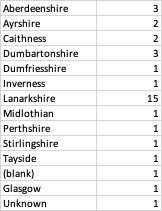
The picture for Scotland is better represented in a table (see below), where there developed a steady core of fans in Lanarkshire, mostly centered around Glasgow.


In Wales, 12 fans made a contribution over the years, of which 9 were in Glamorgan.


In Northern Ireland, 11 fans made their presence known, fairly well distributed, with the largest group of 4 based in Co Antrim.


I have no knowledge if these clusters of fans in certain counties made contact with each other. 


I am interested in what drove the explosive growth of UK comic fandom in 1975. Is it just an outlier, or were there other factors at play?  Or perhaps more interestingly, what caused the decline from 1976 onwards? The UK inflation rate in 1975 peaked at 24.24%, and declined only to 16.54% the following year. Comic prices had gone from 5p to 10p over this period, and the availability of colour Marvel comics had declined to avoid competition with the UK Marvel weeklies. Perhaps it was just a case that pocket money could not buy nearly so many comics, and supply issues were preventing new readers coming on board.


There’s a lot more analysis yet to be done on the data - for example, the types of questions raised in Alan Austin’s “We Want Information” column . What is clear is that in the early days questions focused on the Golden Age - that mythical time before 1959. As the years rolled by, questions were much more related to concerns of T&P distribution breaks and Non-Distributed issues of Marvel Comics. Fans were becoming educated consumers.


I don’t claim this to be an exhaustive analysis ; certainly a good read of other fanzines of the time will yield more names, but I do think the pages of FU/CU reflects the growth of UK comic fandom in its second decade.


Reading through the roll-call of names mentioned in the pages of FU/CU the names of various individuals who made the transition to the professional comics world jump out - John Bolton, Kev O'Neill, Grant Morrison, Dez Skinn, etc - along with others less well known. Other people found careers as musicians, lawyers, writers, designers, with quite a few names still to be found at London Marts today, both as dealers and punters.


If Mr J.C. Hill of Watford, Hertfordshire should be reading this, did you ever write your envisioned History of UK Comics Fandom?


UK Comic Fandom today


So how big is UK comic fandom today - if we accept that it was perhaps a couple of thousand with a core of almost 500 active participants back in the late 70s?


Is UK comics fandom just a bunch of men in their sixties and seventies trying to rekindle those days of the 1970s when anything seemed possible? Does comics fandom for the latest comics even exist? Where does an intelligent discussion of new comics today take place? Certainly not on the Social Networks I frequent. 


As of a few months ago, these Facebook groups targeted at a UK audience recorded the following membership: 


  • 936 members of London Loves Comics
  • 288 in Fanscene 
  • 4,200 in Marvel UK comics
  • The Comic Book Group UK.  1,600
  • Comics Buy and Sell UK.  4,000
  • Comic Books for Sale UK.  19,000 members


Perhaps there is a substantial following today, but once you weed out the Silver Age and Bronze Age fans, and the professional sellers, the Cosplay fans, the MCU an DCEU movie fanbase, does that core set of fans of the printed page exist?


Comments welcome.


© Ian Baker, 2023

Friday, October 7, 2022

London Life and the Westminster Comic Marts

by Nigel Brown

© GT-Man, from Wikipedia

[This time around SuperStuff co-editor Nigel Brown takes us back to the days of the late 70s with memories of those great Westminster Comic Marts past -- Baggsey (Ian)]

Portsmouth in the early 1970s was a great place to collect American comics (see the ongoing SuperStuff73 series on ‘Searching for comics in Portsmouth, 1970s style’), but as I wrote back in 1984, in SuperStuff #11, “Of the second-hand shops we haunted, on a recent trip I was only able to find two that possibly had some comics for sale”. Combined with the distribution problems that limited the availability of new comics off the newsstand, by the mid-1970s Portsmouth began to lose its lustre for the enthusiastic comic collector. 

We’d already begun to take the odd school half-term trip up to London to Dark They Were & Golden Eyed in Berwick Street, and to Alan Austin’s ‘Crypt of Comics’ in Clapton, so when it came to decision time, I can’t say that I’d chosen to study in London just because of the accessibility of comics, but I admit it was a major factor!

My choice of London paid off. By late 1978 I was studying close to Angel tube station in Islington (not yet the gentrified area it was to become). I was within an easy walk up Islington High Street and Upper Street to Canonbury Lane, where I would spend many a happy hour hanging out in Alan Austin’s Heroes shop after he opened there in June 1979. In those days he still sold mainly comics.

(As an aside: before Alan Austin moved his business to that location, I used to visit his First Floor Offices in Mare Street, Hackney, on the odd Saturday, where I remember buying a pretty ropey (though intact) Fantastic Four #1, and also us both speculating on the future value of the newly published Peter Parker, The Spectacular Spider-Man #1. That would place this latter memory in September/October 1976, when I would have been visiting up from Portsmouth. I do recall that the consensus was that this new # 1 Spider-Man issue would never match the highly sought-after comics Amazing Fantasy # 15 and Amazing Spider-Man # 1, and the years have proved us right.)

©Marvel. Spectacular Spider-Man #1

Another regular destination in my student days was Dark They Were & Golden Eyed, by then in St.Anne’s Court, along with the newly opened Forbidden Planet (founded in 1978) in Denmark Street (Paul Hudson’s Comic Showcase in Covent Garden wouldn’t be opening until April 1982). By then, Dark They Were was becoming a shadow of its glory years, suffering under the high shop rent demanded in Soho, and the real excitement was reserved for Forbidden Planet. Not only did Forbidden Planet stock items not seen in Dark They Were, but Forbidden Planet pioneered creator signings that generated big thrills for fans, including a signing that had the fans queuing around the block in June 1979 to meet Neal Adams. 

Other notables that I met at signings were Philip José Farmer in January 1981 and A.E. van Vogt in May 1982. It was also the kind of shop where I recall seeing Stephen King queuing up at the till, and Bob Monkhouse making a noisy visit.

© Unknown. Forbidden Planet, Denmark St , mid-Aug 1980

But the bonus of my new London-based life was the Saturday mart at Westminister’s Methodist Central Hall.

I’ve lost count of the number of comic marts I’ve attended over the years, beginning with the Emsworth comic mart in May 1974 (see SuperStuff73 June 2021: ‘Announcing the publication of Alan Austin’s book…’). I still occasionally make it to the marts held these days at the Royal National Hotel in Bloomsbury, but those Westminster marts in the late 1970s/1980s stick most in my memory.

Located almost opposite Westminster Abbey, and at that time the headquarters of the Methodist Church (who’d raised the money to build it), Westminster Central Hall is a Grade ll listed building built in Edwardian times, at the height of Empire (and it looks it) clad with cream limestone in a baroque style that both reassured and awed in equal measure. The perfect place for a comic mart… comic collecting had finally ‘arrived’!

At the time, I didn’t realise that the Westminster marts were instigated and organised by Nick Landau (Titan Distributers), also one of the names behind Forbidden Planet. Although we can remember attending Westminster Marts as early as February 1975, the marts became a regular event  from November 3rd 1979, with five marts in 1980 and were bimonthly throughout 1981.

Westminster Central Hall is a large venue, but the dealers managed to fill every niche (in both senses of the word!) with over 100 stalls, even up on the stage that looked down upon the palpably enthusiastic crowds. I remember Ken Harman used to have that spot.

(Ken, incidentally, was the dealer with whom I once swapped my Portsmouth-collected run of 1960s and early 1970s Superman titles – Action Comics, Superman, Superboy and some others – for a selection of fine-graded Marvel first appearances, including Fantastic Four, Hulk, Spider-Man, Iron-Man, Thor… all now long sold on…)

SuperStuff stalwarts Ian Baker and Geoff Cousins would sometimes make the trip up from Portsmouth for these events; Ross Carter, Portsmouth’s resident Star Trek specialist, would come up on occasion. We would join the anticipatory queue inside the marble foyer and, when the heavy oak doors opened at noon, unhampered by any entry charge, be part of the rush inside towards the treasures within.

Clutching our wants-lists, it wasn’t long before gaps in our collections were being filled as we did creditable impressions of frantic bees searching out pollen amongst fellow swarms of enthusiastic fans.

Particular comics I bought at the Westminster Marts included an Action Comics #28, with its striking Shuster-like Paul Cassidy cover, and its interior Superman art by one of my favourite early Superman artists, Jack Burnley. I also remember buying a copy of Avengers #3 with its classic battle between the Avengers and the Hulk, with the Sub-Mariner in his first cross-over from the Fantastic Four comic. I can’t remember the prices of these comics, but – and it pains me to admit this in these times, whereby the target to get more students into university has resulted in the costs being borne on students’ shoulders – these comics were well affordable from my student grant…


©DC. Action Comics #28. A Westminster Mart acquisition.

© Marvel. Avengers #3. Another Westminster Mart find.

Apart from Ken Harman, I remember other dealers attending included Paul Hudson (from whom I bought the Action Comics #28), and others I recognised from the earlier marts held at Lyndhurst Hall in Kentish Town and at the Royal Horticultural Society’s Old Hall. I remember chatting with Mike Lake, by then one of the founders of Forbidden Planet, as I used to correspond with him when he dealt with comic imports at Dark They Were &  Golden Eyed in their Berwick Street days, back in the mid-1970s.

By then, Alan Austin had stopped being a big player at the marts – he would just have a few boxes of comics on a friend’s table.

Many regular comic fans and dealers became familiar faces in that time, even if we didn’t know their names, but I recall one particular conversation I had with a non-fan: the Yes musician Steve Howe. Someone mentioned that he was there, and – in those days – I wasn’t yet a curmudgeon so I simply went up to him, introduced myself and we had a nice chat. He was friendly, and explained that he was there as his son was a comic fan. I remember giving him sound financial advice: that comics were a good investment! I have no idea if he took me up on that…

After the mart, I would sometimes return to my digs with my fellow Portmuthians to gloat over our newly acquired comics.

Given where this particular memory sets the scene, I know that this must have been after one of the earlier marts at the Royal Horticultural Society’s Old Hall in late 1978, possibly on November 5th; I have this particularly vivid memory of happily inspecting a copy of Amazing Spider-Man # 18 which I’d purchased at the mart that day, notable in that it completed my set of Spider-Man.

The day sometimes ended with a visit to the West End, to see a film at the superior cinematic facilities at the Empire Leicester Square or at the Dominion in Tottenham Court Road. That additional attraction of life in London is another story, to be told elsewhere. Suffice it to say that when I first saw Star Wars (as it was simply known back then) in its first run in early 1978, I saw it at the former Odeon Festing Road in Southsea with Ross Carter. The Millennium Falcon jumped into hyperspace and, at that exact moment, we were left looking at a blank white screen. The film had broken. Needless to say, when I re-watched Star Wars at the Dominion Tottenham Court Road a few weeks later, it was a less hapless performance!

Nowadays, I’m grateful that the marts at the Royal National Hotel still offer the comic mart experience, and in truth the depth and range of comics on offer means that there are still desirable comics to be had, and even the odd bargain on offer. Perhaps not always for comics these days; I recently picked up a near mint copy of the ‘Magpie ABC of Space’ book by Peter Fairley (1969) for just £5.


All marts have been fun, but looking back, the Westminster Marts were magic.


© Nigel Brown


Tuesday, May 3, 2022

Three boys and three typewriters: the secret origin of SuperStuff

[Thanks to regular commenter McScotty for posing the question...."Was SuperStuff a real fanzine?" My good pal Nigel Brown, co-editor, co-founder of this blog, and regular columnist, took up the challenge of telling the SuperStuff story... ]

 by Nigel Brown

It was Ian Baker’s idea to do our own comics fanzine. I came up with the name SuperStuff, no doubt inspired by my favourite comic book character.

We’ve already described how it was, fifty years ago, when we hunted down American comics books all over Portsea Island (‘Mad DC Comic Hunt’ and ‘Comics Shops in Portsmouth (Upcoming blog entry)’). 

To set that time in context, that was just before Marvel decided to enter the UK comics market with their own comics (they had earlier allowed reprints in Fantastic, Terrific, Pow! Wham! and Smash! comics in the late 1960s).The Mighty World of Marvel # 1, a UK comic, arrived in September 1972. This was successful enough for them to follow it up early the next year, with the appearance of Spider-Man Comics Weekly #1 in February 1973. (I remember we were pretty scornful of these comics when they first appeared, comparing them to the full colour and up-to-date American originals that were still available in newsagents, and as back-issues in second-hand shops.)

A more epoch-defining event in the SuperStuff story occurred that following Easter, on April 22nd 1973, when Ian Baker received his first issue of Alan Austin’s Fantasy Unlimited #14, having seen an advert for it in Exchange & Mart.

I subscribed soon after, and together with Ian we began to send postal orders off for back-issue comics to ‘fill those gaps’ in our comic collections.

It took another year before we produced our own comics fanzine.

Shang-Chi swipe © Marvel. The rest © SuperStuff.

SuperStuff #1 debuted in May/June 1974 (with an optimistic March cover date). It was, frankly, the best imitation of Fantasy Unlimited that we could manage… but so what? We had tremendous fun doing it. If we could have only transferred a small part of our enthusiasm onto our schoolwork I’m certain our schoolteachers would have been impressed by our diligence and energy!

As Alan Austin has described himself in his book about his life in comics (Comics Unlimited: My life as a Comic Collector and Dealer ), a major problem with producing fanzines is the duplication required for any kind of wide circulation.

Alan himself eventually solved this problem by acquiring a second-hand Gestetner Roneo No.2 duplicator. We never got that far, using two pieces of carbon paper with our typewriters to produce three copies in total of our own fanzine. Three sheets of carbon paper rendered the last page too faint to be legible. (Ian recalls experimenting with four carbon papers, but he had to hit the keys on his old Remington typewriter so hard that his Dad would call upstairs: “Stop that racket!”)

After the debut of SuperStuff #1, we were away. A second issue followed shortly afterwards.

Although I was the ‘editor’ of the first issue, in truth it was a total joint effort. We would each type up our own pages, then put them all together to make up the fanzine.

Once SuperStuff was established, it became an outlet for our creative energies and we produced further issues down the years. Some I produced wholly by myself, others were typed out by Ian and our other comics-collecting friend, Geoff Cousins. A healthy rivalry developed between us, leading to greater efforts to produce bigger and better fanzines, although still with circulations of three!

At least we knew our readership.

The SuperStuff contents were a mixture of comic and science fiction paperback reviews, along with some original fiction and articles (many of which were swiped from sources as varied as other fanzines, the comics themselves and, as I recall, even The Radio Times). We did come up with the odd original article, or took what was there and rewrote much of it to fit in with our own opinions.

Ian remembers that the paper we used for SuperStuff originally came from school, so the most expensive outlay was the carbon paper and the photocopies (5p) for the covers, first done at the Portsmouth Main Post Office, then later in the Main Library by Portsmouth Guildhall.

Here’s what we produced; see the end of this blog entry for a selected list of the contents of each issue.

SuperStuff covers #1-#10. Characters © their respective publishers


I was pleased enough with SuperStuff #7 to send one of my precious copies to Alan Austin. He wrote back with a encouraging letter (that I published in the letter column of SuperStuff #9) but – more importantly – he asked if I had any material he could use for his own fanzine, by then named Comics Unlimited. I sent him a reworked article I’d written for my other fanzine Fantastic Voyages #2 (A Chronology of the Planet of the Apes), and he published it as the cover article in Comics Unlimited #36 (May 1976).

Planet of the Apes Chronology republished in Comics Unlimited #36


This was the second SuperStuff era-inspired article to see print in another fanzine. Previously, I’d had an article I’d written in SuperStuff # 1 (about Kirby’s 4th World) appear in the fanzine Eon #2 (May/July 1975).


EON #2 reprinted the Kirby 4th World article from SS #1

Geoff Cousins had a contribution published in one of Alan Austin’s fanzines, with a Silver Surfer illo in Fantasy Unlimited #27 (June 1975), and he also drew a Conan cover (unpublished) for Alan Austin's abandoned Sword & Sorcery issue of Comics Unlimited, which would have been #38.

Not that Ian Baker’s name was lacking in Fantasy Unlimited, either. He often contributed a wide range of interesting questions to the popular ‘We Want Information’ feature that Alan Austin ran.

Looking back, Ian notes now that we pretty much achieved our aim of producing a new SuperStuff every school holidays from March 1974 to May 1976, which covered eight issues.

1974 to 1976 was really the heyday of our fanzine-producing, but I decided to produce a SuperStuff swansong in 1984.

By then, I had access to Alan Austin’s own Gestetner 160 in the basement of his Islington shop, Heroes. He was generous with his time and patience and, along with his encouragement and advice, I managed to print enough copies of SuperStuff #11 (August 1984) to go on sale to the public.

We had begun SuperStuff as an imitation of Alan’s own Fantasy Unlimited fanzine, and now I determined to make this final SuperStuff a true tribute, printed on the same hallowed machine that had printed Fantasy Unlimited.

The main feature was an interview with Alan himself. I also was lucky enough to commission an original Baragrin strip for SuperStuff, generously provided by Patrick Marcel and Jean-Daniel Breque. SuperStuff #11 also featured articles by Ian Baker and others such as the leading Portsmouth Star Trek fan and founder of S.T.I.G. (Star Trek Information Group), Ross Carter.

© Nigel Brown. SuperStuff #11 - 1984

Alan Austin sold SuperStuff #11 in his shop Heroes, and Paul Hudson in Comics Showcase was also kind enough to allow a box of SuperStuff for sale on his shop counter in Covent Garden.

I can’t recall how many were sold, but an issue has turned up on eBay. If anyone still has a copy I’d advise them to hold onto it as one of the rarest genuine fanzines of that era!

That was intended to be the end of the SuperStuff story, but thanks to advances in technology since those days, SuperStuff has come alive again as the blog Superstuff73…  as much fun to produce, I admit, as those type-written carbon-copied fanzines of yesteryear.

©Nigel Brown


List of SuperStuff issues 1-10


SuperStuff # 1

March 1974 cover date (May/June 1974 interior date)

Nigel Brown editor. Nigel Brown, Ian Baker contents

This featured articles on Kirby’s 4th World, World’s Finest Comics, Marvel’s Shang-Chi and various comic indexes, ending on a page with our spare comics for sale.


SuperStuff #2

April 1974. Nigel Brown editor. Nigel Brown, Ian Baker contents

This featured a Neal Adams biography, along with articles on C.C.Beck, DC’s Plop!, Marvel’s Iron Fist, and a feature on the best Batman artists.


SuperStuff # 3

Summer 1974. Ian Baker editor. Ian Baker, Geoff Cousins contents

This issue was more TV orientated, with an interview with Burt Ward of the Batman TV series and a piece on Star Trek, alongside articles about Iron Man, Robert E. Howard and a biography of Walter Gibson. 


SuperStuff # 4

March/April 1975. Ian Baker editor. Nigel Brown, Ian Baker, Geoff Cousins contents

This had articles about the origins of some Marvel super-heroes, Kirby’s Forever People and an interview with Arthur C. Clarke. 


SuperStuff # 5

July/August 1975. Ian Baker editor

We featured Kirby’s O.M.A.C., Ditko’s The Creeper, the best way to store comics, and an index of the first Bantam paperbacks reprinting Doc Savage pulps.


SuperStuff # 6 (incorporating Nigel’s separate fanzine Fantastic Voyages # 3)

April 1976. Ian Baker & Nigel Brown editors & contents

This issue continued the Bantam Doc Savage paperback index, a retyping of a Batman TV series script, as well as an article about The Spectre.


SuperStuff # 7

April 1976. Nigel Brown editor & contents. 

This was a Superman Special, featuring articles about the Golden Age Superman, a comprehensive origin of Krypton and Superman, as well as the second part of The Spectre article.


SuperStuff # 8

May/June 1976. Ian Baker & Geoff Cousins editors & some contents

This issue featured the changing images of women in comic books, along with articles about Red Sonja, the origin of The Batman, and the Alan Dean Foster Star Trek paperbacks.


SuperStuff # 9

July 1978. Nigel Brown editor & contents.

This featured articles about comic back-issue prices, the new super-hero TV series (one starring Wonder Woman, the other The Hulk), and an index of SuperStuff issues 1 to 8, 

SuperStuff # 10

July 1980. Nigel Brown editor & contents

This slimmer issue featured comic and book reviews.


We also produced our own fanzines separately, towards the end of 1975:


Fantastic Voyages #1

August 1975. Nigel Brown editor.

Similar mix of contents to SuperStuff, with opinion column, comic information feature and comic quiz.


Fantastic Voyages # 2

Autumn 1975. Nigel Brown editor

Similar mix of contents to SuperStuff, with a Planet of the Apes chronology, Denny O’Neil interview.


The Light of Other Days #1

Autumn 1975. Ian Baker editor

An intended mix of Science Fiction paperback reviews and discussions of Black & White SF comics. This never got beyond the "ashcan" stage.


The Light of Other Days and Other Worlds

Winter 1975. Geoff Cousins editor


Amazing Science Fiction Stories # 1

April 1976. Nigel Brown editor & contents

Science fiction.


SuperStuff Special #1

September 1979. Ian Baker editor & contents. 

An original Shadow story.