Well, sorry for the delay, going through the whole of November without a SuperStuff post, but am hoping to make it up this month.
Anyway, I thought I’d take a closer look at a comic that had always intrigued me, but never had. I’m not sure if Thorpe & Porter ever put it on our spinner racks in the UK. The comic in question is "Jerry Lewis meets Batman". (The Adventures of Jerry Lewis #97). I didn’t even know who Jerry Lewis was back in 1966. To me this seemed to be a bizarre edition of The Brave & The Bold.
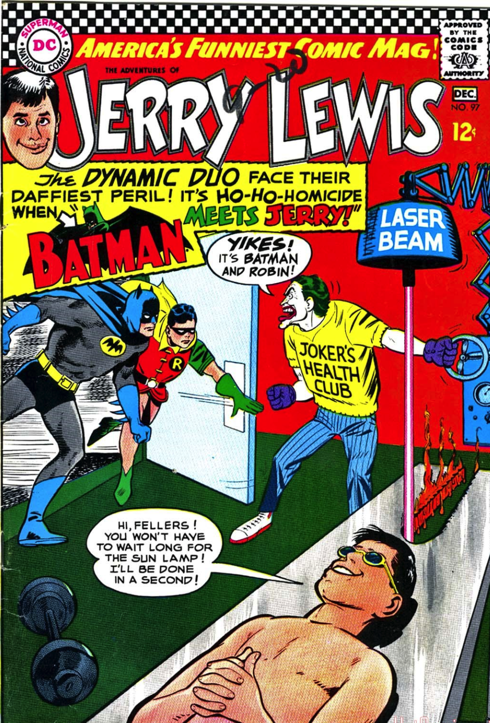
The cover is credited to Bob Oskner, but appears to incorporate a swipe of Dick Sprang’s rendition of the Joker’s face, with perhaps also a swipe of Batman & Robin drawn by Carmine Infantino and Joe Giella. It also seems to incorporate an homage of sorts to Goldfinger with the laser beam cutting through Jerry’s sun-bed.
Finally reading the comic today, it is a bit of harmless fun with Batman and Robin goofing around with Jerry Lewis. The renditions of the Dynamic Duo by Bob Oskner are an improvement over the work being ghosted by Sheldon Moldoff on the official Batman comic at the same time, but there is a lot of evidence that no-one from the Batman/Detective creative team had informed Oskner of elements of the "New Look" introduced two years earlier in 1964. The renditions of the Batmobile and Joker are right out of Dick Sprang's 1950s comics. Also of note is that there is no “Bob Kane” logo on the splash page, which illustrates a scene not to be found in the comic itself, with Jerry Lewis being tied to the clapper inside the bell in a tower.
The reason for this scene is an allusion to the Batman TV episode “The Bookworm Turns (April 20th 1966) which had appeared earlier that year, and incorporated Jerry Lewis in a cameo turn during a "Bat-Climb". (In the TV episode, it is Robin who is tied to the clapper in a clocktower bell. )

Reading this nonsense, it made me realize that there used to exist a whole sub-genre of comics, with a well-known comedian as the protagonist, that appears to be no longer with us.
But it got me thinking? How did comedians get into comics? And where are comics featuring comedians today?
So why did this trend start? As the old joke goes
- "What is the secret of successful comedy?"
- "T-T-T-timing!"
DC was late to pick up the potential for "comics in comics", and it was only the pressure from the anti-horror lobby that drove DC to look for other subject matter to divert criticism of their superhero line. In the early 1950s, with sales for superhero themed comics on the decline, National Periodical Publications began licensing the right to use celebrity images. Family favourite Bob Hope was tapped for a series which was to run for 109 issues from 1950 through 1968. Bob's wisecracking, yet nervous (but ultimately heroic) persona was deemed ideal for the medium. Shortly afterwards comics appeared featuring Jerry Lewis and Dean Martin, to be followed by comics of Phil Silvers and Jackie Gleason, amongst others. They enjoyed robust success throughout the 1950s.
The comedians featured were famous for slapstick and one-liners. All white men. They were of a generation that had embodied the strong tradition of comedians crossing over from vaudeville.
But as the 1960s got underway, public taste in comedians was changing, as was the age and taste of DC's comic book writers. Stand-up comedians were now the rage, with an edgier set of material and a strong appeal to the college set.
And so in 1967 DC tried-out a comic featuring a young stand-up, Woody Allen. The comic was Showcase #71 - a Maniaks try-out featuring a story about Woody Allen putting on a Civil War musical, written by young DC staffer E Nelson Bridwell.

Back in 1967, Woody Allen was a break-out star in movies, not only appearing in films Casino Royale and What’s New Pussycat, but was also heavily involved in writing the scripts. His appeal was of a brash New York humour revered by the pop culture intelligentsia, far removed from the comedians of prior generations. An acceptable Lenny Bruce.
As anyone who is familiar with Woody Allen’s standup routine of the early sixties as recorded on Long-Playing LPs will attest, his wandering monologues get seared into your brain, as they were no doubt by young writer E Nelson Bridwell. But material that is very funny when delivered in front of a crowd can become very laboured in the written form, and more so on the comic page. Bridwell even went so far as to include the "My parents bought me a dog. It was an ant. I called him Spot" story, but it comes across as pretty flat as rendered by Mike Sekowsky.
The comic died a death, and neither Maniaks nor Woody Allen appeared in another Showcase. DC did not try again, and quietly left their humour line to decline until it was quietly cancelled between 1971 and 1972. Don Rickles, the stand-up "insult" comic made a brief appearance in Jimmy Olsen #141, and that was it. Neal Adams was to draw the final 4 Jerry Lewis comics.

Humour comics resurfaced subsequently in comics targeted at the young crowd, usually as a TV tie-in to a family-friendly comedy or cartoon. More recently celebrities Stephen Colbert, David Letterman and Sarah Silverman have appeared as guest stars in the books of others, but It is difficult to image a DC comic today led by current stand-ups like Bill Burr or Patton Oswalt.
Will we see the re-surgence of comedians in the comics in the future?
