Showing posts with label superman. Show all posts

Tuesday, December 6, 2022

Edmond Hamilton, Science Fiction, and Superman


Edmond Hamilton at Nycon 3, Sept 1967. (Photoshop enhanced)

by Nigel Brown

If you have a leaky pipe, you get a plumber, and if you can’t drive, you use a taxi, and if you want to publish science fiction, you should use a professional science fiction writer.


Superman’s origin was set firmly within the science fiction genre, with his creators, Jerry Siegel and Joe Shuster, part of early science fiction fandom and steeped in the pulp magazines of that era. Superman editor Mort Weisinger also had deep roots in the world of science fiction. Together with future Superman editor Julie Schwartz, he founded the first literary agency specialising in science fiction and fantasy. Their first client was the science fiction writer Edmond Hamilton.


Hamilton later married film-script and science fiction writer Leigh Brackett, known for her excellent adventure stories, a talent she took to her work on the Star Wars sequel, The Empire Strikes Back.


He was amongst a number of science fiction writers (Manly Wade Wellman, Otto Binder, and Alfred Bester) that Weisinger employed after becoming an editor at DC comics. Weisinger knew that seasoned writers could be trusted to turn out accomplished comic book scripts.


Hamilton brought a strong science fiction element to his Superman stories that would add a sense of wonder, perhaps now lacking, after the first years of publication of Superman. Readers had gotten used to the idea that a man could fly, had super-strength and do all the other fantastic things that had made Superman such an initial hit.


An excellent example of this is the story Hamilton wrote for the landmark #300 issue of Action Comics (May 1963).


©DC. Cover of Action #300

The story, 'Superman Under the Red Sun' (with art by Al Plastino), is a classic meld of Superman mythos and the sort of science fiction that wouldn’t be out of place in a pulp magazine.


Stories about the post-human far future have been a theme in science fiction since its beginning. The Time Machine (1895) by H.G.Wells includes a location set ‘more than thirty million years hence, the huge red-hot dome of the sun… and the red beach… seemed lifeless.’ 


Other notable explorations of this subject have been William Hope Hodgson’s The Night Land (1912), and famed science fiction editor John W. Campbell’s story Twilight (Astounding Stories, Nov. 1934). 


Hamilton himself wrote a story ‘In the World’s Dusk’ (Weird Tales, March 1936), so it’s no surprise that he brought this idea to the Superman comic.


'Superman Under the Red Sun' is set so far into the Earth’s future that our sun has aged red, depriving Superman of his power to escape. The humans of this future, a million years hence, have all migrated to other worlds, abandoning Earth.


©DC. Action #300. The Last Man on Earth

The planet’s oceans have all dried up. This setting is described at the beginning of Hamilton’s story ‘In the World’s Dusk’: ‘… there lay the white salt desert that now covered the whole of earth… long ago the last seas had dried up and disappeared…


©DC. "In the World's Dusk". Action Comics #300

Superman finds a companion, a Perry White android, and then crosses an empty oceanic basin. He encounters a whale that has evolved legs again to cope with the changing conditions of this scientifically feasible future. In a small way, Hamilton’s work is an introduction to the concepts of biological and stellar evolution.


©DC. Land-Whale from Action Comics #300

 It makes for a thoughtful story, from which a young reader might take away more than just an afternoon’s light diversion.


No big space battles. No crowds of super-heroes and villains facing each other down at the ends, or beginnings, of multi-universes.


Sometimes less is more.


© Nigel Brown


Sunday, August 28, 2022

Comics placement in Movies: The Wrong Arm of the Law

Spent part of this Saturday afternoon re-watching the 1963 British comedy The Wrong Arm of The Law. I’m sure many of our UK readers recall seeing this film many times on Christmas afternoons in the early 1970s, when I used to avidly watch any British comedy film of the late-1950s and early 1960s.

© Studio Canal. The Wrong Arm of the Law 1963

The film The Wrong Arm of the Law was one of the last films that Southsea-native Peter Sellers made in England before decamping to Hollywood, paired with Lionel Jeffries (incidentally Jeffries' brother owned a TV aerial and electronics shop in Southsea) for comic support.

Studio Canal have remastered this black & white film for blu-ray and the image really sparkles. Peter Sellers and Lionel Jeffries are on top form, and the extensive London suburb location work of various High Streets has real nostalgia value for a time of long gone streets and cars.

The film remains most famous for the high-speed car chase around Uxbridge Moor in a classic Aston Martin DB4, but this time around my eye was caught by comic books on display. 

There is a scene half-way through the film when police officers are idling the time in a control room on "No Crime" night, when the gangs of London have agreed a truce. To pass the time, they are all reading different magazines.

Take a look at this shot; what do you see? Look closely.

© Studio Canal. The Wrong Arm of the Law

Dominating the foreground is the Dell Comic Car 54 Where Are You?, issue #3, cover dated October 1962, published in the US June 14th 1962. The earliest this comic would have been on sale in the UK was at the very end of September 1962.

© Dell . Car 54, Where Are You? #3

© Dell. Car 54, Where Are You? #3 - Interior Art

Car 54, Where Are You? had aired on NBC on TV in the States from September 1961 to April 1963, but it was not until April 9th 1964 that ITV premiered the show in the UK, with the final UK transmission on 29th September 1966. The strong placement of the comic on screen would only have had relevance for US cinema-goers at the time of the films release in 1963.

The eagle-eyed among you will have spotted the 'Superman' logo on the magazine that the young lad is reading in the background. It is an unusual styling of the logo. After a bit of digging, I've concluded that the comic in question is an issue of UK comic weekly Buster, folded around to show the Superman masthead from an interior page.

According to George Shiers' "Whacky Comics" blog, Superman US newspaper strips were repurposed  in the UK in 1959 for the pages of Radio Fun, continuing right up until the title merged with Buster in 1961, at which point it continued in Buster for a further year. The panel below (credit the Whacky Comics blog) is a sample of a Superman page within Buster.

© Fleetway Comics. Scan credit to George Shiers

So we can conclude that the Buster comic (published prior to the end of 1962) and Car 54 #3 (in UK end Sept 1962) were reasonably contemporaneous, but there is a timing mystery concerning the headline of a newspaper seen on screen a few seconds later. (See below).

© Studio Canal. Headline "Ron Flowers Collapses".

The newspaper headline "Ron Flowers Collapses" refers to Wolves football (soccer) player, wing half Ron Flowers, who collapsed from 'flu during the England national team practice on 12th April 1962. It is interesting that a newspaper at least six months old was used in the filming.

I am coming to the conclusion that the scene with Car 54 and Superman were cut in at a later date for the US release of the film, and that UK Studio Canal have restored the film from a US print.

There is one final shot of an unknown comic page in this scene. I have rotated the image should any of you wish to peruse your Buster collections to identify the exact page.

© Mystery page - presumably from Buster in 1962.

Monday, August 22, 2022

Searching for comics in Portsmouth, 1970s style : Part Three

 [ Continuing a multi-part blog documenting the Mad Comic Hunt of collecting American Comic books on Saturday afternoons in the early 1970s. You can read Part One here and Part Two here.  -- baggsey]

An essential accessory to our comic hunting around Portsmouth was the canvas haversack that Nigel and I wore to hold the comics we collected along the way. These haversacks were purchased from Ben Grubb's Army Surplus store in Commercial Road, and were intended for carrying heavy school text books around. But at weekends, they were used for a better purpose. I don't think we were at all worried that the rough canvas would damage the comics. 

© Alarmy Stock Photo. A typical comic-fans' haversack


© Map from Google. From Castle Road to Somertown

Those of you following this blog series will recall that the previous stop was just inside Kent Rd, Southsea. We now re-mount our bikes for a quick trip of 50 yards or so into Castle Road, where we find...

Stop #14: Wilson & Co., 81 Castle Road. Newsagents at the bottom of Castle Road.

© Google. Site of Wilson's, 81 Castle Road

This newsagents is now a barber shop, but interestingly still retains the facade of the original newsagents. No plastic neon signs. The comic rack used to hang on the left hand side of the entrance. SuperStuff co-editor Nigel Brown reminisces:

“This was where my father used to stop to get cigarettes, after picking me and my brother up from Sunday School, on the way to my grandmother’s for our regular Sunday lunch. I remember him lifting me up to browse the comic rack – out of a child’s reach (perhaps to discourage pilfering as the rack was in the shop’s doorway!. We were allowed one comic each. When we got bigger, he used to detach the whole stand from the wall and bring it down to our height. After I accumulated sixty comics or so, I’d give them to my grandfather to sell (for a penny?) from a cardboard box he put on his counter at the family’s Edinburgh Road tobacco/confectionery shop.

“I bought many DCs here, from about 1967 onwards: mostly the Superman titles, Adventure Comics featuring the Legion of Super-Heroes, and also Flash. I remember being creeped out by the cover of Flash # 186 in 1969… but I still bought it!

"Stan Lee might be a legend, but in my book Jim Shooter's not far behind... .. not only did Shooter write the first Superman comic I read (Superman # 190), but he was 14 years old at the time!!

“This Castle Road newsagents was a reliable source of DCs – and also later well-positioned on the walk home from school – and seemed to stock a good range. I particularly remember buying Kirby’s stunning New Gods # 5 there, in 1971, and flicking through it in wonder, out in the street.” – Nigel 

© DC Comics. Superman #190 - Nigel's first comic.

© DC. Flash #186 - a suitably creepy cover.


© DC. New Gods #5

“Wilson’s was a newsagent owned by Mrs King, part of a local chain she and her late husband owned. I had a Saturday job in the Summer of 1978 opening the shop in the morning and marking up the papers for delivery, before heading to the Marina Cafe on Southsea Seafront for my other holiday job. By that date, Wilson's were no longer selling American comics.” – Ian

Leaving Wilson's, we head north towards Elm Grove, turning right/east to "Stan's", a shop which as the years rolled towards the mid-1970s, became one of the first ports of call for new Marvels. 


Stop #15. S Stan, Newsagents, 76 Elm Grove, Southsea

Stan's was situated a couple of doors east of the Elm Grove/Grove Road North traffic lights. It was not a pre-possessing shop (well, which newsagents were?), but it was well placed as being almost adjacent to Knight & Lee's boys school-wear shop, which our mothers dragged us to for new bits of school uniform from time to time.

© Google. "The Package Free Larder" site of Stan's


“Stan’s was a newsagent that carried Marvels (one of the relatively few places), and was a frequent stop in the 1975-1976 period, although the shop had been open under that management since 1972.  I have no special memories of it, but looking back through my diary I know that I bought copies of Daredevil issues and Kirby’s return to Captain America there in early 1976” - Ian


© Marvel. Captain America in Kirby's 1976 run

From Stan's, we now head north towards Somerstown, an area of Portsmouth with an identity of its own. (That's code for it being a part of Portsmouth where you cycled warily, lest some of the local youths took a dislike to you.) Importantly for us, Somerstown featured both a good newsagents that stocked comics on a spinner rack inside the door.


Stop #16. A.G. Taylor and Son, Somers Road.

© Unknown. A G Taylor's in 1971.

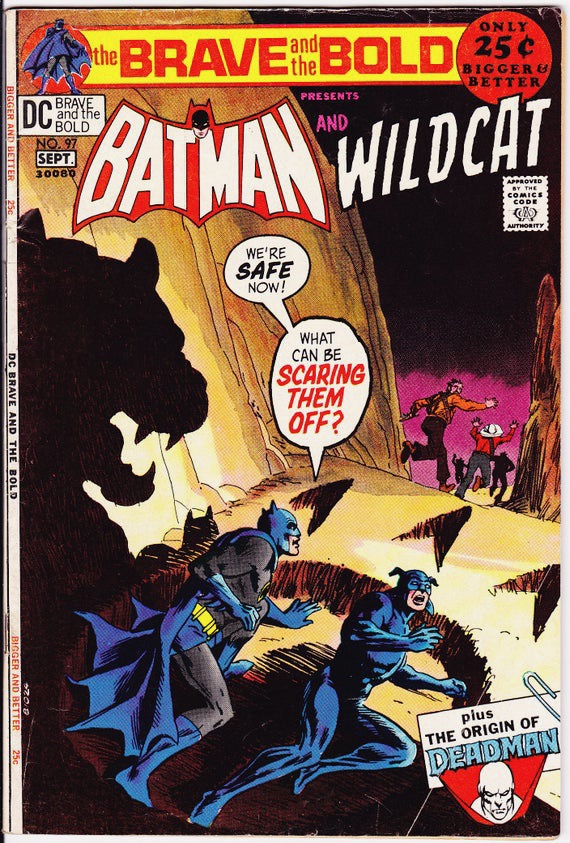
“There was a small newsagents in Somers Road, a DC shop. It had the spinner rack just inside the window. I remember getting Brave & Bold #97 there - the Wildcat team-up issue with a great Nick Cardy cover. I particularly remember that I picked up this issue having already read B&B #98 (The Phantom Stranger team-up) and #99 (The Flash team-up). This comic cemented my intention to collect Brave & Bold henceforth. I also remember that this shop was a good source of House of Mystery issues.The shop may have also featured a small Post Office Counter, but my memory is hazy on that score.” – Ian

© DC comics. Art by Nick Cardy


Re-reading the comic today, it is a great Bob Haney tale that takes Bruce Wayne (and Batman) to South America. Although Bob Brown did the pencils, the inks are unmistakably Cardy's. His art style so dominates  Bob Brown's pencils that some panels look like Cardy drew the whole thing. The panel of Batman's face below is prime Cardy.


There was to be one more stop in Somerstown before we headed towards the Dockyard.

Stop #17. Unknown newsagents in St Paul's Road area

The vagaries of urban redevelopment in Portsmouth have in many places completely razed row upon row of houses, and re-aligned roads, and built new blocks of flats. My pal Geoff Cousins and myself both remember a convenience store somewhere in the vicinity of St Paul's Road that we'd visit around 1974 on the bike ride, but a recent drive slowly cruising around the area yielded no evidence of the place. Perhaps some spark of memory will re-surface, but for now, we'll leave the area of Somerstown and head towards the Dockyard....in the next installment.

Saturday, June 26, 2021

A Question of Character: The Difference between the early Golden Age Superman and Batman Villains - by Nigel Brown

 The poet John Donne said “No man is an island”. This is true even of comic book superheroes. Superman, for example, has help from Lois Lane (in dramatic terms) in maintaining his secret identity as a weakling, when she subjects Clark Kent to frequent bouts of public humiliation.

Seen in this light, a comparison between villains confronted by the Golden Age Superman and the Golden Age Batman throws up some interesting differences between their core values as superheroes.


A key principle of drama is to have a fair match in abilities between one side and the other. If too unbalanced, there’s no drama because the more powerful side will quickly overwhelm the other and it’s game over before readers can engage with the story.


A good example of how a worthy opponent for our hero can put rocket fuel into a story can be found when Sherlock Holmes encounters Professor Moriarty: the consulting detective versus the “Napoleon of Crime” (‘The Adventure of the Final Problem’ 1893). The reader enjoys seeing Holmes stretched further than ever before to defeat this enemy. At the Reichenbach Falls the stakes cannot be higher, and the unsatisfactory result had the public clamouring for more.


Moving into the 20th century, past the horrors of the first World War and the Spanish Flu pandemic, a hundred years ago we were about to enter what became known as the Roaring Twenties. Western society, especially in the United States, took a huge gasp of relief and it became party time.


Carnivals and fairs became increasingly popular in America after World War One (as stated by Hanif Abdurraqib in his book A Little Devil in America). Stuart Jeffries has written of this in The Spectator magazine (27 March 2021), in reference to the dance marathons of the time. There was also an American obsession for testing bodily limits; weightlifting was met with acclaim.


In these circumstances it’s easier to understand, as well, how the teenager Jerry Siegel come up with a carnival-dressed strongman who was capable of physically going beyond human limits: Superman.


Superman’s origin story, on the first page of Action Comics No. 1 (June 1938) explains that Superman’s core value is to be ‘champion of the oppressed’ and to help those in need. 


The Superman Mission


Given Superman’s ability to do whatever he wants, this can be seen, for someone with ultimate personal power, to demonstrate ultimate personal selflessness. The antithesis of this would therefore be the characteristic of ultimate selfishness, to be expressed as putting oneself ahead of everyone else (in ‘pulp’ comic book terms as desiring ‘total world domination’).


So how do Superman’s opponents measure up to this antithetic motivation? We can test this by examining the first published stories of Superman.


The generic ‘villain’ of each story is named first, with the stories listed in order of appearance:


  • Mobsters and political corruption (Action Comics No. 1 June 1938)
  • Corrupt munitions magnate (Action Comics No. 2 July 1938)
  • Corrupt mine owner (Action Comics No. 3 August 1938)
  • Corrupt football coach (Action Comics No. 4 September 1938)
  • Collapsed dam (Action Comics No. 5 October 1938)
  • Criminal brand licensers (Action Comics No. 6 November 1938)
  • Loan-shark preying on circus (Action Comics No. 7 December 1938)
  • Fence encouraging boy thieves (Action Comics No. 8 January 1939)
  • Police Captain hunting Superman (Action Comics No. 9 February 1939)
  • Corrupt chain-gang boss (Action Comics No. 10 March 1939)
  • Corrupt oil stock investors (Action Comics No. 11 April 1939)
  • Corrupt automobile manufacturer and reckless drivers (Action Comics No. 12 May 1939)
  • Jewel thieves New York World’s Fair No. 1 June 1939)
  • The Ultra-Humanite, a scientist (Action Comics No. 13 June 1939)
  • The Ultra-Humanite, a scientist (Action Comics No. 14 July 1939)
  • Gangsters seeking sunken treasure (Action Comics No. 15 August 1939)
  • Gambling racketeers (Action Comics No. 16 September 1939)
  • Boxing racketeers (Reprint from daily newspaper strip Superman No. 2 Fall 1939)
  • Scientist (Reprint from daily newspaper strip Superman No. 2 Fall 1939)
  • Businessman (Reprint from daily newspaper strip Superman No. 2 Fall 1939)
  • The Ultra-Humanite (Action Comics No. 17 October 1939)
  • Blackmailing newspaper owner (Action Comics No. 18 November 1939)
  • The Ultra-Humanite (Action Comics No. 19 December 1939)
  • State orphanage manager (Reprint from daily newspaper strip Superman No. 3 Winter 1939)
  • Jewel smugglers (Reprint from daily newspaper strip Superman No. 3 Winter 1939)
  • The Ultra-Humanite (Action Comics No. 20 January 1940)
  • The Ultra-Humanite (Action Comics No. 21 February 1940)
  • Aggressive warring nation of Toran (Action Comics No. 22 March 1940)
  • Luthor, scientist (Action Comics No. 23 April 1940)
  • Luthor, scientist (Superman No.4 Spring 1940)
  • Luthor, scientist (Superman No.4 Spring 1940)
  • Foreign agent (Superman No.4 Spring 1940)


At a superficial level, there’s no doubt that Superman fulfils his remit to be a champion of the oppressed as he battles corruption in all levels of society (ranging from criminal fences corrupting children to corrupt senators in Washington DC), but it’s not until a year later, in Action Comics No. 13 (June 1939), that he’s up against the Ultra-Humanite (defined by his name as ‘beyond human’) and who could be termed a true ‘supervillain’. The Ultra-Humanite is a character that possesses the antithesis of Superman’s core value: he wants to rule the world. Superman has three more encounters with this supervillain, and then – essentially – the Ultra-Humanite is replaced by a red-headed Luthor (who lacks the super-human powers of the Ultra-Humanite but, nevertheless, is a brilliant scientist with a world-ruling ambition).


Aim of the Ultra-Humanite


Luthor's Aim


Compare this record with Batman:

From Batman’s origin story (not in the first comic featuring Batman, but in a two-page vignette in Detective Comics No.33 November 1939), we learn that Batman’s raison d’etre is to be ‘warring on all criminals’.


Batman's Mission


So looking at Batman’s opponents in those first stories, matching the Superman tally:


Batman (pre-Robin) – 

  • A businessman (Detective Comics No. 27 May 1939)
  • Jewel thieves (Detective Comics No. 28 June 1939)
  • Doctor Death, a scientist (Detective Comics No. 29 July 1939)
  • Doctor Death, a scientist (Detective Comics No. 30 August 1939)
  • The Monk, a supernatural being and vampire (Detective Comics No. 31 September 1939)
  • The Monk, a supernatural being and vampire (Detective Comics No. 32 October 1939)
  • A group of scientists (Detective Comics No. 33 November 1939)
  • A scientist (Detective Comics No. 34 December 1939)
  • An explorer (Detective Comics No. 35 January 1940)
  • Hugo Strange, a scientist (Detective Comics No. 36 February 1940)
  • A foreign agent (Detective Comics No. 37 March 1940)
  • Hugo Strange, a scientist (Batman No. 1 Spring 1940)


Batman and Robin –

  • Protection racket gangsters (Detective Comics No. 38 April 1940)
  • The Joker (1st story Batman No. 1 Spring 1940)
  • The Cat, un-costumed Catwoman (Batman No. 1 Spring 1940)
  • The Joker (2nd story Batman No. 1 Spring 1940)
  • Chinese opium ring (Detective Comics No. 39 May 1940)
  • Clayface, an actor (Detective Comics No. 40 June 1940)
  • Counterfeiting ring (Detective Comics No. 41 July 1940)
  • The Joker (1st story Batman No. 2 Summer 1940)
  • The Crime Master, a brain damaged meek museum curator (Batman No. 2 Summer 1940)
  • Clubfoot, who murders to own a goldmine (Batman No. 2 Summer 1940)
  • Circus owners (Batman No. 2 Summer 1940)
  • A scientist (New York World’s Fair Comics No. 2 1940)
  • An indebted art patron (Detective Comics No. 42 August 1940)
  • Corrupt city officials and racketeers (Detective Comics No. 43 September 1940)
  • Giants, in Robin’s dream (Detective Comics No. 44 October 1940)
  • The Puppet Master, a super hypnotist (Batman No. 3 Fall 1940)
  • Men afflicted with myxedema (Batman No. 3 1940)
  • Mobsters running a crime-school for boys (Batman No. 3 1940)
  • The Cat-Woman, in costume (Batman No. 3 1940)
  • The Joker (Detective Comics No. 45 November 1940)


Immediately it’s clear that Batman (and later, with Robin) faces threats much more personified by ‘supervillains’ than Superman.


Taking a ‘supervillain’ as being an opponent with a colourful name, and perhaps additional fighting skills beyond the average (not necessarily ‘Super’ in the kryptonian sense), then Superman – in his first 32 stories – fights just two of these (the Ultra-Humanite and Luthor) in 28%, or just over a fifth, of the tales.


Batman, in contrast, battles a much higher rate of nine supervillains, in 46%, or nearly half, of the stories.


Why this difference?


Part of the explanation may be that it was enough of a novelty that Superman, as the pioneer superhero, was shown to be fighting ‘ordinary injustice’ in the form of mobsters, corrupt officials in different fields, and even natural disasters (the collapsed dam). But after a year of this, Superman needed greater challenges and so the Ultra-Humanite, the first of Superman’s many supervillains, turned up in the June 1939 Action Comics.


Note that Batman’s first ‘supervillain’, Dr Death, also debuts in July 1939, within a month of Superman’s first supervillain. So perhaps it’s only a consequence of Batman’s later debut that Batman faces his supervillains at an earlier stage in his career.


Dr Death's Plan


We can test this theory by looking at both the Superman and the Batman stories to see if the supervillain ratio changed after the debut of the ‘supervillain’ in June/July 1939 in their respective comics.


Over the next nineteen stories, for both of them:

  • The number and proportion of ‘supervillain’ stories are nine for Superman, which is 47%
  • For Batman stories, the number is twelve, which is still a higher percentage than in the Superman stories, at 63%.

So something more significant is still going on.


I think that is rooted in the difference of core values between Superman and Batman.


Batman has a much more focused mission in his war on all criminals compared to Superman, with Superman’s more general mission of championing the oppressed. 


As a requirement in the ‘dramatic’ testing of Batman, therefore, it’s no surprise that Batman’s more likely to be encountering specific individuals (‘anti-Batmans’, if you like to call them) to test him (in a dramatic sense: ‘Moriarty’s to test ‘Holmes’s).


Incidentally, this explains why the Joker is such an apt and enduring opponent for Batman. Crime, at its most basic form, is disorder in society. Batman has sworn to war on all criminals, essentially a particular type of social disorder, and the Joker represents – in his purest form – absolute social disorder. To quote Heath Ledger as the Joker in the movie The Dark Knight (2008): “Do I really look like a guy with a plan?... I’m not a schemer. I try to show the schemers how pathetic their attempts to control things really are.”


I think that the existence of the Joker, and thereby the duality of Batman/Joker, has elevated the Batman character to a higher level of literary creation (and Alan Moore demonstrated this magnificently in Batman:The Killing Joke, his 1988 graphic novel). The Joker has been going strong for over eighty years now (almost as long as Batman), and is still popular, even to the point of meriting his own movie without Batman (Joker 2019, with Joaquin Phoenix in the title role). 


The Recurring Joker


But this does raise the question, does Superman have an obvious equivalent to Batman’s Joker? I don’t think so, and this is to Superman’s detriment as a well-rounded literary character.


Lex Luthor has always been posited as Superman’s greatest foe.


Let’s put him to the test. Is he the ‘ultimate selfish villain’?


Perhaps not. A classic Silver Age Superman story proves that he’s not totally consumed by his selfish demeanour. His altruistic actions and attitude to the people of the planet Lexor are demonstrated in the Edmond Hamilton story ‘The Showdown between Luthor and Superman’ (Superman No. 164 October 1963).


Lex Luthor Self-Sacrifice


So, given his altruism, Lex Luthor cannot be the absolute antithesis of Superman. So who is?


I’ve suggested another name elsewhere (What’s in a Name? Superman’s greatest enemy we don’t hear about. superstuff73 July 25 2020) but I have another suspect, perhaps frivolous. Not an enemy, but certainly an adversary. There’s one constant character in the Superman mythos who’s been there from the beginning, has always been a professional rival to Clark Kent, has always been totally selfish in seeking their own happiness, and, in many ‘imaginary’ stories, when this has been achieved, Superman has lost his powers (in effect, his existence as Superman has been negated), and, again, I note that Alan Moore had a nod to this in his terrific two-part story “Whatever Happened to the Man of Tomorrow?” (Superman No. 423 and Action Comics No. 583 both September 1986). So, perhaps not so much tongue-in-cheek after all, Superman’s greatest adversary is, and has always been… Lois Lane.


copyright. © Nigel Brown

Sunday, July 10, 2011

The Mad DC Comic Hunt (or Tales of the Fabulous Bronze Age)

by Nigel Brown


This is an unashamed account of a time long gone, thirty-nine years ago by the calendar. Let me start at the beginning…

*

Like most people I was brought up on Dandys, Beanos, Toppers etc. but one day, when I was about seven, I wanted something different. I was getting tired of the wholesome adventures of Desperate Dan and the rest of the gang. My eyes lightened upon a rack of glossy looking comics and I soon purchased my first American comic, Superman No. 190.


There’s no need to tell you how much more exciting those DCs were, and I soon began to collect them at a rate of about one a week. Then I discovered that other shops that sold DCs and it wasn’t long before I had a collection of about sixty comics… collected so that I could read them again whenever I wished.