Showing posts with label Windy City Pulp and Paper. Show all posts

Monday, April 6, 2026

Windy City Pulp and Paper Con 2026 report


Another year has passed (why are they passing so quickly?) and it’s time again for a report on this year’s Windy City Pulp and Paper Convention, again held at the Westin Lombard, in the Chicago suburbs a couple of weekends ago. It was a busy weekend for pulp and comic fans, as Wondercon was also taking place on the West Coast. 

The Westin Lombard

Since my first visit to the Windy City Pulp & Paper Con in 2009, I’ve always hugely enjoyed my annual attendance, as much for the conversations as perusing the dealer’s room. This year was the 25th anniversary of the con, and shows no sign of diminished attendance.  I signed up for a 3-day pass, which at $35 was a far better deal than the upcoming hugely commercial C2E2 comic con at McCormack Place in downtown Chicago, which is charging $140 for a 3-day pass, with $81 for a single day.


So what does one get for $35 at the Windy City?  In addition to receiving the annual convention book issued by Moon Dog press, (this year focused on Argosy magazine), the attendees receive access to the dealer’s room, artwork exhibitions, movies and movie serials featuring pulp heroes, an estate auction, and panels hosted by pulp experts.


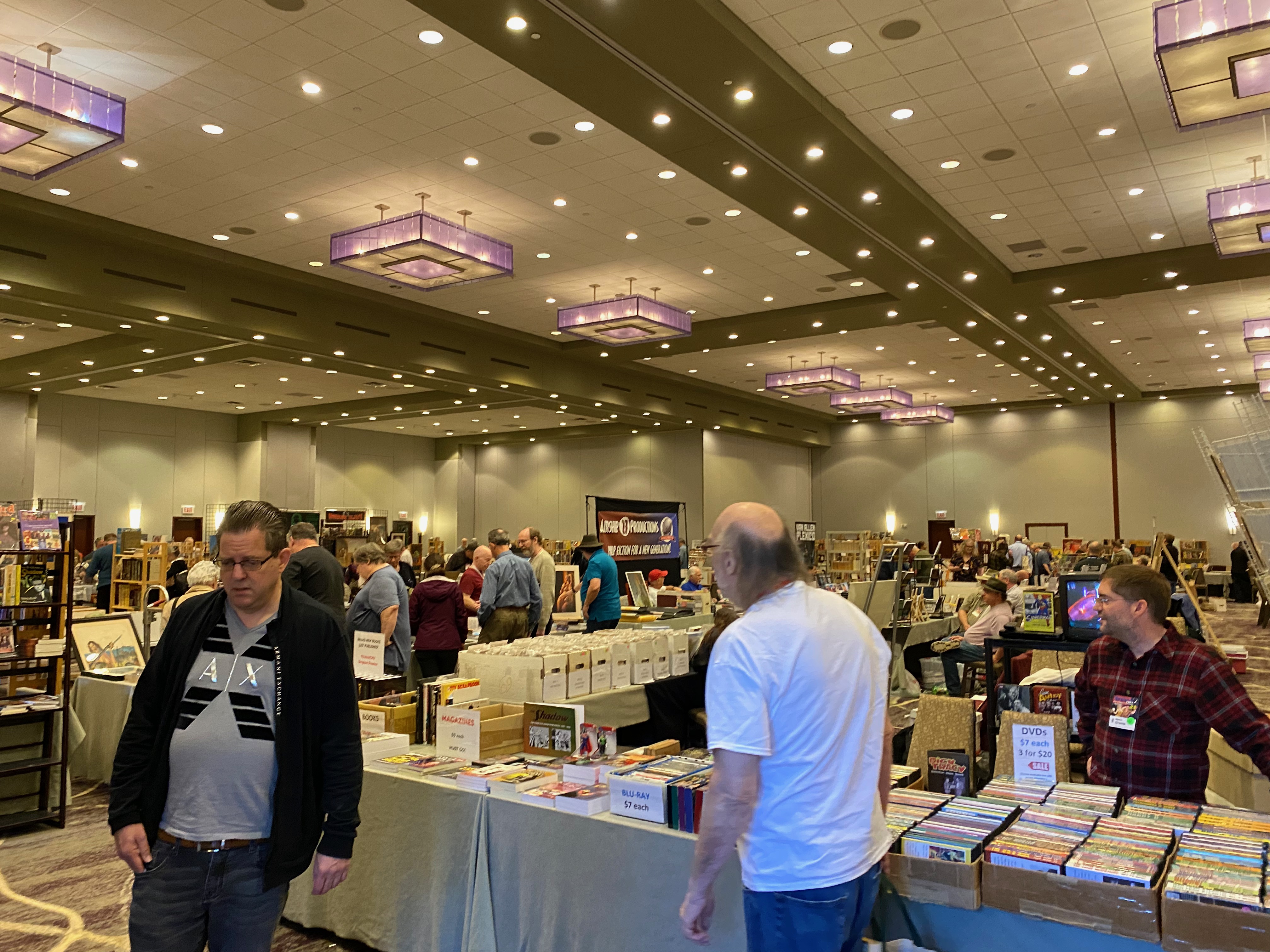
The dealers' room comprises two massive ballrooms with the intermediate panel removed. I arrived around midday on Friday to find the room filled with attendees. I headed over to author and pulp historian Will Murray’s table for a long chat, and to pick up up some Doc Savage hardback editions of his Bantam paperback stories from the 1990s he had brought for me.  


Will shared with me some information he’d researched on the proposed content for the Marvel Black & White Doc Savage magazine #9, prior to its cancellation in 1976. The full information will be appearing in the 100th issue of Bronze Gazette later this year, so no spoilers, I’m afraid.


Subsequently I moved to the Adventure House table and bought some 1970s Avenger and Shadow paperbacks to fill in a few gaps in my collection, replacing books I’d sold in 1989.  Prices were in the $5-$10 range for decent copies.


By the close of the dealers' room on Friday, I had only scratched the surface of what was on view, only managing to go around the tables on the room's perimeter.  Before the room closed for the day, I picked up four Deadly Hands of Kung Fu issues with Adams covers for $27 in total, and Savage Tales #16, from a dealer with the biggest collection of Marvel Black & Whites I’ve ever seen - bagged, boarded and excellent condition. 


I resolved to attend again the following day (Saturday) , having spied a table full of Bronze Age comics priced at $5 each. A quick glance showed the stock was in great condition.


$5 Bronze Age comics, with Golden Age on display at back


Following a brief trip to McDonalds, I returned for the evening agenda of a panel discussing the history of Argosy magazine, followed by the presentation of Pulp writers awards for 2025.


---------------------- 


Saturday dawned, and I made the 40-minute drive back to the Westin for day 2, and to complete my tour of the dealers’ room.


It took me 3 hours to go to every table! I ended up buying a whole load of 1970s DCs to fill in gaps, priced at $5 for Bronze and $10 for silver age - amazing value for decent issues! On another table I bought 6 Silver-age comics priced at $5 each, or 3 for $10!


3 for $10!


Of course, there were lots of Golden Age comics for sale as well.


Fellow SuperStuff scribe Nigel Brown asked me to comment on what I noticed about the slabbing of pulps and comics, and the general attitude to it.


Slabbed pulps.  Note Weird Tales #2 on sale - not slabbed!

Embiggen the photos to read the prices.
Certainly I saw more slabbed pulps here than ever before, although it probably only represented well less than 1% of what was for sale across all the dealers. 


Anyway, I also had a long conversation with a couple who had a table purely of slabbed pulps. I was looking at slabbed pulps valued from $1000 to $95,000 and beyond. They said that slabbing is a relatively new thing for pulps and controversial. But CGC have developed a grading system, and Heritage have started a program of pulp-focused auctions of major collections. They said that the focus for slabbing was high-end, rare or key issuess. The attraction of selling through Heritage is that they get it graded and slabbed by CGC, and then the seller only has to pay for the grading and slabbing once it sells at auction. 


I’ve included a couple of photos of some of what they had on the table, showing prices if you zoom in. The All-Story from 1912 was the first Edgar Rice Burroughs story, priced at $95,000.


Incredibly, the same table had a copy of  Weird Tales #2 (April 1923) for sale, unslabbed (See photo above). That is the rarest issue, rarer than Weird Tales #1. I’m told it is unthinkable for something like that to be for sale at a UK event. I understand that another copy of Weird Tales #2 (graded by CGC at 8.0) is shortly to go up for auction at Heritage.


There were so many Weird Tales for sale - in fact, pretty much any pulp, obscure or not. Nonetheless, the overwhelming number of pulps on sale were in the lowly mylar or polypropylene bag. I’ve included a few photos of pulps up to auction on Friday evening.


Reflecting the sustained interest in pulps, there is an Overstreet price guide equivalent for pulps called Bookery’s Guide To Pulps, with the latest 4th edition just published. (See photo). 


The one thing I did not see were copies of the Ballantine Cornell Woolrich paperbacks from 1982. I’m missing five of them.


——————

Observations:


  • More comics on sale than at previous cons, and the subject matter had extended beyond comics featuring purely pulp heroes (eg Conan, Kull, Doc Savage, Shadow, Avenger) or SF-anthology type comics (eg Strange Adventures, etc).
  • The quality of the comics on sale was excellent (say 7.x for Bronze Age), far better than I’ve seen at local recent marts held in village halls.
  • The pricing on the comics was hugely competitive ; one dealer selling any Bronze Age for $5 and any Silver Age for $10.  Marvel Black & Whites in excellent nick for 50% discount.  I’m not sure what is happening here.  I think there is a bifurcation in the market at the top end of dealers where slabbed pre-1975 comics in 9.x condition are the major focus, and more realistic prices are offered for non-slabbed comics say in 8.x condition and below,


On the pulp side of things, there does seem to be a push towards slabbing of key issues, but the practice is controversial within the pulp community. On the other hand, with the brittleness of pulp paper , slabbing is probably the only way to preserve some of these artifacts.


On the vintage paperback front, prices are still very low for 1960s books, with some exceptions.  There also was a large selection of vintage TV tie-in mass market paperbacks.


Finally, so what did I buy? 


© Marvel.  Couldn't resist these.

© DC and Marvel. $5 each!

© Will Murray and Altus Press.


What’s next?


There is a vintage comic-focused Chicago Minicon on August 9th - will be high-end dealers - no cosplay! https://secondcitycon.com/Attendees.aspx


Pulpfest in Mars PA July 30th - August 2nd

https://pulpfest.com/2025/12/15/an-amazing-century/


Monday, April 24, 2023

Steranko in the Windy City


© Black Dog Books.

Back in the early carbon-copy days of SuperStuff (and I’m talking 1974 here), we could’ve only dreamed of sitting down and having a conversation with one of our idols. So this past Friday morning I started the day with no idea that by early afternoon I would’ve had a 30-minute conversation with famed  illustrator, comic historian, publisher and advertising/creative designer Jim Steranko, still vigorous, engaged and excited by the potential of the medium.

It happened this way. It had been a year since my last report of the annual Windy City Pulp and Paper Convention (see here for the 2022 report), so I decided to swing over to Yorktown Westin hotel in Lombard on Day One of the 2023 event to see what had changed in the year since the first post-COVID con had taken place. I was pleased to see that it was already vibrant and humming at 11am in the morning.

The Windy City Pulp & Paper con is a fascinating event, anchored around a main dealers room, with pulp-related films, auctions and panels taking place in smaller ball-rooms around the building. This is no scruffy comic mart set in the back-room of a downstate bowling alley. Attendance was high for a Friday morning, and a cursory look at prices indicated that the lower prices from last year, where many dealers were looking to shift pre-COVID inventory, were a thing of the past.


Upon arriving my welcome back contained a copy of Windy City Pulp Stories #22, an annual book published especially for the con by Black Dog books of Normal, Illinois.  In addition to reprinting some rare pulp stories ,it lead with a very interesting historical essay by Will Murray on the uncredited authors of G-8, plus also some fascinating excepts from the writers' trade journals of 1933, providing great insights in market conditions at that time. The idea of this book, providing content and context to stimulate further interest in the hobby seems a very sound one to me, and could be transferred to the comic-con world as well.


Being a pulp convention, the pickings for comics enthusiasts was generally limited to pulp-related comics, but also included many interesting novelties such as the colour Sunday Funnies sections from 1940s newspapers.


A box of Superman and Tarzan Sunday Funnies from the 1940s

My own route into the pulp world had been via the Doc Savage, Shadow and Avenger paperback reprints in the early 1970s, and then by the subsequent DC and Marvel comic adaptations of those characters. My knowledge of pulp history was subsequently informed by the research and writings of Will Murray and Ron Goulart. So I’m pretty much a pulp novice who doesn’t know too much about G-8 and His Battle Aces, or The Spider, or any of the more obscure characters that surfaced in the 1930s, parallel to the growth of the nascent Science Fiction pulp world. But if I had a barrel of cash this con would be the place to fill in the gaps in my knowledge - table after table of classic pulps - both adventure and SF - and 1950s/1960s paperbacks with their saucy, enticing covers by the artists who had made their bones in the pulp world. 


My first stop was at Chuck Welch’s table. Chuck is the editor of the pre-eminent Doc Savage fanzine “The Bronze Gazette”, which had carried a version of my blog entry on the links between Serpico and Doc Savage from a while back. It was a pleasure to meet him. I encourage anyone with an interest in Doc Savage to take a look at the website  . 


Following my first turn around the dealers table, I headed over to Will Murray’s table, shared with Anthony Tollin, to pick up a copy of Mr Murray’s expanded, revised and retitled edition of his 1980 work “The Duende History of the Shadow”, now christened “Dark Avenger - The Strange Saga of the Shadow”.  I can’t wait to find the time to read the book. Mr Murray also shared that he will be publishing a further volume, collecting a multitude of Shadow articles written over the years, which I will no doubt seek out.


© 2022. Will Murray

Finally I came to a table which was devoted to rare pulp items for sale. What had caught my eye was a copy of #1 of the UK Batman mini-pulps published under the World Adventure Library banner by World Distributors in 1967 - priced at $300! I had paid a pre-decimal one shilling for it in 1967, as recounted in this 2021 blog entry  .


Raising my eyes from the table, I encountered the outstretched hand of Jim Steranko himself on the opposite side, safari-suited and coiffed hair, introducing himself with the question “Can you think of any other comic book artist who has also held a fine art exhibition in one of the most prestigious galleries in the US?”.   I hazarded a guess that perhaps Frank Robbins had exhibited his paintings once he had retired to Mexico, but I don’t think that was the answer that Mr Steranko was looking for. 


Artwork © Steranko

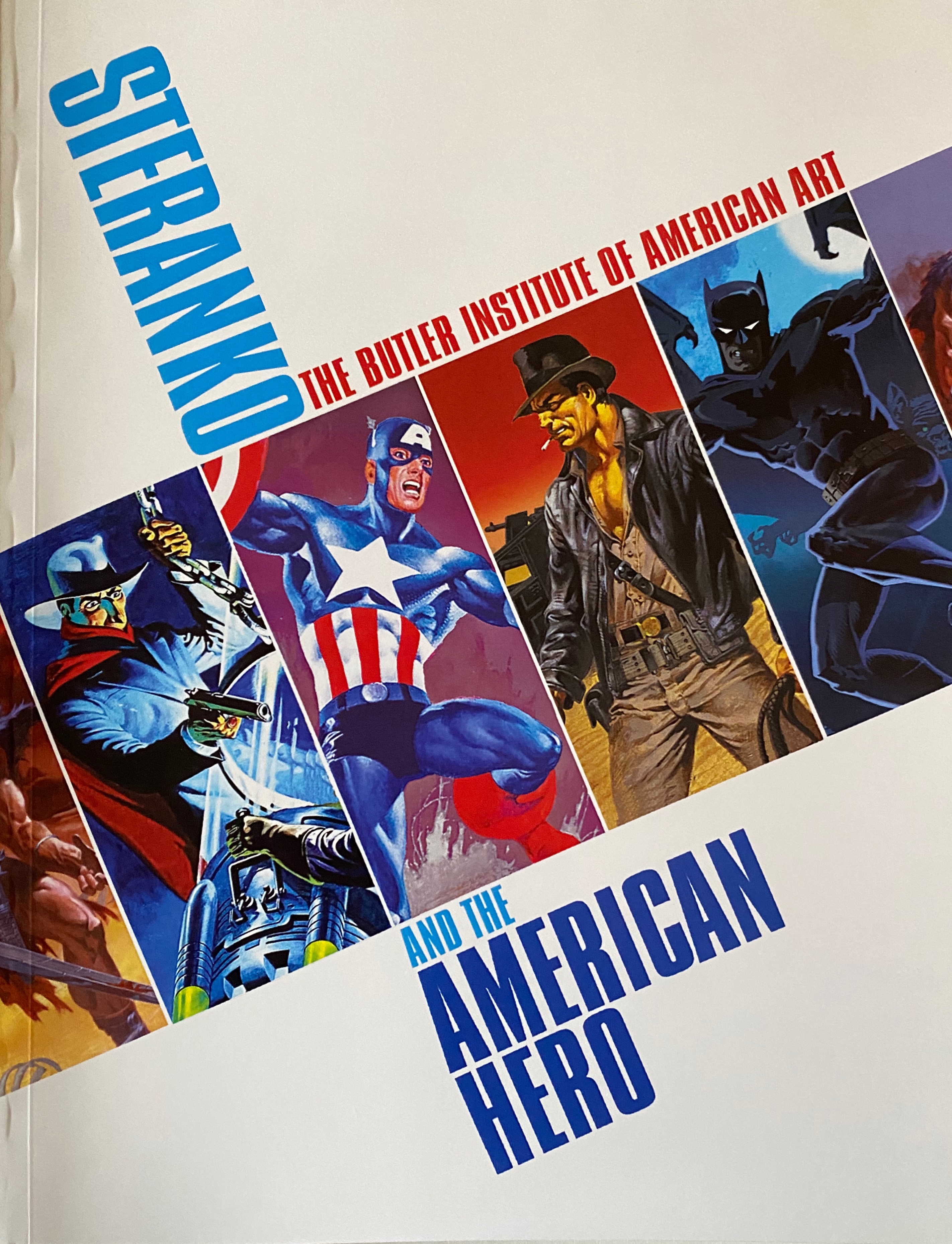
Referring to his artbook “Steranko and The American Hero”, published as a companion piece to his exhibition by the Butler Institute of American Art, we then had a pretty wide-ranging conversation about his approach to art. He opined that artists were either intuitive or analytical. He put Kirby in the intuitive category - someone who drew from his imagination without initial regard to composition - whereas Steranko saw himself on the analytical side, thinking through the placement of elements in a  picture, very much influenced by his advertising discipline.  One example of Kirby’s approach was a sketch of Captain America where Kirby started by drawing Cap’s belt buckle, and then expanding the image out from the centre.


We discussed Steranko’s work on Chandler, as well as his cover design for the Philip Marlowe graphic novel collection.


We also discussed his Shadow paperback covers commissioned for Jove/Pyramid back in the 1970s, and the degree of freedom that he had on overall design. There were no unpublished covers in that series - he always worked on commission. All fascinating stuff.


Mr Steranko  is still working today, most currently on conceptual art for Francis Ford Coppola’s upcoming film Megalopolis (currently in production), continuing a strand of conceptual artwork creation which encompassed Raiders of the Lost Ark, Blade Runner and Coppola’s Dracula.


My final question was about his famous work “Steranko’s History of Comics’, which was published as two volumes of an anticipated six-volume series. Steranko told me that in fact  he had envisioned a four-volume set. He said that he had completed much of the content for Volume 3, but whether it would ever be published was an open question.


I would have liked a photo of Mr Steranko, but he declined as it had been a policy of “no photos” that he’d had to adopt. I made do with his personalized signature in my copy of Steranko and The American Hero”. It was a great pleasure to meet the gentleman ; he is truly a force of nature and remains an outstanding talent. 


And now one of the last men standing from the Bronze Age.


Text © Ian Baker.


All images used are copyright their respective owners and are included here under the context of  Fair Use for the purposes of illustration


Monday, May 9, 2022

Windy City Pulp and Paper Convention - Con Report

It’s been thirteen years since I last attended the Windy City Pulp and Paper Convention, one of the premier cons in the US that focuses on pulps and related ephemera. It’s a big 3-day event held at the upmarket Westin hotel in Lombard, in the Chicago suburbs. Since it was a beautiful Spring day on Saturday (May7th 2022) I decided to head over to Lombard to see how the con had changed since I last attended in 2008.

© Ian Baker. The Westin, Yorktown Center, Lombard, IL.

I had paid $25 for a 1-day membership, which entitled me to attend the dealers rooms, the panel discussions, the films on show, and the painting gallery. A 3-day membership cost $35.


Upon arriving my welcome back contained a copy of Windy City Pulp Stories #21, an annual book published especially for the con by Black Dog books of Normal, Illinois. In addition to reprinting some rare pulp stories by Dashiell Hammett and Robert E Howard and others,it lead with a very interesting historical essay by Will Murray on the Fall and Rise of Fiction House, a prime mover in the transition of the sedate dime novel to the fast adventure stories of the pulps. The idea of this book, providing content and context to stimulate further interest in the hobby seems a very sound one to me, and could be transferred to the comic-con world as well.


© Black Dog Books, Normal, IL


I spent a very enjoyable few hours wandering around the dealer tables. What struck me immediately about a Pulp con (as opposed to a Comic-Con) was the both the attendees and dealers are in general significantly older than their Comic-Con counterparts. These are people who probably first encountered pulps through the 1960s and 1970s reprints of Doc Savage, The Shadow, Conan, Tarzan and that stimulated their passion for those characters, which in turn made them seek out the original pulps.


© Ian Baker. Dealers Room.

Entering the main ballroom, at first glance it seems similar to a comic mart, but this time the long boxes are full of pulps in Mylar bags. Immaculate pulps are displayed on stands and it is quite a sight to see the bright painted covers of The Shadow by George or Jerome Dozen on display, along with the Spider and The Avenger, amongst others.


The Adventure House dealer's table.


Part of the Adventure House stand.


Of course, copies of Astounding Stories and other seminal SF pulps are also to be found alongside the more character-driven pulps.


In addition there were quite a selection of Golden Age comics from a few dealers, along with a good selection of DC and Marvel comics from the 1970s that featured comic adaptations of famous pulp characters (eg Ka-Zar, Conan, John Carter of Mars, Tarzan, etc) .


But it is not all pulps. Mass-market paperbacks from the 1960s and 1970s were also on sale - those cheap sci-fi and cheap-thrill paperbacks with frequently sleazy covers that really filled the vacuum left by the pulps after they died in the late 1940s.


A typical $2 box

I saw no price gouging at all. There were a few slabbed CGI-authenticated pulps but usually valuable stock was displayed in the usual Mylar bags, and available for inspection. Comics for sale were in the $3-$5 range. I saw good quality Doc Savage Bantam paperbacks for sale as low as $1 each. People were there to enjoy themselves and meet old friends.


I wound up having an enjoyable discussion with Will Murray (foremost authority on Doc Savage and the writer of a score of Doc Savage novels since the 1990s, writing under the original house name of Kenneth Robeson). Mr Murray is in process of arranging the publishing of a revised and updated version of his “Duende History of the Shadow”, a book I first bought back in 1979. I’ll be first in line to get the revised book. For anyone interested in the history of the pulps, I can particularly recommend three of Mr Murray’s non-fiction books - “Writings in Bronze” (essays on Doc Savage), “The Rise of The Shadow” (essays focusing on the background to the character and the original radio show), and “Wordslingers” (a history of the Western pulp, which I found fascinating).


I ended up buying a few old Avenger paperbacks for the re-acquisition nostalgia value, a couple of 1970s “Weird Heroes” anthologies by Byron Preiss, and two of the most recent Doc Savage novels by Will Murray. I returned home a happy man.


Part of my haul.

So, it was a very enjoyable morning and afternoon. I did not get the opportunity to return in the evening for the Saturday panel sessions (the son of artist Norman Saunders - famed for his Mars Attacks and Batman trading card paintings - was due to run a session), but I will be sure to return next year.


© Ian Baker