 |
| © DC Comics and Topps - 1966 |
One of the first Batman trading cards I ever owned was this one - “Black Bat” set # 38 - of the Dynamic Duo posing outside the entrance to the Batcave from within Wayne Manor. This is interesting because:
- The Batcave entrance had been replaced by an elevator in the comics two years earlier in 1964
- Access to the Batcave was by a sliding bookcase to the famed Batpoles in the current TV series
- The Batman trading card shows a laboratory room beyond - not stairs, nor a cave nor steps to a cave
- It asks the question "Why are they in costume within Wayne Manor?"
As previously mentioned on this blog, Norman Saunders usually (but not always) painted the trading cards based on pencil drawings supplied by Bob Powell. Saunders then included additional details not present in Powell’s pencils, so the paintings were always likely to have some deviation from comics canon.
I thought I’d take a deep dive into the history of the grandfather clock as the entrance to the Batcave, and see if I could locate any earlier material that might have inspired the specific elements of the painting by Norman Saunders.
The text on the back of the card by Larry Ivie gave no clue, so I decided to go back to the beginning, to the first time that the Batcave’s origin was documented in the Batman "dailies" on October 29, 1943, in a strip entitled "The Bat Cave!”.
 |
| © DC Comics , Oct 1943 |
As you can see, the entrance to the cave in this strip was by a sliding bookcase.
However, that same year 1943, the first Batman & Robin movie serial was released, which featured a large grandfather clock as the entrance to the cave from within Wayne Manor. Bob Kane was so taken by the idea that he passed it on to writer Bill Finger for subsequent incorporation into the comic. [Interestingly, the conceit of a large grandfather clock covering the entrance of a secret room was lifted from the 1920s silent film “The Mark of Zorro”.]
Note that in the 1943 serial, the clock is about 8’ tall, and the dynamic duo squeeze through the front of the clock, past the pendulum to gain access. The clock appears to be in the library.
 |
| © Columbia Pictures and DC Comics. Bruce Wayne (Lewis Wilson) squeezes through the clock into the library. |
The serial also features a sequence when Batman and Robin enter the manor in costume, and the pass through the clock to the Batcave beyond.

And furthermore, the serial featured a crime lab for the first time.
 |
| © Columbia Pictures and DC comics. The "Bat's Cave" crime lab |
It was five years later that the clock was incorporated into DC canon in 1948’s Batman #48 “1,000 Secrets of the Batcave”. (Editor Jack Schiff, Artist Sheldon Moldoff, Writer Bill Finger) when burglar Wolf Brando enters Wayne Manor and accidentally stumbles against the clock, triggering a switch that opens the clock and reveals the Batcave beyond.

 |
| © DC comics. Batman #48 |
The clock was then to be featured in 25 stories across the next 19 years across the three comics Batman, Detective and World’s Finest, even past the time when until Julie Schwartz took over Batman and Detective Comics editorship in 1964 and replaced the stairs with an elevator.
What emerges within those comic stories are two distinct versions of the clock:
- 1. A clock around 6’ in height which swings open (usually hinged on the left hand side to the wall) to reveal a flight of descending stairs in the subsequent panel
 |
| © DC Comics. Batman #99. "Phantom of the Batcave". Artist Sheldon Moldoff |
- 2. A much larger clock - presumably 8’ in height and wider - which enables our heroes to open the glass front and pass through (generally run through) the clock onto the stairs beyond.
 |
| © DC Comics. Batman #110. "The Phantom Batman". Artist Dick Sprang |
Regardless of the design of the clock, all comics and the 1943 movie serial showed an immediate drop to the stairs beyond.
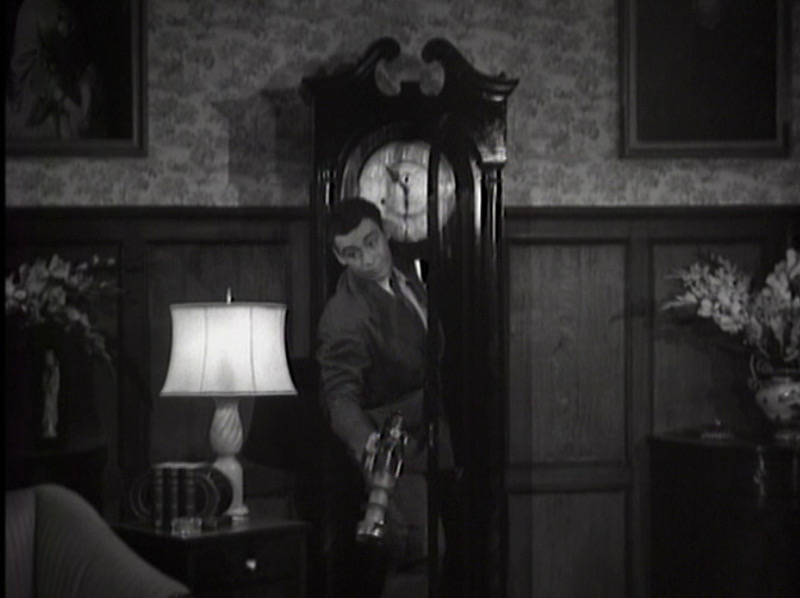
But the subsequent 1949 Batman & Robin movie serial starring Robert Lowrey had no stairs beyond the large grandfather lock.
 |
| © Columbia Pictures. Bruce Wayne (Robert Lowery) rushes through the clock to the room beyond in the 1949 movie serial |
Throughout these comic stories, our heroes never go through the clock in costume, with one partial exception, which I cover below.
Bill Finger was to write the majority (13) of the Batman stories featuring the grandfather clock (closely followed by Edmond Hamilton with a tally of 9 tales) , but the decisions on how the clock was portrayed fell to the artists themselves.
If the stories were drawn by Sheldon Moldoff , the clock was depicted as about 6’ tall and swung out to reveal the entrance to the Batcave ; if drawn by Dick Sprang (the “good” Bob Kane ghost), the clock was much larger with a door on the front that our heroes passed through.
 |
| © DC Comics . My personal favourite of the stories is Dick Sprang’s “Batman Baby Sitter” from Batman #93, 1955. |
Looking at the list of stories, the appearance of the clock seemed to almost alternate between issues. In Batman #110, in the same issue, Sprang and Moldoff draw the clock completely differently in subsequent stories. Editor Jack Schiff did not seem to care about lack of continuity, despite editing all three comics featuring Batman during the entire period.
 |
| List of all stories with the grandfather clock |
Although Jack Schiff was editor of World’s Finest during this entire period, it was not until World’s Finest #109 in 1960 that the clock appeared in a story drawn by an artist other than Sheldon Moldoff or Dick Sprang. (Neither Jerry Robinson nor Lew Sayre Schwartz ever drew the clock, for example). World’s Finest #109 was drawn by Curt Swan and written by Jerry Coleman. In this story (Street date 3/3/60), “The Bewitched Batman” , Robin and Superman in costume walk through the larger clock onto the stairs beyond, and being the only instance of costumed heroes using the entrance.
 |
| © DC Comics . World's Finest #109. "The Bewitched Batman". Artist : Curt Swan |
I’m inclined to believe that Curt Swan was influenced by Dick Sprang’s larger clock approach than with Sheldon Moldoff’s movable clock. [Sprang was a friend of Curt Swan , referring to him by first name only in an AlterEgo #107 interview]
Swan was to draw the clock twice more, in 1964 and 1965 (this time in stories written by Edmond Hamlilton) and in each appearance drew the clock as an 8’ tall clock, but variously had the clock swing or slide aside to reveal the stairs to the cave.
The final rendition of the clock was by Al Plastino (World’s Finest #165 - street Jan 26th 1967) showing a smaller 6’ clock being simply moved to the right.
 |
| © DC Comics. World's Finest #165. The last appearance of the grandfather clock in the Silver Age. |
By this time, Mort Weisinger had taken on editorship of World’s Finest, and seemed completely unaware that Julie Schwartz had replaced the grandfather clock with an elevator three years earlier back in 1964!
[Unlike Marvel of this period, editorships of DC comics were run like personal fiefdoms, which explains the lack of continuity between Batman/Detective, World’s Finest and Brave & Bold during the 1960s.]
So back to the Batman trading card origins: if there was any influences at all on Norman Saunders, it was the 1943 movie serial and the comics imagery of Dick Sprang. The 1943 movie serial was the only example of Batman and Robin in costume outside the clock in Wayne Manor. This scene was most likely the source of the idea for the trading card, but Saunders or Powell may have been influenced by Curt Swan’s rendition of Robin and Superman passing through the clock.
The 1949 movie serial however provided the concept that the clock led directly to the crime lab on the same level.
More recently, there has been much retconning of the grandfather clock’s importance in the Batman mythos, with the hands of the clock being set variously to 10:47pm or 10:48pm as the time of Bruce’s parents' death. ( Batman vol. 3, #69 (March 2019))


