Thursday, April 28, 2022

H G Wells and War of the Worlds

[I started writing this before I’d read McScotty’s blog entry about Amazing Adventures #18 over at his blog  which is well worth a visit].

© Marvel


H.G. Wells - © Public Domain

My home town of Portsmouth and its seaside resort Southsea has many historical heroes with links to the Bronze Age of comics, of which famed SF & Fantasy writer and visionary Herbert George Wells is but one.

It is hard to imagine if HG Wells, while working in a Draper’s Bazaar in Elm Grove, could have foreseen that one day he would be teaming up posthumously with Stan Lee and Don McGregor on Amazing Adventures #22, wherein Killraven battles the Human Squid, but I’m sure that he would have found the Marvel adaptation “inspired” by his War of the Worlds in tune with many of the ideas of his vast portfolio of SF creations.

Wells’ connection to Southsea stems from the time between 1880 and 1883, when he had an unhappy apprenticeship as a draper at Hyde's Drapery Emporium in Southsea. His experiences at Hyde's, where he worked a thirteen-hour day and slept in a dormitory with other apprentices, later inspired his novels The Wheels of Chance, The History of Mr Polly, and most appositely Kipps, which portray the life of a draper's apprentice as well as providing a critique of society's distribution of wealth.

It was soon after leaving Southsea for Woking in Surrey that Wells enjoyed his most creatively fertile period, when  he planned and wrote The War of the Worlds and The Time Machine and completed The Island of Doctor Moreau, (all of which would inspire later Marvel comics adaptations).

Slightly more than a generation later, in the United States in April 1926, famed editor Hugo Gernsback would reprint much of Wells's work in the pulp magazine Amazing Stories, regarding Wells's work as "texts of central importance to the self-conscious new genre".

And so a further generation after the pulp Amazing Stories, it was fitting that Wells’ work was featured in Marvel’s own Amazing Adventures comic in the guise of Killraven - freedom fighter Jonathan Raven - depicted in several post-apocalyptic alternate futures. Created by co-plotters Roy Thomas and Neal Adams, under the auspices of scriptwriter Gerry Conway and initially penciller Adams himself, the character first appeared in Amazing Adventures vol. 2, #18 (Cover-dated May 1973) .

© Marvel

The cover was very clear on the basis of the source material “Amazing Adventures featuring “WAR OF THE WORLDS” based on concepts related in the prophetic novel by H G Wells!” .

Co-creator Neal Adams' early ideas for Killraven involved the character being the son of a Doc Savage archetype. (Ref: Comic Artist #3). This concept had been reworked by the first issue in which co-creator Adams penciled only the first 11 pages with Howard Chaykin completing the remaining nine. The second issue was fully written by the debut's scripter, Gerry Conway, followed in the third by Marv Wolfman.

On the alternate-future Earth designated Earth-691 by Marvel Comics, the Martians from H. G. Wells' The War of the Worlds return in 2001 for another attempt at conquering the planet. With humanity enslaved, the men forced to battle gladiator-style for the Martians' amusement, Jonathan Raven (dubbed Killraven as his gladiatorial nom de guerre), escapes to join the Freemen, a group of freedom fighters .

As the series progressed, the link to Wells’ original vision became more and more tenuous, as reflected in the constantly changing book’s title across 22 issues (Amazing Adventures #18-#39 inclusive).


#18 "Amazing Adventures featuring “WAR OF THE WORLDS” based on concepts related in the prophetic novel by H G Wells"

#19 (Note “Prophetic” was dropped) "Amazing Adventures featuring “WAR OF THE WORLDS” based on concepts related in the  novel by H G Wells"

#20-#27( New tagline “The Most Widely Acclaimed Science Fiction Series Ever!”) "Amazing Adventures featuring “WAR OF THE WORLDS” based on concepts related in the  novel by H G Wells"

#28 (All reference to H.G. Wells dropped from the cover) "Amazing Adventures featuring “WAR OF THE WORLDS” - featuring Killraven!"

#29-#34 (rebranded - and H.G. still gets the boot!) "Killraven…WARRIOR OF THE WORLDS”

#35-#39 "War of the Worlds"

While the series was running, Marvel UK had developed a headache over content for their Planet of the Apes weekly, as they were running out of US Planet of the Apes content to reprint.  They hit upon the idea of repurposing Killraven as “Apeslayer” for the UK Planet of the Apes fan base as an emergency measure. The US Killraven stories were partially redrawn and re-lettered to create a new story that would fit into the Marvel version of the Planet of the Apes continuity. (Fun Fact: technically Apeslayer is the first ever Marvel UK-originated character).

Apparently, the UK team felt that Apeslayer, by way of Killraven, was so far removed from the original source material that H G Wells did not require a credit in the UK P.O.T.A. weekly. In fact, the credits for “The Birth of Apeslayer” do not even mention Neal Adams himself as either co-creator or contributing artist despite integrating artwork by the great man himself


© Marvel - enbiggen this to read !! Comparison of Killraven and Apeslayer

As H.G. Wells’ books were still within UK copyright at the time, rebranding Killraven as Apeslayer in the UK, and removing any reference to H G Wells on the US comic covers, may have been a move to avoid any legal issues.

The UK Apeslayer adaptations appeared in just 8 issues of Planet of the Apes weekly (#23-#30) , running from March 29th 1975 to May 17th 1975.

What was strange is that Marvel did not choose to stop distribution of the US Amazing Adventures in the UK during this period, which would have been the May-September 1975 cover issues (#30-#32),  but they had previously stopped the distribution of US issues #23-#25 a year earlier in 1974, with those issues not being available in UK price-variant guise.

Amazing Adventures was eventually cancelled with issue #39. I don’t believe that I owned all of the issues. I certainly collected issues #18 and #19 in 1973 (bought from Simpsons in Osborne Rd), and was again buying later issues in April 1976 from See's newsagents in Copnor, but it was not a regular purchase by that time. The overlap with Planet of the Apes weekly had caused me to put the US Amazing Adventures comic far down the list of US Marvels to buy each month. 

Marvel tried some innovative pricing approaches with their UK price variants; issues #18-#22 were 8p each ; following the “non-distributed” hiatus of issues #23-#25, issue #26 was priced at 7p, before returning to 8p pricing with the next issue. In that time of rampant inflation, the price quickly rose from 9p to 10p, and became too rich for my blood. However, if HG Wells had miraculously survived into the 1970s, I suspect he would have sought out and enjoyed every issue.

Killraven would later resurface in his original incarnation in the UK Star Wars Weekly a few years later.When Marvel UK eventually began reprinting the original Killraven series in Star Wars Weekly, one reader complained that they had 're-drawn Apeslayer, with Martians'.


Thursday, April 7, 2022

A week in Ventnor - July 1972

Sometimes comic memories stick in the mind because they’re linked to seminal events in your life.

In the summer of 1972 I had just turned 13, and so I was allowed to go on my first holiday on my own, to Ventnor on the south side of the Isle of Wight to stay with my Aunt and Uncle for a week.


I went with high hopes of getting more comics at Mr Keen’s antiquarian bookshop in Pier Street, Ventnor. Earlier that year  on a holiday with my Mum and Dad - at Easter -  I had hit the jackpot with scoring a pile of comics in Mr Keen’s antiquarian bookshop in Ventnor at 2p each, including a run of most of Detective 390-412- which included those classic Denny O’Neil/Neal Adams Man-Bat stories plus the Enemy Ace crossover. (For those you wishing to take a look at Google street view , the address is 19 Pier Street, Ventnor. Mr Keen is long gone, of course, owning the shop from 1972-1981.)


Each day that week  in July I would walk down from Upper Ventnor to the town centre in the hopes of finding new comics in John Menzies or at one of the seafront gift shops.


Even though it was Summer, I felt compelled to wear my over-sized army-surplus combat jacket which had come from Ben Grubbs, a store in Portsmouth. I felt it lent me an air of rugged individuality.


My Aunt and Uncle’s daughter, my cousin, who was four years older than me at seventeen, welcomed me to tag along with her, her boyfriend and their friends. Her boyfriend (“call me Zak”) was an amiable bearded long-haired groovy guy with a penchant for check jackets with wide lapels.  I felt honored to be allowed to hang out with them (no doubt at the behest of my aunt).


The Regal, Shanklin, 1972


The week kicked off on a Sunday night with a trip to Shanklin to see Diamonds are Forever at the Regal cinema in Shanklin. We went in a van driven by a friend of my cousin. I think there were five of us siting on a mattress on the floor in the back, as we rattled around inside the rear of the van. (I have an inkling that the driver - a curly-haired, more conventional, friendly guy inclined to a rosy complexion - had a crush on my cousin.)


What a film! This was my first exposure to Sean Connery as Bond (having previously seen OHMSS in 1969), and the early scene where he is trapped in a coffin inside a crematorium incinerator sticks in my mind. I also took notice of the film poster (by the great Robert McGinnis), realizing how the common motif of Bond with his arms folded had become connecting tissue across all the Bond film posters.


As I went to bed that night at my Aunt’s house (I was staying in the room vacated by my cousin’s older brother who was away) I became aware that a paperback book had fallen on the floor from where it had been tucked under the mattress. It was a bit of an eye-opener for. 13-year old.


That book was The Perfumed Garden (Panther Edition,1966), a translation of an ancient Indian sex manual by Sir Richard Burton, famed Arabist, polymath and explorer. I would a few years later re-encounter Sir Richard Burton as the fictional protagonist in Philip Jose Farmer’s book To Your Scattered Bodies Go. Well, those Indians knew a thing or two about human gymnastics that wouldn’t end up an an Olympic sport , and I reflected that learning a different language at school may have had applications I had not previously appreciated. 


The Silvermere Cafe gift shop where I found Detective #355

The next day I decided to walk down to the seafront, and on the spinner rack of a gift shop I found an excellent condition copy of Detective #355  (“Hate of the Hooded Hangman”).What a find! Six years after publication and not a crease! It felt almost as good as if I’d found Detective #27! I can remember the crispness of it now (presumably sun-baked over the previous 6 summers, even though there was no evidence of direct sunlight fading)


The Rex Cinema, Ventnor

As the week was coming to a close, hormones raging, I persuaded my Aunt to take me to see Up The Front at the Rex Cinema on Thursday. I was a great fan of the Carry On films at this time, and figured that this would probably be a bit risqué, with Frankie Howard ably supported by the ample charms of Madeline Smith. I was not disappointed, although I think that my Aunt had some misgivings that she was culpable in exposing her nephew to something so salacious (well it was “A” rated).


So at the end of the week I returned home with the experience of having moved in a maturer circles of friends, had some education that garden swings had more uses that previously envisaged, had seen an exciting Bond film with a fantastic poster by Robert McGinnis, had seen Madeline Smith in fine form on the silver screen, and had an immaculate copy of Detective #355 safely stored in my haversack.


Shanklin - the Isle of Wight ferry


As I crossed the Solent back to Portsmouth on the Isle of Wight ferry "Shanklin", waiting for me back in Pompey was the prospect of the new DCs hitting the spinner rack on the following Thursday.


What a summer! Golden Days indeed.

Wednesday, January 26, 2022

Belfast, Thor and growing up in the Sixties

Over the weekend I watched the most wonderful film “Belfast” , Kenneth Branagh’s autobiographically-inspired film of growing up in Belfast in 1969. For any of us British schoolboys born around the start of the sixties, the film will touch on a lot of memories and emotions of a time that has suddenly disappeared. 

All the actors are at the top of their game, and the young Jude Hill as “Buddy” is a revelation. I shelled out $19.99 to watch it with the family on Amazon Prime and it was well worth it. The attention to period detail in the film is immaculate, and for those of you with an abiding affection for Star Trek, Thunderbirds, Corgi and Matchbox toys, the enjoyment is that much the greater. 

Those of you with eagle eyes will spot young Buddy reading a Thor comic (#139 – “To Die Like A God”) and if you zoom in, you’ll even see that Buddy is reading the 10d UK “price variant” edition. (A two-year old comic at the time the film is set). A nice nod to Branagh’s subsequent desire to direct the first Thor movie. 

Great stuff! Go and see the film, or stream it. You’ll thank me.
© Universal/Focus Features. "Buddy" (Jude Hill) reading Thor #139

© Marvel Comics.


Saturday, January 15, 2022

Where were you in ’72? Remembering when comics were “relevant”

 Do you remember when comics were “relevant”? 

Any discussion of social relevance in comics always lights upon the topics of skin color and social deprivation highlighted in Green Lantern/Green Arrow #76, or mentions Speedy’s drug addiction as shown in Green Lantern/Green Arrow #85 and #86. While it is true that those stories can be regarded as the high water mark for DC comic books connecting with real-world issues,  they also marked the start of a decline to a blander and less challenging approach to packaging superhero material that continues to this day. 

Green Lantern #76. © DC Comics 1970

When New York mayor John Lindsey praised the “no-holds barred” approach to highlighting drug abuse depicted in Green Lantern/Green Arrow in 1972, DC had been quietly bringing “relevance” into DC comics for the past 4 years since 1968, reflecting a growing desire by a small cadre of young writers at DC to tackle the most pressing social injustices in a way accessible to a college youth disaffected and worried about going to Viet-Nam.

Over a period of five years, thirty-eight DC comics tacked the problems of the day head-on, and a further forty-plus comic stories, while less confrontational, quietly reflected the current mores within the United States ; the changing attitudes to Women’s roles in the pages of Wonder Woman and Lois Lane ;  Bat Lash humourously bringing the modern hippie counter-culture to the Old West, and Tomahawk highlighting contemporary Native American concerns through the lens of Hawk, Son of Tomahawk. In addition, Mike Friedrich’s authorship of the Robin back-up stories first in Detective Comics and then subsequently in Batman brought a modern perspective to college life.

Looking back from a vantage of fifty years, I think that DC did a great job of educating me on social issues as a 12-year old. I was not an avid reader of UK-produced comics and I doubt that if I’d been a collector of solely UK comics that I would have been exposed (either consciously or sub-consciously) to the evils of political corruption or environmental concerns at such a tender age.

From 1968 to 1973, stories of relevance snaked their way through many popular DC titles, although I think it is fair to say that if you were not a fan of Justice League of America or Green Lantern/Green Arrow, the themes may have passed you by.

1968 - DC dips its toe in the water of social relevance

The start of "relevance" at DC. Wonder Woman #178. © DC Comics

It can be argued that the ascendance of “relevance” marked the start of the comics Bronze Age. Certainly, the first flag planted in the ground for “relevance” in comics was the September 1968 issue of Wonder Woman #178 “Wonder Woman’s Rival” , under the shepherding of twenty-nine year-old Denny O’Neil. Denny wrote a story in which Wonder Woman re-assesses her life and motivations, in the process relinquishing her costume in the quest to become a liberated woman.  These early "New" Wonder Woman stories did not overtly push the Women’s Lib agenda. In fact, many of the stories still revolved around Diana Prince trying to hold on to Steve Trevor as a romantic beau, but the fact that DC’s most famous female superhero was embracing the new social sensibilities sent a major message to the audience. Young Denny O’Neil was quietly crafting some major changes, first under the editorship of old DC hand Jack Miller, and then subsequently under artist-turned-editor Mike Sekowsky.

Reader reaction on the letters page of Wonder Woman #181 was overwhelmingly positive, and included praise from a certain Mark Evanier. Relevance was off to the races!

Denny O’Neil was already a known advocate for the peace movement and women’s rights when he joined DC. In a later interview with Gary Groth of The Comics Journal he said “It was part of my agreement with DC that I will not be asked to write a story glorifying war because I don’t believe that war is ever a good thing and I would not feel comfortable with a military hero. I also don’t like to write romance stories. I did Millie way back when. That’s a skeleton in my closet, though. I think the way those stories are handled demeans what happens between a man and a woman.”

The following month in October 1968, Bat Lash #1 hit the stands (again written by Denny O’Neil, this time abetted on plot by Sergio Aragones,  drawn by the incomparable Nick Cardy) which introduced a counter-culture Western hero – an amoral, hippie-inspired lead character – in a quietly subversive and highly enjoyable comic romp.

© DC Comics . Bat Lash #1

1969 - Personal Responsibility and Political Corruption take center stage

And so for a period of six months over the end of 1968, these comics were quietly reshaping the landscape, until April 1969 saw the first in-your-face “relevant” DC comic in the guise of Brave & Bold #83 “Punish Not My Evil Son”, to be followed two issues later by Brave & Bold #85 “The Senator’s Been Shot!” , both from the pen of Bob Haney and the pencil and brush of Neal Adams. 

B&B 83 - Punish Not My Evil Son: greed is the face of evil. © DC Comics

“Punish Not My Evil Son” involved Batman and the Teen Titans battling corruption in the oil industry, whereas “The Senator’s Been Shot!” highlighted political corruption, and marked a major turning point in establishing Green Arrow as a tough advocate for social justice. Interestingly, Brave & Bold #85 ends with Bruce Wayne, as a US Senator, arriving at the last minute to move the anti-crime bill forward, in a clear support for democracy and belief in Government. Richard Nixon is featured, two years before the Watergate allegations cast him in a very different light.
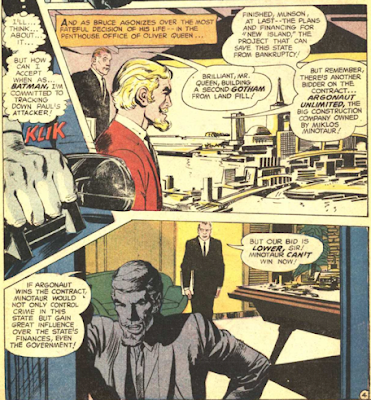
© DC Comics. B&B 85. The dangers of big business corrupting Government

©DC Still believing in Democracy before Nixon's downfall

Writer Bob Haney was an interesting individual. Having first entered the comics business in 1948, he was very much autonomous in his writing approach under the flexible editorship of Murray Boltinoff. A brief bio of Bob published in that same Brave & Bold issue underlined that “Bob feels that the whole world of comics and animation has yet to reach maturity and proper exploitation”. I suspect that Bob Haney had much in common with the much younger Denny O’Neil, and was open to co-ordinating themes across comic lines. I think it is fair to say that DC avoided bringing contentious issues into the pages of their big mainstream money-makers (Batman, Superman, Detective, Action), but had fewer concerns about using the pages of a lesser-known Batman title like Brave & Bold as a vehicle for more ground-breaking storytelling.

The year of 1969 was rounded out by two Justice League of America issues (#75 and #77) which directly addressed concerns about individual, personal accountability (a theme that would be re-visited a number of times ) as evidenced by the “new” Green Arrow coming to terms with his new place in the world in “In Each Man There is a Demon”, and the insidious perils of political manipulation in a story “Snapper Carr – Super Traitor!”. Both stories were written by Denny O’Neil, with art chores by Dick Dillin and Joe Giella.

© DC Comics. JLA #75. Green Arrow gets introspective.

© DC Comics. JLA #77. "Snapper Carr - Super-Traitor!"

© DC. Green Arrow hits out at the "dumbing down" of society.


1970 Going mainstream with Race, Pollution, Native American Rights

As the year turned to 1970, some shaking out of the DC portfolio had taken place with the cancellation of Bat Lash as of issue #7, but the presence of “relevant” story telling was on the rise. February 1970 saw the first of a JLA two-parter focusing on the perils of pollution in Justice League of America #78 “The Coming of the Doomsters” (by Denny O’Neil, Dick Dillin & Joe Giella) , while over on Batman #219, the Neal Adams’ Christmas classic backup  “Silent Night of the Batman” quietly slipped in some observations of street homelessness and GI’s returning from Viet-Nam, as written by emerging author and O’Neil protégé Mike Friedrich.

©DC JLA #78. "The Coming of the Doomsters"

© DC. JLA #78. Green Arrow takes on pollution

March 1970 saw the second part of the JLA pollution story #79, “Come Slowly Death, Come Slyly”, and then in April 1970, Green Lantern/Green Arrow #76 took relevance to a whole new level as “Beware My Power!” exploded on comic-buyer’s senses , bringing together multiple themes already addressed by Denny O’Neil in the pages of JLA, but now cemented by the dynamic artwork of Neal Adams. 
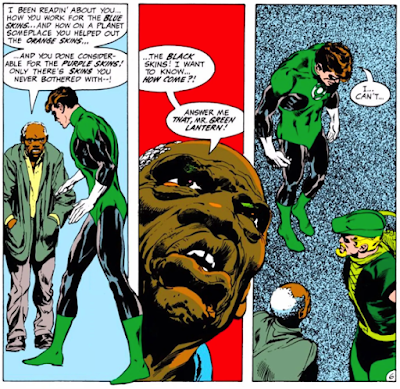
©DC. Green Lantern/Green Arrow #76 "Beware My Power"

Then began a sixteen-issue run covering GL/GA #76-87, 89 and Flash #217-#219 with stories that were to directly address the full spectrum of social issues through the lens of the skepticism of Green Arrow, contrasted with the sometimes naïve conservative sensibilities of Hal Jordan. As the series got underway in the summer of 1970, the first issues to be addressed were racial discrimination, worker exploitation, the problems of Native American reservations , and the disposal of toxic waste. A heady brew. The agenda was clearly set, and other books in the DC were taking notice.

©DC. Lois Lane #106. Why did Superman build this machine?

As the Autumn of 1970 came into view, two full years after the first Wonder Woman story set in the Age of Aquarius,  DC’s other major female role-model Lois Lane started to demonstrate a similar social awareness, when in October 1970 she  first embraced Women’s Lib by first charging Perry White with sex discrimination, and the following month decided to use a machine constructed by Superman to turn herself into a black woman so that she could embrace the Black Experience first-hand. This was a rather heavy-handed and patronizing, if well intentioned, piece by Robert Kanigher (“I am Curious (Black)”). Looking back now, the idea of assigning a morose, middle aged white male to write the story seems unfathomable. If published today, the cover was the epitome of “click-bait”.

As the year rolled towards a close, unbridled relevance was now featured as the main topic in two major comic books each month. In November 1970, while Lois was taunting Superman that she was black, the Justice League fought a villain who first wanted to enforce a peace serum on the global population, before deciding that mass genocide was a better way to address the world’s problems and start over in JLA #84 "The Devil in Paradise". This opus was the work of Bob Kanigher, Dick Dillin and Joe Giella, giving Bob Kanigher the honour of having two “relevant” stories on the stands in the same month.

Even Tomahawk, in its final few issues before becoming "Son of Tomahawk", was tailoring its Old West stories to address contemporary issues of race.

©DC Comics. A fine Neal Adams cover for Tomahawk #128

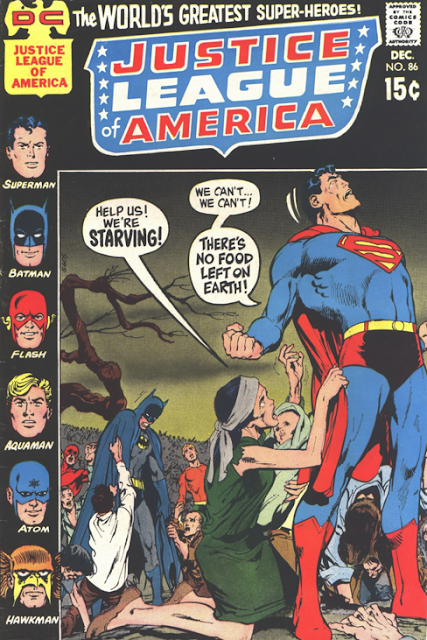
Dec 1970 can be seen as the start of "peak relevance" in DC comics. Wonder Woman and Lois Lane were reflecting the broader concerns of the younger generation, with Green Lantern/Green Arrow and Justice League of America as the backbone of “relevance” in comics, with a continuous stream of stories directly addressing hot issues. The perils of over-population were highlighted in GL/GA #81 "Death Be My Destiny" and a Justice League of America (JLA #86) featured a story about Food Supply in a tale called “Earth’s Final Hour” written by young Mike Friedrich (Denny O’Neil is billed as “script consultant”) and artwork by Dillin and Giella.  Joining the band of relevant comics was the re-tooled “Son of Tomahawk” #131, inventing Hawk as a new counter-culture hero in the Old West, with modern sensibilities and dyed hair.

©DC Comics. GL/GA #81 "Death Be My Destiny"

©DC JLA #86. "Earth's Final Hour"

1971 Population growth, Food Supply and the worst social evil - drugs!

March 1971 saw a Green Lantern story (#82) that again tackled the issue of personal integrity and responsibility, this time from Green Lantern’s point of view. The start of the decade was a time of self-analysis and the rise of the importance of the “shrink” in US culture, which made these stories of self-discovery so relevant.  Over at JLA #88, "The Last Survivors of Earth", Mike Friedrich had written a story about the last survivors of Earth and questioned our over-reliance on technology.

Perhaps the well was running dry, or audience appetite for this kind of polemic was waning, but after March 1971, DC cut back to publish a maximum of one “relevant” tale per month, featured either in Green Lantern/Green Arrow  or Justice League of America.

GL/GA #83 (May 1971) contained a story both lampooning Nixon and Spiro Agnew, while also showing how Carol Ferris’ paralysis , her physical disability, was not an impediment to success. 

In June, JLA #90 ran a story about the importance of ecology “Plague of the Pale People” by Mike Friedrich. Over at GL/GA #84 - Green Arrow made unambiguous comments about the evils of a world overun by plastic, and the effect it has on our society, touching on topics of smog over company towns, and even citizen brainwashing. The mixing of different concerns into one story served to dilute the impact of each of the issues mentioned.

Already the stories were becoming more of a harangue than an enjoyable entertainment. All credit to Friedrich and O’Neil for their passion, but I suspect that the sales were starting to wane.

1971 was a pivotal year for comics publishing. Printing costs had spiraled ; the price of the traditional comics had risen from 10 cents to 12 cents to 25 cents for a 48-page comic. More content was needed to fill those pages. And so three years since Wonder Woman first set the ball rolling, August to December 1971 saw a brief resurgence with both the two-part Green Lantern/Green Arrow  drugs issues (GL/GA #85 and #86)  and a two-part JLA story with a plea for co-existence and listening to those whose language we cannot understand”Earth – The Monster-Maker” written by Mike Friedrich. 

Mike Friendrich addressed the same themes in a two-parter Robin story the following months as a back-up in Batman #235 and #236 (“Society of Outcasts” & “Rain Fire”), drawn by Irv Novick & Dick Giordano, which highlighted the generation gap issues between hippies and the older conservative generation. The year was closed out with stories about Black Power in Green Lantern #87 which introduced John Stewart as Green Lantern’s back-up, and a tale reflecting on the situation of soldiers returning from Vietnam in Justice League #95.

1972 Running Out of Steam

As 1971 turned to 1972, DC took a rest from social messages, and the first three months of 1972 saw no direct stories concerning social issues. April 1972 then saw a brief resurgence with a story about corporate greed and corruption in GL/GA #89 (with arguably the finest final panel in any comic story I had read). In her own comic, Lois Lane walked out on her job at the Daily Planet, as the Lois Lane comic book came under the editorship of Dorothy Woolfolk.

©DC Comics. Green Lantern has had enough.

But the resurgence was a false dawn, and we waited until issues cover-dated June 72 to read another Mike Friedrich-written plea about preserving the ecosystem, in JLA #99. Son of Tomahawk quietly ceased publication with #140.

©DC. Art in the Kubert style by Frank Thorne could not save Son of Tomahawk

Relevance was not yet dead, but it was on life-support.

The commercial realities of the price of paper and printing had caused the 25-cent/52 pages comic to be scaled back to a slimmer 32 pages for 20 cents, and thus August 72 to Dec 72 saw the final Green Lantern /Green Arrow “relevant” story relegated to the back pages of Flash #217-219 in a story arc “The Killing of an Archer”, again focusing on the importance of taking personal responsibility. As the publication of this 24 page story was spread over the five months of three bi-monthly issues, the importance of relevance was clearly on the wane.

While the Flash issues were playing out, Oct 1972 saw the final issue of Lois Lane #127 to be edited by Dorothy Woolfolk, and with Dorothy’s exit any concerns about Women’s lib also disappeared from those pages.

Nov 1972 saw the publication of the last Women’s Lib version of Wonder Woman (#203) in a special “Women’s Lib issue!” before she returned to her Amazon garb and left the realm of the modern business woman behind. Dorothy Woolfolk had previously taken over as editor of Wonder Woman #197 in Nov 1971, but almost immediately passed control to Denny O’Neil with #199, in which issue Denny laid his cards on the table in the editorial about his view of Diane Prince as the modern woman. Despite his best intentions, his editorial reads as slightly sexist and condescending. But within a few issues, the stories became tighter, culminating with WW #203 as the “Women’s Lib Issue”, featuring a rendition of a Carmine Infantino lookalike as a magazine publisher. Denny’s full-page editorial is worth a read, and reading between the lines you can sense his unhappiness at having to hand-off to Bob Kanigher.

©DC Comics. Wonder Woman #203. "Women's Lib Issue!"


And so almost five years after Woman Woman #178 ushered in the era of relevance in DC comics, it was only appropriate that Woman Woman should usher it out.

1973 - Don't Look Back in Anger

And that was pretty much it for “relevance”. Denny went on to handle a large portfolio of new books for DC (including The Shadow) and the social concerns of 1972 were swept away with the excitement of the new books of 1973. I did not notice the change of tone at the time.

The last word about Social issues was left to Batman on the final page of Batman #251, cover dated September 1973 , “The Joker’s Five Way Revenge” when the Joker slips up on a oil slick on the beach, allowing Batman to capture him. Batman laughs “I never thought you – my arch enemy – would make me grateful for pollution!”

©DC Batman #251. The last word on pollution.

Now it is clear to see that "Relevance" had been the baby, the brainchild and the passion of Denny O’Neil, ably abetted by young college sophomore Mike Friedrich, and supported by long-time stalwarts Haney and Kanigher . 

Neal Adams has received (and accepted) the lion's share of the credit for "relevance" in comics, and is without doubt the artistic name almost exclusively associated with “relevant” comics, but without the work of Dick Dillin & Joe Giella, Nick Cardy,  Mike Sekowsky, Irv Novick and Dick Giordano, it would have been a much slimmer body of work.

When  "Snowbirds Don't Fly" (GL.GA #86) won the 1971 Shazam Award for "Best Individual Story", New York Mayor John Lindsay wrote a letter to DC in response to the matter, commending them, which was printed in issue #86.  Once DC had achieved National approval and exposure, wiser heads probably thought it was time to move on.  Concerned that they might be perceived as preachy, the stories dialed back on social relevance.

Denny O’Neil did not abandon social commentary completely, but the storytelling became more nuanced. Looking back on his career in an interview with Gary Groth for The Comics Journal around 1980, Denny said “I liked conflict and turmoil when I was 25. I don’t know what it is about being 25, but you’re hungry for conflict, for turmoil, and you run toward it. When I was a newspaper reporter, a story involving that kind of thing had infinitely more appeal for me than a story, for example, I did about a lovely old Japanese gardener and his wife who were having a wonderful and tranquil old age. That was a real good story I did, and it was very moving, but I didn’t enjoy it nearly as much as I enjoyed the time that I got some real heavy dirt on the police department and I showed that these authority figures had really dropped the ball.”

“I’ve written a lot of scenes where people regret the fact that violence was necessary in a given situation. In one of the best stories I ever did, “There Is No Hope in Crime Alley,” the whole point of it is that the old lady who stayed in the slums and never raised a finger to anybody was a much greater hero than Batman — which he acknowledges on the last page. That’s the way I go with it.”

I encourage you to take the time to read the full interview that Denny did back in 1980 and released in full form in The Comics Journal #66 (September 1981), https://www.tcj.com/rationality-and-relevance-dennis-oneil/

For those of you interested in statistics, here is the breakdown of number of stories dealing directly with different social issues over that 5-year period of 1968-1973. None of those topics remain any less important in today’s world. These Bronze Age comic stories were positive and optimistic, in that they showed that these sometimes insoluble problems could be addressed if individuals were willing to put themselves on the line.

How did “relevance” in comics affect your world view? Is it time for modern comics to “grow up” again, or is the sanitized world of the DC and Marvel Comic universes the best place for our heroes to operate?


Friday, December 31, 2021

Happy New Year To All Of Our Readers

Superman © DC Comics. With apologies to Action #81


Just a note to everyone who stopped by our blog this past year to thank you all for the encouraging comments and to wish you all the very best for 2022. 

Thanks especially for the support my good pal Nigel Brown and I received in getting the word out regarding the publication of the autobiography of Britain's first full-time comic dealer, the late Alan Austin. The book helped to keep the Bronze Age of comics alive in the hearts of many, fifty years later.

So, please ring in the New Year with the beverage of your choice and please read comics responsibly! 


Friday, December 24, 2021

“Star light, star bright, First star I see tonight”

With the festive season now upon us, I thought it might be appropriate to cast our collective minds back to the days of DC Bronze Age Christmases of yore, and revisit some of those classic covers and stories where our heroes venture out into snowy vistas and experience a non-denominational ephipany of sorts (or at least lock up a criminal dressed as Santa). Before researching this blog entry, I’d assumed that I’d find covers galore – too many to adequately cover in a few pages – but in fact, I found that there have been relatively few Christmas covers on non-humour DC comics across the years. The Bronze Age in fact sports more than its fair share of Christmas covers, but it must be said that some of the best Christmas stories were buried at the back of a comic, and had no corresponding Yuletide cover.

© DC Comics. Superman's Christmas Adventure #1 - 1940

Going back to the earliest era, the first DC comic that I could find with a Christmas cover was in humour book More Fun Comics #16 from December 1936, but it wasn’t until December 1940 that a popular hero – Superman – first shared a cover with Santa in the special Superman’s Christmas Adventure #1. It was 3 more years before a superhero again featured on the cover with Santa, when Wonder Woman, Flash and Green Lantern appeared on the cover of Comic Cavalcade #5 in December 1943. The following Christmas, Superman returned in Superman’s Christmas Adventure #2 (Dec 1944), and Batman & Robin appeared with Santa on the cover of Batman #27 along with the related story inside “A Christmas Peril”. 

© DC Comics. The first Batman "Christmas" cover


In the wartime era there followed a few other stories inside comics which featured our heroes (Batman, Superman, Wonder Woman, Boy Commandos, Sandman, etc.) in a Christmas setting, but nothing that merited a Christmas cover. Of course, the lack of a Christmas cover may have been a sales tactic to keep the comic books on the stands longer, into the January period.

Generic Christmas covers appeared on mainstream DC hero comics throughout the late 1940s, but in the 1950s and well into the 1960s,  Christmas covers exclusively graced the humour magazines (Rudolph the Red-Nosed Reindeer, Buzzy, Leave it to Binky, Fox and Crow, Sugar & Spike), and it was not until Christmas 1967, seventeen years after Superboy appeared in the snow on the cover of Adventure Comics #161 , that a mainstream superhero/hero DC comic featured a Christmas scene. That comic was Teen Titans #13, “The TT’s Swingin’ Christmas Carol” with a great cover and superb interior art by Nick Cardy, destined to be reprinted at least 7 times over the years. I love the colouring of the story, a good-hearted updating of Charles Dickens’ “A Christmas Carol” complete with groovy hip dialog courtesy of scribe Bob Haney, who at age forty-one rolled-out every cool phrase he imagined the flower-power generation used.

© DC Comics. Teen Titans #13 - Xmas 1967


© DC Comics. Teen Titans art by Nick Cardy. Love the colours.

Two years later, Christmas 1969 saw the publishing of the famed “Silent Night of The Batman” which received rave reviews, even though it was hidden as a back-up in Batman #219. This was a pivotal story, in that it directly addressed the spirit of Christmas, was “relevant” (a GI is shown  returning from Vietnam), had no villain – only good will to all men.  Mike Friedrich and Neal Adams have never been better.

© DC Comics. "Silent Night of the Batman". Art: Neal Adams

Perhaps the Teen Titans Christmas cover in Dec 1967 was an experiment to see if a Christmas-themed drove additional sales on hero comics. It seems it had not been the case, and it was three years later (Dec 1970) when DC instituted an annual pattern of only one non-humour comic featuring a festive scene, with the Hot Wheels club featured in Hot Wheels #6 in “The Humbug Run”.    Christmas 1971 was blessed with two Christmas covers – one from Tomahawk #138 “Hawk Son of Tomahawk: Christmas” and the other from Batman #239 “Silent Night, Deadly Night”, a tale of redemption and second chances for a hardened criminal on a snowy Christmas Eve. Batman says “God Bless” and spots the star in the night sky.  

© DC Comics. Batman and the Star of Bethlehem. Batman #239


The back-up story was “The Loneliest Men in the World” from Batman #15 (Christmas 1942) in which our heroes spread good cheer and gifts to various men who have lonely jobs and often get overlooked. But it ends on a slightly jarring note when villain Dirk Dagner gets sent to prison for life and Bruce Wayne says that since Dirk is consumed by hatred and greed he should remain caged…no warm thoughts of Christian redemption from the  Batman of 1942!

© DC Comics. No Christmas love for Dirk Dagner!


Christmas 1972 featured Batman again (Batman #247 “Merry Christmas”) , a 6-page hostage situation on a snowy Christmas Eve where Batman gets an unexpected helping hand in the form of a bright star in the sky. Denny O’Neil and Irv Novick share the creative honours on this one.

In 1973 it was the JLA’s turn with Justice League of America #110 (“The Man Who Murdered Santa Claus”) in a story penned by Len Wein and drawn by Dick Dillin and Dick Giordano. The moral is that all of the JLA were willing to give their lives so that the rest of humanity might live. The cover of the comic was less than inspiring, though.

© DC Comics . JLA #111 - an uninspired cover.


In Christmas 1974, DC decided to drop the idea of a new Christmas story in a mainstream hero book and instead issued Limited Collector’s Edition C-34 “Christmas with the Superheroes” collecting a number of Christmas stories published in previous years. 

This collection approach had proved such a hit that DC again published a Limited Collector’s edition C-43 “Christmas with the Superheroes” which included the classic Neal Adams Batman story “The Silent Night of the Batman” amongst others. DC decided to also publish a brand-new Christmas story “Robin’s White (Very) Christmas” in Batman Family #4). It was a back-up written by Bob Rozakis, drawn by Jose Delbo and Vince Colletta. It is an amusing story of Dick Grayson helping his girlfriend and the Hudson University security chief deliver Christmas presents when thieves steal the sleigh and presents. After the case is solved, it looks like Dick will be snowed in and unable to meet up with Bruce, Alfred and Aunt Harriett for Christmas, but will get the chance for some one-on-one time with his girlfriend at Hudson U. But in the final panels his style is cramped when Bruce and team turn up as a surprise for Dick.

Christmas 1976 featured no Christmas covers on hero comics, and we had to wait until April 1978 when DC put out the “T’was the Night Before Christmas” in House of Mystery #257, well after the festive season.

Christmas 1978 featured three Christmas-themed mainstream comics – Batman #309 “Have Yourself a Deadly Little Christmas” from Len Wein, John Calnan & Frank McLaughlin (Blockbuster saves a suicidal young woman and sacrifices his life in the process), Brave & Bold #148 “The Night the Mob Stole Christmas” (Bob Haney, Joe Staton & Jim Aparo) (Bats teams with Plastic Man to foil a tobacco-smuggling ring and head down to Florida for the denouement. Back in Gotham City Lacey’s Dept store had been robbed of its goods and decorations ; Bats and Plas get the thugs to restore the store to its glory (Retail is just as important as faith) and Green Lantern #113 “That they May Fear No More” (a snowy Christmas Eve story by Denny O’Neil, Alex Saviuk and Frank Chiarmonte that finds GL and GA protecting a pregnamt woman and her famiy from thugs. The wife Marcy gives birth to a child – new hope – as Christmas Day rings in).

In Dec 1979, Frank Miller pencilled a new Batman story written by Denny O’Neil  “Wanted: Santa Claus – Dead or Alive” published in DC Special #21. Again, the intervention of the light from the star gives Batman the edge he needs to rescue the department store Santa (a crook trying to go straight) and another tale of redemption on Christmas Eve comes to a close. 

Following Miller’s popular tale, the era of the classic Christmas story appeared to have passed, even though various Christmas offerings have continued to appear over the years beyond the Bronze Age.

If the number of reprintings of DC Christmas stories are any gauge of popularity, then the stories of the Bronze age were the heyday of these tales. The stories were secular, but were also stories of hope, charity and love, with a nod towards the influence of a higher power of goodness to offer the chance of personal redemption.  The star in the sky was a recurring motif in the tales written by Denny O’Neil.

Interestingly, despite the use of the term Christmas falling out of popular usage in the US media in deference to the more inclusive “Holidays” starting in the early 1980s, there has been little attempt to incorporate other religious festivals into stories. Out of the 246-plus original stories involving the Holidays in DC hero-comics since 1939,  I counted only 14 instances of Hanukkah being referenced, and I found no stories built around any of the other religious festivals.

For those of you who like statistics, the most popular Christmas story (measured by the number of reprints) has been Batman “Christmas”, first published in Batman #9 (with no festive cover, but a classic cover nonetheless), having been reprinted at least 11 times. Filling out the top 3 spots are “The Silent Night of the Batman” (7-plus reprints) and “The TT’s Swingin’ Christmas Carol” (7-plus reprints).

Batman has appeared in more Christmas stories than any other hero, leading with 38 stories, followed by Superman at 15, with the Teen Titans at 9 and Flash at 8. Whether this preference for Batman as the bringer of Christmas cheer was down to the influence of Denny O’Neil, or simply that Batman is the most earth-bound hero, is open to conjecture.

Story titles across the years have been invariably plays on well-known Christmas phrases or repurposing of well know Carol titles, or nods to classic literature. 

A good story appears perhaps once in a decade. To paraphrase Slade’s Christmas hit from 1973 “…..The Old Ones are the Best”.


“Merry Christmas Everybody!”


Tuesday, December 7, 2021

Comedians in Comics

Well, sorry for the delay, going through the whole of November without a SuperStuff post, but am hoping to make it up this month. 

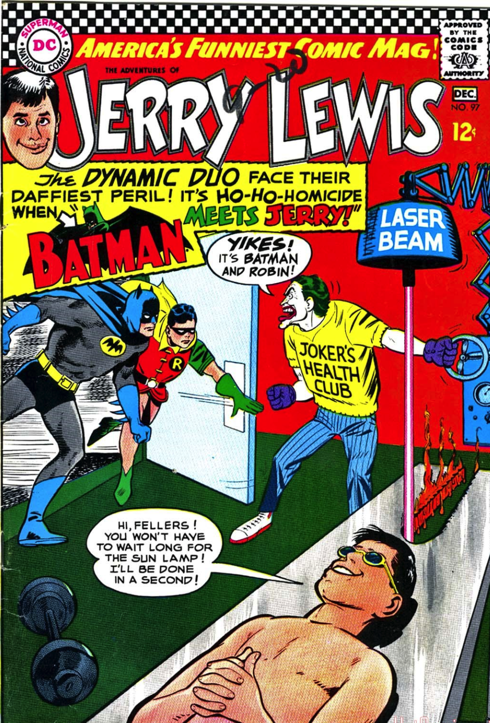
Anyway, I thought I’d take a closer look at a comic that had always intrigued me, but never had. I’m not sure if Thorpe & Porter ever put it on our spinner racks in the UK. The comic in question is "Jerry Lewis meets Batman". (The Adventures of Jerry Lewis #97). I didn’t even know who Jerry Lewis was back in 1966. To me this seemed to be a bizarre edition of The Brave & The Bold.


The cover is credited to Bob Oskner, but appears to incorporate a swipe of Dick Sprang’s rendition of the Joker’s face, with perhaps also a swipe of Batman & Robin drawn by Carmine Infantino and Joe Giella. It also seems to incorporate an homage of sorts to Goldfinger with the laser beam cutting through Jerry’s  sun-bed.

Finally reading the comic today, it is a bit of harmless fun with Batman and Robin goofing around with Jerry Lewis. The renditions of the Dynamic Duo by Bob Oskner are an improvement over the work being ghosted by Sheldon Moldoff on the official Batman comic at the same time, but there is a lot of evidence that no-one from the Batman/Detective creative team had informed Oskner of elements of the "New Look" introduced two years earlier in 1964. The renditions of the Batmobile and Joker are right out of Dick Sprang's 1950s comics. Also of note is that there is no “Bob Kane” logo on the splash page, which illustrates a scene not to be found in the comic itself, with Jerry Lewis being tied to the clapper inside the bell in a tower. 


The reason for this scene is an allusion to the Batman TV episode “The Bookworm Turns (April 20th 1966) which had appeared earlier that year, and incorporated Jerry Lewis in a cameo turn during a "Bat-Climb". (In the TV episode, it is Robin who is tied to the clapper in a clocktower bell. )


Reading this nonsense, it made me realize that there used to exist a whole sub-genre of comics, with a well-known comedian as the protagonist, that appears to be no longer with us.

But it got me thinking? How did comedians get into comics? And where are comics featuring comedians today?


So why did this trend start? As the old joke goes 

  • "What is the secret of successful comedy?" 
  • "T-T-T-timing!"

DC was late to pick up the potential for "comics in comics", and it was only the pressure from the anti-horror lobby that drove DC to look for other subject matter to divert criticism of their superhero line. In the early 1950s, with sales for superhero themed comics on the decline, National Periodical Publications began licensing the right to use celebrity images. Family favourite Bob Hope was tapped for a series which was to run for 109 issues from 1950 through 1968. Bob's wisecracking, yet nervous (but ultimately heroic) persona was deemed ideal for the medium.  Shortly afterwards comics appeared featuring Jerry Lewis and Dean Martin, to be followed by comics of Phil Silvers and Jackie Gleason, amongst others. They enjoyed robust success throughout the 1950s. 


The comedians featured were famous for slapstick and one-liners. All white men. They were of a generation that had embodied the strong tradition of comedians crossing over from vaudeville.


But as the 1960s got underway, public taste in comedians was changing, as was the age and taste of DC's comic book writers.  Stand-up comedians were now the rage, with an edgier set of material and a strong appeal to the college set.


And so in 1967 DC tried-out a comic featuring a young stand-up, Woody Allen. The comic was Showcase #71 - a Maniaks try-out featuring a story about Woody Allen putting on a Civil War musical, written by young DC staffer E Nelson Bridwell.


Back in 1967, Woody Allen was a break-out star in movies, not only appearing in films Casino Royale and What’s New Pussycat, but was also heavily involved in writing the scripts. His appeal was of a brash New York humour revered by the pop culture intelligentsia, far removed from the comedians of prior generations. An acceptable Lenny Bruce. 


As anyone who is familiar with Woody Allen’s standup routine of the early sixties as recorded on Long-Playing LPs will attest, his wandering monologues get seared into your brain, as they were no doubt by young writer E Nelson Bridwell. But material that is very funny when delivered in front of a crowd can become very laboured in the written form, and more so on the comic page. Bridwell even went so far as to include the "My parents bought me a dog. It was an ant. I called him Spot" story, but it comes across as pretty flat as rendered by Mike Sekowsky.


The comic died a death, and neither Maniaks nor Woody Allen appeared in another Showcase. DC did not try again, and quietly left their humour line to decline until it was quietly cancelled between 1971 and 1972. Don Rickles, the stand-up "insult" comic made a brief appearance in Jimmy Olsen #141, and that was it.  Neal Adams was to draw the final 4 Jerry Lewis comics.


Humour comics resurfaced subsequently in comics targeted at the young crowd, usually as a TV tie-in to a family-friendly comedy or cartoon.  More recently celebrities Stephen Colbert, David Letterman and Sarah Silverman have appeared as guest stars in the books of others, but It is difficult to image a DC comic today led by current stand-ups like Bill Burr or Patton Oswalt.


Will we see the re-surgence of comedians in the comics in the future?