Wednesday, August 4, 2021

The Criminal as Anti-Hero in Comics by Ian Baker

3 faces of Parker: Lee Marvin as "Walker", "Savage" and "Stark" © Warner Bros, Fantagraphics, DC


I was watching Get Carter earlier this week - a film I had not watched for 25 years or so - and pondered that although the film (and the book on which it was based) were created in the time of the Bronze Age, that the concept of criminal as hero (existing in the genre "neo-noir") was not something that had figured in the comics I was reading at that time.


For those of you unfamiliar with the novel Get Carter (aka Jack’s Return Home) by Ted Lewis,  or the satisfyingly faithful film adaptation directed by Mike Hodges (starring Michael Caine) the story revolves around a London gang enforcer returning to his hometown to discover who killed his brother, and exact retribution. 
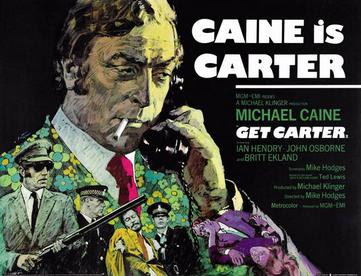


It’s a compelling story and has been hailed as a seminal “Brit-noir” classic, although if truth be told, the film shares elements with  the 1961 film Blast of Silence (which starts with a train emerging from a tunnel into daylight) and ends on a very similar note as the credits roll. 


Get Carter also shares many similarities in premise and execution with both the book and films of Richard Stark’s (pseudonym of Donald Westlake) The Hunter, in which the anti-hero Parker is on a personal mission to hunt down the fellow gangsters who betrayed him.


3 versions of The Hunter: Paperback © University of Chicago Press, Hardback with plates by Darwyn Cooke © PenguinRandomHouse, Comic Adaptation © IDW Publishing


My first exposure to this type of storytelling was around June 1st 1974  (the weekend incidentally following my first comic-con attendance in Emsworth) when my pal Geoff Cousins and I went to the Essoldo cinema in Albert Rd, Southsea to see The Outfit, a film adapted from an early Parker novel by Richard Stark. I remember being slightly confused that I was being asked to root for the bad guy.


The popularity of these types of films has persisted since Kubrick’s The Killing in 1956, through to the current day. Most notable in the 1960s was Point Blank, the first adaptation of Richard Stark’s The Hunter, the Parker debut starring Lee Marvin as Walker (the name substituted for Parker). 


The protagonist of these films is usually a man untroubled by conventional morality, but works and acts within the bounds of his own code of conduct. A professional with survival skills, only in extremis is he driven by emotions of retribution or revenge. Unlike the purer motives of the Private Detective in fiction, he is only driven to right past wrongs where he has a personal stake in the outcome.  Sometimes mistakenly categorized within the P.I. genre, in fact the neo-noir genre is a genre unto itself. The website The Violent World of Parker is a good starting point for a deeper dive into the books and films that inspire or are inspired by this genre, and is highly recommended.


So how has the neo-noir hero fared in comics? 


It is fair to say that the image of the criminal anti-hero has been a creation of the movies which was then transplanted into comics ,and has been nurtured most recently by creators the likes of Ed Brubaker, Frank Miller, Max Allan Collins, Darwyn Cooke and others.


Crime comics were big in the 1940s and 1950s (Crime Does Not Pay, Justice Traps The Guilty, etc), with a clear mandate to show that criminal activity was a bad thing. Nonetheless,  the tough material was squeezed out during the purge of comics in the late 1950s which feared glamorizing the criminal, leaving the likes of the anodyne DC’s Mr District Attorney to pick up the slack.


Mr District Attorney post-Frederic Wertham


In the next decade, Gil Kane independently published His Name Is... Savage #1 (June 1968), which had an image of Lee Marvin as Parker on the front cover, riffing on the Parker persona by making the lead an espionage agent, and jettisoning the criminal element of the character.


Crime stories resurfaced briefly in 1972 in Jack Kirby’s In The Days of the Mob (a look back at organized crime in the 1940s) , and DC introduced Jonah Hex - (All Star Western #10 Feb 1972) - a bounty hunter who worked outside the law - but this was the closest that DC would come to a criminal anti hero until Max Allan Collins wrote about a mob enforcer on The Road to Perdition in 1998 for Paradox Press (a DC imprint).


Over at Marvel, February 1974 saw the introduction of Frank Castle as the Punisher in the Amazing Spider-Man, and so the idea of a man who operates outside the law and adopts extreme tactics in pursuit of the unredeemable entered the MCU.


Pulp revivals of the likes of the Shadow in the late 1980’s started to introduce a more brutal modern interpretation of the anti-hero, but with a clear understanding that our protagonist was on the side of law-and-order.


Sin City from Frank Miller introduced a neo-noir world in April 1991, but no single protagonist who fit the professional thief mould.


It was Darwyn Cooke who finally brought the character of Parker (renamed “Stark”), the professional thief and hard man,  into the original DC graphic novel Selina’s Last Score (2002), to be followed by a brief re-appearance in DC’s Solo (2004), Stark coming off the worse for wear following an altercation with Batman in the story Deja Vu.


Since then, several American and British comic book writers have created interesting work in the crime comics genre, sometimes incorporating noir themes and novelistic storytelling into realistic crime dramas and even into superhero comics. These writers include Brian Azzarello (100 Bullets, Jonny Double), Brian Michael Bendis (Sam and Twitch, Jinx, Powers, Alias), Ed Brubaker (Gotham Central, Criminal), Frank Miller, David Lapham, John Wagner (A History of Violence, Button Man), Chris Condon and Paul Grist, ably interpreteded  by artists of the calibre of Sean Phillips and Jacob Phillips.


Their work has figured predominantly in independent comic magazines, and increasingly in original graphic novels (OGNs). Interestingly, Sean Phillips was commissioned to adapt the opening sequence of 1961's Blast of Silence into a short comic included with Criterion's DVD release of the film in 2008.  Take a look at his blog for more information.


© Criterion and Sean Phillips


The pioneering work of Darwyn Cooke and IDW in 2009 of adapting the Parker novels directly to hardback OGNs has opened the gate for subsequent creators to bring these sorts of stories to a different audience than the average comic-book reader.

Those of you who have seen Get Carter may recall that the opening sequence of the train journey from London to Newcastle is a fascinating montage of the exterior of increasingly nondescript cities and empty farmland intercut with Carter enjoying the luxury of First Class travel on British Rail in 1970. Carter surveys his fellow travelers and notices that one passenger is reading the The Sun newspaper with the headline “Gaming Chiefs warn of Gang Wars” while a schoolboy reads a comic. 


Name that comic - presumably 1970/1971 timeframe

Can anyone identify the comic? 

Sunday, July 25, 2021

Remembering The Penguin Aurora model kit

Aurora Penguin Kit, circa 1968. A bit dusty, with cigarette and umbrella missing

Back in the late 1960s, I starting to get interested in model kits, starting first with Airfix Spitfire aircraft and Royal Navy ships, and then progressing to acquiring the TV-series-related models advertised on the back of US comics, following the acquisition of the Stingray kit as previously advertised in TV21.

I remember then getting the Seaview submarine (from Voyage to the Bottom of the Sea), and then my fancy was taken by the adverts for the Aurora kits of DC heroes (Batman, Robin, Superboy, etc) and villains. Throughout this period, my Dad was the one making and painting the kits for me, as I leaned over his shoulder and breathed in the smell of the glue…   


I have no clue what happened to most of the kits (probably sold to the guy who ran the Timeslip shop in Fawcett Rd in Southsea in the early 1980s), but as luck would have it, I still have The Penguin kit (plus box and instructions). The kit was purchased from the Fratton Bargain shop in Fratton Rd, Portsmouth around 1968.


Around the mid 1970s my pal Geoff Cousins had a go at repainting the model to more closely approximate the dress of Burgess Meredith as the Penguin, and did a pretty good job (IMHO).


I was very impressed by the quality and detail of the rendering of Burgess Meredith as the Penguin, and was very disappointed by lack of detail and realism of the Batman kit that Aurora re-issued around 1974.


Does anyone have any thoughts on the differences in detail between the Penguin kit and the other Aurora kits? Just compare the facial detail on the Penguin kit with the facial detail on the Batman kit issued at the same time. Like night and day.


Here’s the box, instructions, a few transfers and the original tube 50+ year old  Humbrol 77 model cement.


As you can see from the photo at the top of the blog, the kit itself is a little bit worse for wear (Penguin cigarette holder missing and umbrella handle missing) and dusty but I’m sure could be restored to prime condition.

Wednesday, July 21, 2021

It’s all one Case : How Serpico, Doc Savage and Thor got it together in 1973 by Ian Baker

I warn you, this post is going to come off like an episode of James Burke’s BBC/PBS series “Connections” from the late 1970s. 

I’ve built up quite a collection of those gritty cop films from the late 1960s and early 1970’s, filmed on location on the streets of New York, which at that time was regarded as quite a dangerous city. In many of the films of that era you find an almost documentary style of filmmaking. Perhaps it is the grainy film stock, or the frequent use of hand-held cameras, but I find these films reflect a reality not found in current day fare. 

 I confess there may also be an element of nostalgia, as on-location films of the 1970s take me back to my first comics & pulp paperback-hunting visits to New York in 1977 and 1978, and brings to mind the thrill of walking those same streets before I was even in my twenties. [There is no experience to compete with walking in New York]. 

Anyway, in 1973 (which you may have concluded is the pivotal year around which this blog revolves) Paramount Pictures released the Sidney Lumet-directed, Al Pacino-starring, movie Serpico, relating the true story of honest cop Frank Serpico who had exposed extensive corruption within the NYPD. Six years earlier, in 1967, the real Frank Serpico first reported credible evidence of widespread systematic police corruption in the NYPD. 


If you haven’t seen the film, it showcases a stand-out performance by Al Pacino, and is miles better than the obscure and short-lived TV series of the same name starring David Birney that BBC showed in truncated form over an 8-week period in early 1977. 

I was watching the blu-ray of Serpico (1973) recently and noticed that there are a number of key scenes that take place in Frank Serpico’s apartment, always with a backdrop of his bookshelf. Perhaps I have become so attuned to Zoom and WebEx meetings these days that my eagle eye immediately spotted a copy of the Bantam paperback reprint of Doc Savage pulp Murder Melody (Bantam #15) sitting on Frank Serpico’s apartment book shelf. At around the 50 min to 56 min mark Murder Melody is visible over the shoulder of his girlfriend, amidst a colourful jumble of other well worn paperback books. 


The art of set dressing is not one of random choice. You may not realize it, but every time you watch a film or TV show, everything you see in each frame is informing your opinion of a character. Even the tiniest, seemingly insignificant details are agonized over before cameras start rolling. From the coffee mug holding pens on a character’s desk to the bathmat outside their shower, nothing is an afterthought, nothing is inconsequential. This type of thought, care, and design is all thanks to set decorators. 
 
Art Director Leslie Bloom was the set-dresser; Thomas H Wright was credited as Set Decorator. Leslie was later Oscar-nominated twice for Best Art Direction-Set Decoration for The Cotton Club (1984) and Woody Allen’s Radio Days (1987), which along with Taxi Driver(1976) and Manhattan(1979) were part of a long-line of New York based film productions on which she provided art direction duties. 
 
The choice of placing a Doc Savage story on the bookshelf - Doc being a New York-based noble incorruptible hero - was not random choice. It was placed there to underline the subtext of Frank Serpico’s own incorruptibility and willingness to put himself on the line, as presented in the film. 

Filmed during the summer of 1972, the Murder Melody paperback in question was the 50 cent original published 5 years earlier in January 1967 . The date of that publishing coincides only a few months prior to Frank Serpico’s original exposure of NYPD police corruption and demonstrates the research that went into selecting that particular book for the film set. 

[Aside: My own original copy of Murder Melody was purchased from a second-hand shop in Portsmouth for 5p sometime in the first half of 1975. The accompanying photo shows my actual copy with its 3/6d sticker from that year. I sold that copy for £3 at Forbidden Planet in Denmark St, London in 1989. 


By sheer serendipity, since starting to write this article, I picked up a replacement copy of Murder Melody in a bookshop in Saugerties, NY earlier this week for $2.] 

Anyway…back to the movie Serpico. Whether the real Frank Serpico was a Doc Savage fan is open to conjecture. This 2019 interview with poet and Bantam Doc Savage fan R.M. Engelhardt recounts a chance encounter with the real Frank Serpico in Nelson’s bookstore in downtown Albany, NY, which suggests that Frank may have had an interest in the mighty Doc.
 
Frank Serpico's fictional New York residence in the movie is located at 5-7 Minetta Street in Manhattan's Greenwich Village. The real-life Frank Serpico, however, lived at Perry & Greenwich, a few blocks away. Either way, the real or fictional Frank Serpico would have likely picked up the book at The Science Fiction bookshop at 52 8th Avenue in 1973 (now long since gone). 

There is another (even more tenuous link) link between Serpico and Doc Savage in that Alan Moore and Kevin O’Neill established that both Frank Serpico and Doc Savage lived in the same shared universe, with the fictional Frank Serpico’s link to the League of Extraordinary Gentlemen (LXG80s) as a proposed member of the previous American League in a visual cameo in LXG80s (League of Extraordinary Gentlemen: 1980s ) As it was later revealed that LXG80s was an April Fools prank, the link is considered apocryphal by many. 

The Bantam paperback cover has a striking James Bama painting showing Doc standing resolute while armed men descend from the sky from cylindrical space ships. This got me pondering where did James Bama get his inspiration for the staging of the characters and the design of the spacecraft?  In James Bama’s commentary discussing the cover in his forward to the 50th anniversary of Doc Savage in the reprint of Murder Melody by Anthony Tollin’s Sanctum books from 2014, he gives very few clues as to the inspiration for the cover, other than he got model Steve Holland to pose with a toy gun that Bama had got from Woolworth’s. 

Bama writes that he had read the story completely (the first written by Kenneth Robeson “ghost” Laurence Donovan) before selecting the scene to be rendered in variations of a purple hue. The original pulp cover by Walter M. Baumhofer and Emery Clarke is rather uninspired, with men simply floating in the air. The Bama cover is much more dynamic, showing the villains descending from a missile-shaped flying craft, and was strangely familiar to me. 

A clue to Bama’s influence is found in an interview with nj.com from 2010. Bama said: “I would copy the Sunday funnies like 'Flash Gordon' and 'Tarzan' ...... ('Flash Gordon' artist) Alex Raymond was my biggest influence." . - James Bama interview: Drawn to the West. Posted Dec 17, 2010  

It then dawned on me that the cover holds an uncanny similarity to elements of the cover of Journey Into Mystery #83 (on sale June 5th 1962) - the first Thor story by Stan Lee and Jack Kirby at Marvel. [Take a look at Kid’s blog over at https://kidr77.blogspot.com/2017/08/come-with-me-on-journey-into-mystery.html for a more thorough dissertation on the development of that cover.] 


Jack Kirby had also cited Alex Raymond’s Flash Gordon as a major early influence on his artwork and design. Comparing Jack Kirby’s Journey Into Mystery #83 cover side by side with Murder Melody, the posing of the aliens jumping from a space ship seem very similar to the Gray Men leaping from a spaceship on the Bama cover. In addition, the spacecraft on both Bama’s and Kirby’s covers both bear very similar designs to those of Alex Raymond’s Flash Gordon stories. 


Whether it was a conscious layout swipe or not, we shall never know. We do know that James Bama was living in New York in 1967, and had done many illustrations for Men’s Adventure magazines in the 1960s for Martin Goodman, also owner of Marvel. Bama met Martin Goodman on several occasions.  I have yet been able to determine if James Bama knew or met Jack Kirby. 

The saga of the Murder Melody cover was not yet complete. Within a year of Serpico hitting the screens, James Bama’s cover of Murder Melody was picked as the basis for the UK Corgi Paperback version of Meteor Menace (a completely different Doc story) , to tie in with the release of the Ron Ely-starring Doc Savage movie. Artist Terence Gilbert was contracted to re-purpose the Bama cover to reflect elements of the Meteor Menace story, and bring Doc’s figure in line with Ron Ely - slightly less muscular, modified hairstyle and wearing the belt buckle with logo. You can see the results below. 


Gilbert is an exceptional artist in his own right, and would have been my first choice to continue the Doc Savage paperback covers for Bantam following the end of James Bama’s tenure. 

So there you have it: Doc Savage influenced the fictional Serpico (and possibly the real Serpico). Alex Raymond spaceship design influencing both Bama and Kirby. Kirby possibly influenced Bama, who in turn definitely influenced Terence Gilbert. 

It’s all one case. 

Monday, July 19, 2021

A Summer Road Trip Interlude by Ian Baker

Part of the SF section - love those 1960s spines!

Do you ever get the feeling that something you find in an old bookstore has been waiting there all the time for you to turn up and buy it? That’s the feeling I had yesterday afternoon when we stopped briefly in the village in upstate NY on a whim, driving  through as part of our summer road trip in Mrs. B’s MINI Paceman, “The Grey Ghost”.


The Grey Ghost


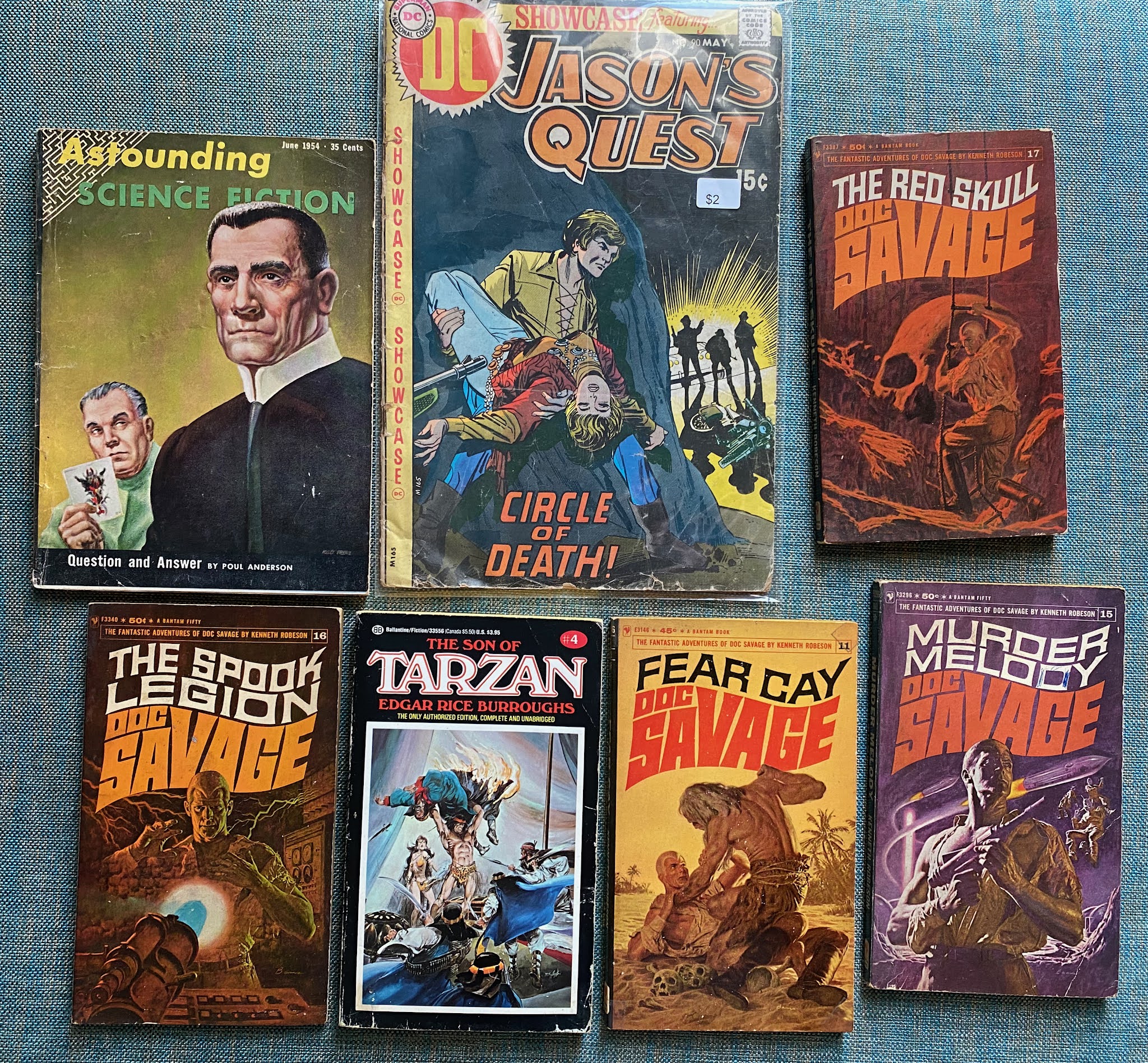
We stumbled across an amazing, small second-hand bookshop with a huge and varied selection of books excellently ordered in custom-built shelves. Upon entering we were hit immediately with that unmistakable smell of old books. And there were two long boxes of comics, a very varied selection of comic-related hardbacks, paperbacks, fanzines and prozines from the 1970s. I picked up the haul below for $17 in total - the DC Showcase Jason's Quest for $2! The Bantam Doc Savage first editions for $2 each! The Tarzan paperback with the Adams cover for $3! The Astounding Stories SF pulp from 1954 for $3!


The $17 Haul


I was greatly heartened to see that book shops like this still exist in out of the way places, where gems can be found at real-life prices , not vastly inflated “collectors” prices.  What has been your experience? Do these places still exist in your neck of the woods?

Wednesday, July 14, 2021

"My Word!!! Sherlock Holmes is a JUNKIE!!!" by Ian Baker


With apologies to Neal Adams, E.R. Cruz and Sidney Paget.


Cataloging old comics recently, I came across Eternity #5 , a Sherlock Holmes comic containing reprints of the 1930s newspaper strips illustrated by Leo O’Mealia (a fantastic illustrator whose work is reminiscent of Mike Kaluta - see cover of Action #2) ,and I erroneously made the assumption that Sherlock Holmes had featured quite a bit in comics over the years, despite traditional Sherlock Holmes stories really not lending themselves to the things that comic books excel at - punchy narrative and explosive action.  


Attempts to turn Holmes into an action hero within comic pages have generally engendered a lukewarm response, Guy Richie’s movies not withstanding. However, the more recent TV series of Sherlock and Elementary, set in the modern age, have successfully breathed new life into an old character, being both commercial and critical successes, and have done so while avoiding the tropes that have sometimes defined the character to the extent of becoming a cliche.


Today we’ll take a closer look at Sherlock Holmes in comics within the confines of the Bronze Age.


As this blog is both Portsmouth and comic centric, let’s start with a brief primer on Holmes’ connection to Portsmouth through his creator, Edinburgh native Sir Arthur Conan Doyle.


Here are a few facts about his creator Sir Arthur Conan Doyle:

  1. Arthur Conan Doyle came to work in Southsea as a young doctor in 1882 to set up a medical practice at Bush Villas in Elm Grove. Here he took up writing Holmes stories to while away the time between patients (strange he would have spare time as I’m sure Portsmouth was awash with social diseases at that time) 
  2. His first Holmes adventure written in Southsea was A Study in Scarlet , followed by The Sign of Four.
  3. He based elements of the character of Holmes , along with his approach to deductive reasoning, on his mentor the Edinburgh Doctor Joseph Bell 
  4. He was also the first goalkeeper of Portsmouth Association Football Club, predecessor to today’s Portsmouth Football Club (“The 3 Lions problem” was an early discarded story idea :-) )


Mark Wingett’s blog on Doyle’s early days in Southsea is well worth a quick read. In addition, many of the Holmes stories written by Doyle contain references to Portsmouth, Southsea, Fratton and the surrounding area, and more detail can be found here.


Despite the number of books, films and television adaptations, I’ve been surprised there are so few iterations of Sherlock Holmes in comic books at all, and only five appearances in the Bronze Age in total.  


Holmes’ appearances in the pages of DC and Marvel in the mid-1970s coincided with that period of frantic expansion prior to the “DC implosion” when the major comic companies were looking around for literary properties that could be easily adapted - the pulp characters such as The Shadow, Doc Savage and The Avenger being prime examples that were transferred with varying success a few years earlier.


Here is the list of appearances by Sherlock Holmes in the pages of DC and Marvel, a mixture of straight adaptations and new material which clearly indicates that there was no strategic plan for developing the character.


  • DC: Sherlock Holmes #1 (Pub 26th June 1975) by Denny O’Neil and E.R. Cruz, adapting The Final Problem and The Empty House, as an integrated story. 

  • DC: Joker #6 (pub Dec 4th 1975) - where the Joker fights head -to-head against an actor who believes he is Sherlock.  Writer: Denny O’Neil Art: Irv Novick 

  • Marvel: Marvel Preview #5 and #6 - A surprisingly faithful adaptation of Hound of the Baskervilles. (published 1976-01-06 and 1976-04-06)  These two stories are superior adaptations drawn by Val Mayerik and Tony Dezuniga ; written by Doug Moench
    © Marvel Preview #5
  • © Marvel Preview #6


  • DC: Detective #572  (published Dec 26th, 1986) celebrating the 50th anniversary of Batman (Mike W Barr and Ernie Cruz, Ed Denny O’Neil).   The Detective Story features an elderly Holmes encountering Batman.


And that’s it.


So why only 5 comics?  Denny O’Neil - as editor and/or writer, was the engine behind the DC incarnations, and has spoken of his affinity for Sherlock Holmes in blogs and videos over the years. Over at Marvel, Archie Goodwin provided editorial duties.


The Marvel Preview issues which Goodwin edited are superb adaptations which take their cue from the Sidney Paget illustrations. Val Mayerik’s illustrations evoke both Paget and Berni Wrightson in equal measure and was obviously a labour of love.  


In contrast, the DC comics adhere to a Basil Rathbone-clone approach inspired by the Universal Studios films of the 1930s and 1940s. All fog, deerstalkers and  “gor blimey’s”. E.R. Cruz's art in the singular issue of “Sherlock Holmes #1” from DC is excellent as well, and the fine lines would have benefitted from a Black & White presentation.


So why did Sherlock Holmes not prosper in the Bronze age of superheroes? Well, there are a number of reasons.


  • A boring costume. Comic book protagonists dress the same from comic to comic, and so stories about regular citizens (even smart ones) are not really suited unless our heroes are members of the police or military, where a uniform provides a consistent look to the hero. DC decided upon clothing Holmes in a green checkered coat and deerstalker in all situations - not the most dynamic of costumes.
  • Lack of Motivation. All great comic book heroes have an origin story. Holmes has no back story or motivation beyond the need for mental stimulation. Doyle’s cold, eccentric thinking machine  has no real friends other than Watson. He describes himself as a “high-functioning sociopath” .
  • Lack of Differentiation. Sherlock is insufficiently differentiated from other crime solvers, and pales in comparison to heroes who can both solve crime with their brains and fists. If he really was the World’s greatest detective, where does that leave Batman?  (I have yet to read a Batman comic where he solves a crime just by thinking through the clues.  Or is there?)
  • No Rogue’s Gallery. Holmes has only one worthy villain - Moriarty - who has been already dispatched in DC issue #1 .

  • Poor use of Locations.  Holmes of the books traveled around the country - he was not stuck in a foggy London. In the Bronza Age the convention was that heroes were bound to a place - Gotham City, Metropolis, Star City, Central City, etc. - and a fog-ridden London would provide limited scope for varied encounters.

  • Constrained by Public Domain.  The Bronze Age adaptations were based on the Holmes character as presented in the Public Domain stories, and the writers were unable to use the stories or characterization of Holmes as found in  the Copyrighted Stories between 1923 and 1927, when Conan Doyle’s personal losses in the Great War brought humanizing changes to the Holmes character .


If we consider the key attributes of Holmes as described by Doyle in the books, we find a cold, calculating, misogynistic, drug addict, relying heavily on Watson as his Boswell, his one fixed point in a changing world.  These are all qualities that make him interesting on TV, yet by the very nature of the Comics Code Authority in the 1970s ensured that these admittedly anti-social qualities could not be easily portrayed.  


The breakthrough of DC’s Green Lantern- Green Arrow #85 in 1972 of portraying the effects of substance abuse was insufficient to result in a major sea change in comic book stories in the Bronze Age. It was more an outlier that signaled the end of “relevance” in mainstream comic books, and certainly did not pave the way for a compelling presentation of Sherlock Holmes.


So is there a good comic to be made to feature Sherlock Holmes today? 


I do believe that it is possible. I am heartened by the superior mystery and character work being turned out today at Image by Chris Condon and Jacob Phillips, or by Ed Brubaker & Sean Phillips , all working in the the noir genre. Their books demonstrate that there is room for non-superhero stories with intelligence, no longer relying on explosive action, in the independent creator-owned segment. I look forward to seeing what is possible. 


Just avoid the foggy streets and deerstalker. 

Saturday, July 10, 2021

Arnold Schwarzenegger in Portsmouth : Body Building and the Fantastic Four. by Ian Baker


© Marvel - with apologies to Swingin' Sammy Rosen 

Growing up in Portsmouth in the nineteen-sixties there was a general feeling that it was the natural order of things that Britain would come out on top. WW2 was still fresh in everyone’s mind, and the general tenor of adult conversations led nine-year-old me to conclude that Britain had defeated Germany single-handed (twice!) and that England winning the World Cup in 1966 flowed from that general greatness. In my mind it followed that Sandie Shaw naturally won the Eurovision Song contest in the following year, 1967. In retrospect by 1968 the cracks were starting to show when Cliff Richard came in 2nd in the contest the following year, and despite the valiant efforts of Scottish songstress Lulu in securing a 4-way tie in 1969 with “Boom-Bang-A-Bang”, the writing was on the wall for British dominance in every field of human endeavour.


So against this background, it also seemed perfectly natural to me to grow up in an island city where famous people were celebrated with blue plaques, road names, building preservation, museums and the like. Portsmouth has many public acknowledgements of famous sons and adopted offspring….Charles Dickens, Sir Arthur Conan-Doyle, H G Wells, Peter Sellers, Neil Gaiman, …Rudyard Kipling…but nowhere on that sceptred isle will you find public commemoration of its most multi-talented, versatile polymath - Arnold Schwarzenegger.


Arnie? I hear you say. Do tell. Where is the Comic connection in this story? Read On…


Arnold Schwarzenegger’s journey from skinny Austrian teenager to the pinnacle of his chosen fields (Bodybuilding, Movie Star, US State politics) has been well documented elsewhere. His connection to Portsmouth comes from those early days when he traveled to London to compete in the Mr Universe bodybuilding competitions. In late 1966, following Arnie’s first bid for the Mr Universe title, he met Bob Woolger who  invited him to train at his gym in Portsmouth for both the 1967 title (which he won) and again for the defense of the title the following year.


And so in the Spring of 1968, Arnold again took the train from Waterloo to Portsmouth & Southsea to train with Bob Woolger, with whom he developed a bond of friendship. The photo below shows Arnold promoting Bob Woolger’s annual dinner dance at the Wedgewood Rooms (a popular venue) in Albert Rd, Southsea on Thursday 25th April 1968.


© Multiple Sources. Bob Woolger and Arnold Schwarzenegger in Southsea, 25th April 1968

© Unknown. The Wedgewood Rooms in the early 1970s


According to recollections on FB group Memories of Bygone Portsmouth managed by JJ Marshallsay Arnold was a familiar figure around Southsea as he walked along Albert Rd between Bob Woolger’s gym facilities in Clive Rd, Fratton and in Clarendon Circle, Southsea, no doubt strolling past many newsagents that stocked American comics populated with body-building supplement ads promoted by past competition winners. 


If he had chanced upon a copy of Fantastic Four #75 that April, he would have seen lacklustre ads from Joe Weider, the famed US body-building entrepreneur, featuring previous Mr Universes. [Aside: Advertising has to tell a story].  By the end of the following year, Arnold would be himself be the centrepiece of those same ads in American comic books.


© Marvel - Joe Weider body-building supplement Advert pre-Schwarzenegger

I have no great memories of buying comics in that period, as the Silver Age transitioned to Bronze, although a quick look at the "Newsstand' on Mike's Amazing World of Comics shows some gems I came to read in later years.
 My preoccupation at that time was looking forward to my birthday in July and hoping for an Action Man plus an Action Man Deep Sea Diver suit .


As the Summer progressed, we have no record of what Arnie did for entertainment. His local choices would have been the Odeon (later The Salon)  at the top of Festing Rd, or the King’s Theatre at the western end of Albert Rd.


Did Arnie go to see Sadler's Wells Opera Company, The Barber of Seville, or sample the other 3 operas at the King’s? Or perhaps opted instead for Charlton Heston in Planet of the Apes at the Odeon.    


[Later that summer I went with my parents to see Hughie Green’s “Opportunity Knocks Winners”show at the King’s on Aug 12th, which had “musical muscleman” Tony Holland (he of the rippling muscles in time to the music) and a very limber female contortionist on the bill (a Hughie Green favourite) , all co-hosted by diminutive Monica Rose. I have found no record that Arnie was in the audience, but I have a suspicion he would have enjoyed it and people would have paid good money to see an Arnie/Tony Holland double act.]


Three days later, by August 15th 1968, my birthday had been and gone, and my free Action Man (UK iteration of G.I.Joe to our American readers) arrived in the mail, in response to my sending 21 stars cut from Action Man accessory packaging.


Arnold had other concerns on his mind ; within weeks he left Portsmouth for London, for his final preparations for the NABBA Mr Universe Contest at the Victoria Palace Theatre on Saturday 21st Sept 1968 at 1:40pm.


Immediately after winning Mr Universe in London a second time, that October he headed out to California on a contract offered by Joe Weider. Weider’s magazines began churning out ghostwritten articles and sensational ads, about how Weider techniques and Weider products were transforming Arnold into a sculpted demi-god set to win the 1969 Mr. Olympia title.


And so readers of Thor #173 (published Dec 9th 1969) were the first to see the famous photoshopped (or cut-and-paste) ad of Arnold with a girl on his bicep.  Ben Grimm (The Thing) had to wait another week until he saw the ad published December 16th 1969 in Fantastic Four #96 (cover-dated March 1970) breaking the “fourth-wall” as the real world of Arnold Schwarzenegger (unnamed but obvious) intruded into the late sixties Marvel Comic Universe.


© Marvel. Schwarzenegger Ad placement critical as a lead into the story
 
And so Arnold trod a path from comic-book reader, to appearing in comic-books as himself, to being part of a comic book story, to eventually playing a famous comic book character.


© Unknown. SALON cinema Southsea. (Showing Kingdom of the Spiders here, but close enough)

The circle was closed (I mean the metaphorical circle, not the the Cinema Circle) on 28th August 1982 when Conan the Barbarian premiered at THE SALON (previously the ODEON) further along from the Wedgewood Rooms on the corner of Albert Rd and Festing Rd, returning Arnie (in spirit if not in person) to Southsea , where his fortunes were forged close to TESCO’s over a distance of 500 yards and 14 years.

Afterword - 

So did Arnie revisit Portsmouth? Many local people claim to have seen him in Southsea in the intervening years, as he revisited the Woolgers.


Arnie certainly did quietly return to Portsmouth for Bob Woolger’s 80th birthday celebrations, and you can read the great man’s speech here from 1992 when  he presented Bob Woolger with a Special award from the US President's Council of Physical Fitness.


Note: I have not exhaustively investigated the duration of Arnie’s appearances in ads in American comics. I shall leave that to others .  But it also appeared in Daredevil #61 (Feb 1970)


Daredevil # 61 Subtitle: Trapped by the Trio of Doom!" (Jester! Cobra! Mr. Hyde!) 


Sunday, July 4, 2021

Green Lantern in the Green Zone - by Ian Baker

My copy of GL/GA 76 from 1975 - Wot! No T&P stamp???

 You have to appreciate that growing up in Portsmouth in the 1960s and 1970s, it was still a town that bore the scars of German bombs from WW2. Memories of the last War were a frequent topic of conversation in our house, and particularly when my father got together with his sisters.  Large areas of the poorer parts of the city - Landport or Somertown or Portsea or Buckland or Fratton had either undergone urban clearance by the Jerries or by well-meaning but charmless urban redevelopment programmes in the 1960s. Southsea bore fewer of the scars, but had not emerged unscathed, with new houses generally built into the gaps of bombed premises.

The view of Palmerston Rd below from the 1950s (credit A Tale of One City) is typical of much of Portsmouth well into the sixties and even seventies.

Palmerston Road 1950s © A Tale of One City 

Those of you familiar with the film Operation Crossbow will remember the scenes of V2 bombs destroying rows of terraced houses. In fact, the scenes of the actual destruction in the film  were staged by using real explosives to demolish real terraced houses deemed either unfit for habitation and/or ready for the redevelopers’ wrecking ball.


Henrietta Street - frame grab from Operation Crossbow


Houses awaiting being blown up for film "Operation Crossbow" © Peter Cuff posted on Memories of Bygone Portsmouth, admin JJ Marshallsay


And so it was within these areas no longer subject to enemy fire that Nigel Brown and I cycled in the spring of 1972 through Somertown, over Somers Rd Bridge (all now gone) to a small, smelly second hand shop in Church Road, just off St John’s Rd in Landport. 


Re-building Somers Town © Mark Henley, posted in Memories of Bygone Portsmouth, admin JJ Marshallsay


On the wall was a scruffy copy of Green Lantern 76. As a Batman fan first and foremost, I deemed Green Lantern to be a second tier character and happily let Nigel buy the comic, while I searched for other buys. It was only a year in April 1973, after I had picked up copies of GL/GA 85 and 86 while on holiday in North Devon did I realize what an awful mistake I had made in passing up on what was to be one of the classic comics of the Bronze Age - in many people’s future view, the comic that sounded the firing pistol of the Bronze Age.


I seem to remember that after much haggling Nigel and I subsequently negotiated a package deal which involved swapping comics and cash, and the photo you see at the top of this post is the actual book, photographed by me in 1975. (I photographed a number of my comics onto slides at that time so that I could project it on a wall, and trace the image to make my own poster.)


I ended up selling the comic to Paul Hudson in Comic Showcase on August 20th 1984 as I sold the final tranche of my teenage comic collection - but I kept the slide transparency of the cover, because I had an inkling I might need it one day....